Tag Archives: THAT OCTOBER

THAT OCTOBER is set in 1984, and the echoes of Vietnam are almost as strong as the mystery

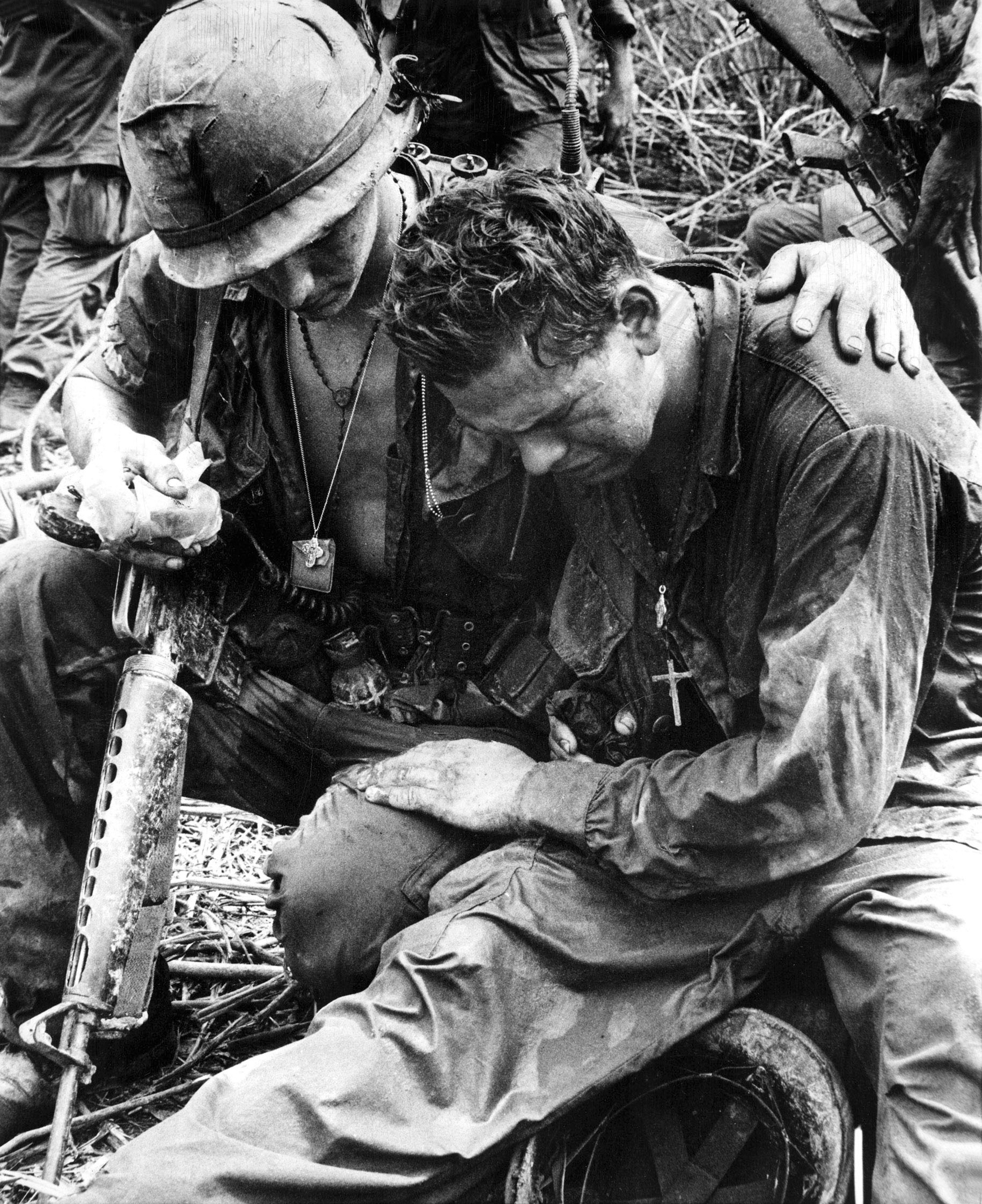
BTJFXP Two soldiers comfort each other under the strain of combat in Pleiku, South Vietnam, 5/26/67.

Some folks who’ve read my novel THAT OCTOBER know there’s more going on than a murder mystery among teenagers in 1984. I won’t get too far into spoilers here, but there’s a point in the book when it becomes less about a killing in Indiana in 1984 and becomes about the echoes of Vietnam.

I knew from when I started writing THAT OCTOBER in 2021 that I’d make the Vietnam War a part of the book. I couldn’t write a book set in 1984 and ignore Vietnam. As one character, a grizzled old newspaper reporter, explains, the war had been over less than 10 years by that point.

People my age and even younger know that war was something a lot of us carried around most of our young lives. Our fathers and mothers had served in WWII and Korea and our brothers and sisters served in Vietnam. War was something we “played” in the backyard. But by 1984, Vietnam was the past.

That’s why THAT OCTOBER was my chance, maybe my only chance, to write about the ripples of the war in Vietnam, which had begun “officially” in 1955. To center a major character’s experience beginning in 1960 in Vietnam felt right.

If you read THAT OCTOBER, you’ll know what I mean. It might strike you as strange that at the end of the book a character gets a Purple Heart for their service in Vietnam, but the war – if often not top of mind – still had ripples in 1984 and still does today.

THAT OCTOBER makes its Kindle debut

I’m not a stranger to my work being made available in different formats. Most – maybe all? – of my co-authored true crime books are available in e-book formats and “The Westside Park Murders” is available in an audiobook format from Audible and other platforms.

But there’s something neat about the e-book format of THAT OCTOBER, my 1984-set high school crime novel.

The book has been out in paperback since June 1 in an edition that shows off my friend and editor Jill Blocker’s beautiful interior design and my friend and artist Sara McKinley’s gorgeous covers. I’ve been really gratified by how good the response has been.

So last week I uploaded THAT OCTOBER to Kindle Direct Publishing and it drops, as the cool people say, on September 1.

The e-book is available for preorder now and I really appreciate the response so far.

Here’s the link:

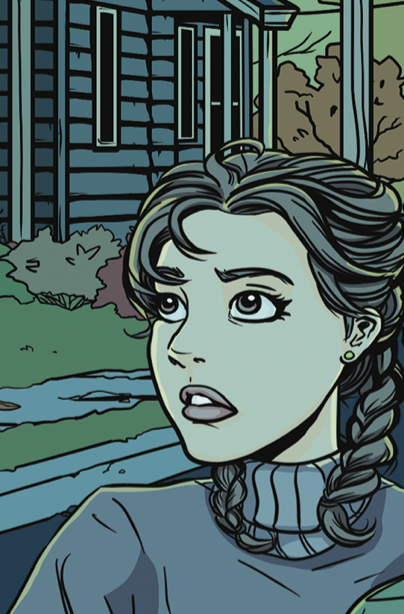
Meet the characters of THAT OCTOBER: Sammi

Another in the recurring series of quick profiles of characters from my novel THAT OCTOBER: Today, Sammi Bradford.

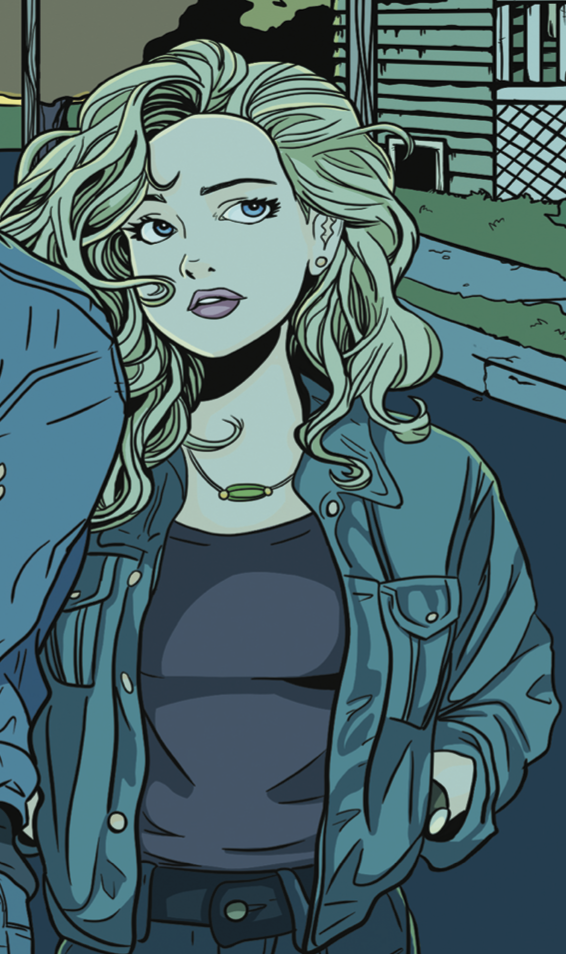
Sammi, like Toni in this space the other day, is the high school friend we all wish we’d had: Beautiful and popular but also unwaveringly loyal. There’s a reason Sammi is the last of the group of four that Jackie talks with in the book. Sammi is probably the closest of Jackie’s friends.

(Sammi is seen on the cover as drawn by my friend, artist Sara McKinley, who is saramckinleyart on Instagram.)

While Sammi’s look was inspired by Brec Bassinger – I’d watched the very fun superhero TV series “Stargirl” not long before, and she looked the way I wanted Sammi to look – Sammi has troubles that none of the other friends have, namely a father in prison.

Sammi’s mom is also the local newspaper editor in Middletown, where THAT OCTOBER takes place, and that gives my young protagonists access to the newspaper library files – the morgue, as some call them – that fuel speculation about one of the major characters in the young heroes’ life.

Sammi might also be the most courageous of the young friends, turning to face a deadly bad guy near the climax of the story, on Halloween night 1984.

Because I love returning to characters in my fiction, Sammi has a cameo in “The Devil’s Cut,” my short story in Hoosier Noir Volume 7. She’s a couple of years older, she wears her hair in an undercut and she has tattoos. Never mind that the time frame of THAT OCTOBER, set in 1984, and “The Devil’s Cut,” pretty much set in the present day, don’t match up.

That’s Sammi.

A cool thing: Finding THAT OCTOBER on Allstora, a LGBTQ+ supporting bookseller (RuPaul y’all!)

Each day since even before THAT OCTOBER was published on June 1, I’ve been looking around the Internet, finding unique and sometimes out-of-the-ordinary places where my novel is mentioned or even available to purchase.

Since finding the book on all the big online booksellers, like bookshop dot org, Amazon, Barnes & Noble and others, I think the most fun surprise has been finding it available through the Allstora site.

Allstora began life as ShopQueer and, according to the site itself, was co-founded by New York Times bestselling author and LGBTQ+ advocate Eric Cervini, drag performer and actor Adam Powell and television icon and author RuPaul.

After finding my book on Allstora, I sent them an email thanking them for carrying it and got a sweet and enthusiastic response from Aubergine:

Hi Keith,

Thank you for your kind words, we’re happy to have you here. 🙂

Have a fabulous weekend! ❤

If you’re wondering why I’m so thrilled to have THAT OCTOBER on Allstora versus any other site where the book can be purchased, it’s because, as some of you who’ve read the book know, THAT OCTOBER has an important gay theme among the high-school protagonists of the story.

That the book just happened to be carried by Allstora is probably just luck, but I like to think that someone, somewhere, recognized the storyline and characters as some that will – hopefully – resonate with readers and count a little toward representation of LGBTQ+ characters in mainstream fiction.

So Allstora, I’m thrilled to be part of your fabulous site.

(My site, meanwhile, is being difficult in letting me post a link to THAT OCTOBER on Allstora, but it should be easy enough to find if you want to direct a little business their way.)

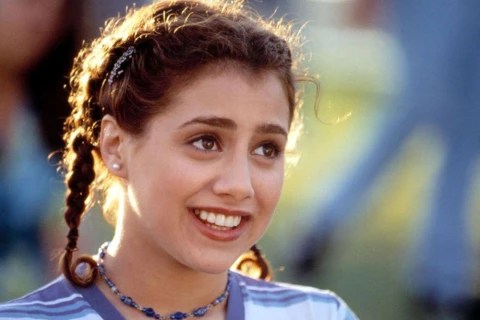
Meet the characters of THAT OCTOBER: Toni

If you’re wondering about those four friends on the cover of my 1984-set high school crime novel THAT OCTOBER, maybe a couple of introductions are in order.

All credit to my friend and amazing artist Sara McKinley for bringing these characters to life for the cover of my book. She’s saramckinleyart on Instagram.

One of the things I tried to do when writing THAT OCTOBER was make some characters familiar without making them stereotypical. I’m not sure I succeeded, but Toni was probably toughest for me.

Toni Carter fulfills the “best friend” role in the book for her unwavering support of Jackie Rivers, but I hoped to give Toni some depth by making her the friend who was most confused and felt most isolated of the girls. Toni is an outsider, with a mom who’s considered strange – she is on the hospital cleaning staff and is a part-time psychic – but whom Toni fiercely defends.

All of us knew or know a Toni: Loyal and sweet and a little out of the mainstream. With a friend like Toni, you’re never alone.

The actress I saw in my head and I was writing Toni: Brittany Murphy, so wonderful in the “best friend” role in “Clueless.” She passed away in 2009 but is forever frozen in time for me as Toni.

More of the cast of characters to come.

And you can buy THAT OCTOBER anywhere, but here’s a link to the Barnes & Noble site:

https://www.barnesandnoble.com/w/that-october-keith-roysdon/1147324325

It should be obvious, but if you write, you’re a writer

I was interviewed for a podcast recently when I was back in Indiana promoting THAT OCTOBER and I ended a question with an off-hand comment that I’ve verbalized before but this interviewer said she really appreciated it.

“If you write, you’re a writer,” I said.

That seems obvious enough, but I think some writers feel like you’ve got to attain some particular level of success, or something, to consider yourself a real writer:

You’ve got to finish every story or article or book that you begin. You’ve got to publish every story or book or see it published. You’ve got to be paid for every one. You’ve got to be published by a prestigious site or magazine or anthology or publishing house, all to be considered a legitimate writer. (Now that I write that sentence, I can’t imagine what a “legitimate” writer would be anyway.)

None of those things are necessary to being a writer.

For certain, it’s a good thing to finish what you’re writing. That’s good discipline and a sign that you’re able to follow through, even if it’s not your best work. It definitely would be a cool thing to try to get every story or book you write published, but no way in the world does that happen to every writer (maybe to Stephen King or Lee Child, and probably not even them).

Getting paid or being published in some cool place is super and I highly recommend it. But that’s not the definition of being a writer.

Sitting down at your keyboard – that’s mine in the photo; please disregard the random junk in the keys – is part of the definition of being a writer. Or sitting down with your notebook or legal pad and your favorite pen.

You’re also a writer if you’re sitting in a comfortable space, staring out the window, watching random squirrels frisk their way past enjoying the sun, or watching the headlights and taillights of passing cars cutting through the dark. While you’re sitting there, you’re probably thinking about stories or coming up with ideas of ways to execute a scene. Or you might just be letting your imagination roam. You can do the same thing while mowing the lawn or watching TV or listening to music.

There’s enough anxiety and imposter syndrome for writers, and always has been, about writing or what they hope to write or what they have written to feel more of it because they’re not turning out a thousand sterling, perfect words every day.

If you’re exercising your imagination, if you’re mulling over characters or phrases or plots, if you’re making notes or writing it out longhand or you’re dashing out a couple of thousand words every day – even if you go back and start over – you’ve accomplished your goal.

You’re a writer.

The moral of the story is …

Here’s a mystery for the ages, and one that I’m not going to solve here.

How much is too much for a writer to care about their work? How much is just enough? How much is not enough?

2024 was a good year for my writing in a lot of ways. Several short stories published. The stories were published with some effort on my part but much more luck. Much more.

So toward the end of 2024, as I began to focus on self-publishing my book THAT OCTOBER, my short story production dropped off dramatically. I didn’t chase every call for submissions like I had been for much of 2024. (This followed a LOT of story rejections, by the way.)

Since I hopped off the short-story-submission merry-go-round, I’ve had, unexpectedly, some luck with short stories. A few months into 2025, Shotgun Honey accepted my short story “Trouble, Start to Finish,” submitted in 2024, and it was published in May. (Link below.) Another story that had been held for months is slotted (for now) for publication, this year I think. Another story that had previously been accepted is still set to publish on December 21, 2025, as far as I know.

Then an author I know contacted me and asked if I had a story in a very particular genre that I might be able to contribute to an anthology he was editing. I had had one in mind and pitched it, he said yes, I wrote it in a couple of weeks and it’s going into an upcoming anthology. I’ll be promoting it when I know some details.

So with THAT OCTOBER out and available everywhere, I’m tentatively looking at short-story writing again. A friend sent me a link to a call for subs and I’m sending the super-short story out this afternoon. No idea if it’ll be accepted.

So is the moral of the story that it’s good to take a breather once in a while? That you should focus more narrowly?

Or is the moral of the story that the less you care about something, the more likely you are to achieve it?

That’d be pretty damn twisted, huh?

I will not quote ‘You Can’t Go Home Again’ – damn it, I guess I just did

I’ve noted on social media in recent days that we recently spent a little time in Muncie, Indiana, promoting THAT OCTOBER and getting together with family and friends and looking around the city that was my lifelong home until we moved to Tennessee almost three years ago.

It made perfect sense to promote the book there because 1.) more people know me there than here and B.) the book is set in my version of Muncie as it was in 1984. The novel’s not a documentary, obviously, but it’s got the overall vibe of Muncie more than 40 years ago and the teenage characters do some of the same things my friends and I did in Muncie when we were that age or a little older – going to movies, watching MTV, going to house parties. I never prowled through a junkyard, I admit, but that part of the book was inspired by my late Uncle Si Stewart, who talked about when he took a shortcut home from school through a Muncie junkyard when he was a kid in the 1950s.

We get back to Muncie once or twice a year since we’ve moved down here, and I’m always so grateful that I get to see family and friends there and get to look around the city I knew so well and covered for the newspaper for most of my life.

I always come away with gratitude for the people I get to see, those that I get to meet and the places that are familiar to me.

But I always feel sad when I’m there. I’m nearly swamped with melancholy while I’m there and for a while after.

It’s not just that the city has changed. It has, and not just in the three years we haven’t lived there. It was changing most of the time I lived there too.

I always explain to people who don’t know Muncie as the city where David Letterman went to college, where the first half of “Close Encounters of the Third Kind” was set, where Garfield the cartoon cat was created and is still produced and where Ball canning jars were made dating back to the 1890s.

It’s the city where four true crime books I co-wrote with Douglas Walker, my frequent collaborator at Muncie’s newspapers, are set. There’s no getting around that Muncie – one of several Midwestern cities that were nicknamed “Little Chicago” – was sometimes a violent and murderous place.

It’s a city that in some ways peaked when I was young, as young as the teenage protagonists of THAT OCTOBER. Its population peaked at just over 76,000 in 1980 and has fallen regularly since to an estimated 64,000 now. Most of the big industrial employers went away, some of the most recent in the 2000s, although luckily there’s some stopping of the bleeding thanks to growth in employment in the education and healthcare fields.

Still, Muncie has struggled and is struggling. The city can’t keep the streets paved. The mall is all but dead. Some, not all, of the government leadership seems determined to wipe out all the welcoming efforts that groups and private individuals have made over the years. And at the same time there’s decades-long efforts to bolster downtown, there’s a proposal to pull the last few hundred government workers out of downtown and put them in an ill-advised government center miles to the south, outside the city limits. (When one of the downtown government buildings was being built in the early 1990s, there was discussion of metal detectors inside the doors. An attorney who oversaw the project said it was insulting to frisk people who were on their way to pay their taxes. Yet here we are, decades later, and metal detectors are a way of life because life is cheap and murder is easy. That said, I think it’s insulting to tell people who pay their taxes that they can’t even pay those taxes or go to court or talk to their representatives without leaving the city, ffs.)

It’s depressing to contrast the city currently with the city as it was in the 1970s and 1980s. I don’t even get into a lot about how thriving the city was in 1984 in THAT OCTOBER, but as strange and upsetting as it was for murder and mystery to envelop the city and the young protagonists of my book, 1984 in the real-life Muncie was a boom time. Life in the city had peaked, in some ways, and in the decades since, it has not struggled its way back.

My friend Tammy told me this morning, as I was ruminating on all this, that my hometown’s struggles reflect this country’s stuggles and she’s right, of course. I take that as personally as I take what’s happened to Muncie.

One of the consistently amusing sights around Muncie is a public art project from a few years ago that prompted artists to decorate traffic light control boxes. The art was contributed by a lot of different artists and ranged from the beautiful to the abstract to the whimsical like the “Stay Weird, Muncie,” message above. I took that picture our first day back and I’ve thought about it a lot.

I’d like to think that my hometown can be weird, interesting, welcoming, fulfilling, progressive but comforting and I like to think it can be a good hometown, either for someone who’s still living there, someone who’s just visiting or someone who’s come home again.

I’d like to think that, and maybe take comfort from that once I shake this profound melancholy I feel. But I’m not sure its possible.

Jumping into the discourse about Bluesky

If you’ve been paying attention, you’ve seen people argue that the social media platform Bluesky is a failure. It has “only” 36 million-plus users, compared to more than 600 million twitter users. (The latter is a number I think is highly suspect, but that’s a topic for another day.)

I joined Bluesky more than a year ago, I think, but I didn’t spend a lot of time on the social media site until last fall, when some odious thing the owner of twitter had done drove other people there. All of a sudden, Bluesky seemed populated – much more so than in the first few months after I had joined – and much livelier.

So-called “Starter Packs” on Bluesky – curated lists of writers, engineers, performers, artists, whatever – gave my follower count a boost early on, but the growth in the number of followers there has been pretty consistent. I have about 2,800 followers there now, compared to more than 4,000 at my peak on twitter. That Bluesky following was built in a matter of months, by the way, compared to all the years since 2009 I’ve been on twitter.

(I still have a twitter account, to keep in touch with friends who are still more active there than on Bluesky, but I spend much, much more time on Bluesky.) I’m also active on Facebook, where I started an author page this year despite my misgivings over the attitudes and behavior of the suck-up American oligarch who owns it, and I post regularly there and on Instagram (same owner, same dislike for the owner). The reason I’m still on all those platforms is, besides keeping up with friends who are on them, is to publicize my book, THAT OCTOBER.

But I spend most of my time on Bluesky, regardless of follower numbers and engagement, because it just feels like the least awful place on socials. I’m not choosing the lesser of evils here, I promise. I feel like using any social media is like building a new house (ie active thread that’s hopefully engaging) on somebody else’s property.

In other words, all of social media is someone else’s real estate. When they want to take it away from us, they can.

That’s also why Bluesky is the least reprehensible social platform. The owners of twitter and Facebook and other Meta platforms have shown themselves to be dishonest in how they treat the people who actively bring eyeballs to those platforms. They take the value of our work and bluster and censure us.

BlueSky seems the least likely social media platform to do this.

This might change if the semi-collective, not-especially-concentrated ownership of Bluesky changes, perhaps through a sale at some point in the future. Money talks and bullshit walks and aside from political ideology, there’s been no more certain death knell for various socials than how much their owners can make by selling them or just selling out.

So I’m spending time on Bluesky – too much time, probably – and little time anywhere else, although I have a presence everywhere. This site is a pretty reliable place to find my latest thoughts but it is not a two-way street, unlike even the worst social.

So I don’t think Bluesky is dying. I do think it is, right at this moment, a less reprehensible (there’s that phrase again) place than the alternatives.

We’ll see if that continues to be the case.

Falling back into short stories

A while back I wrote here about how I’d taken a break from writing and submitting short stories to concentrate on selling my novel THAT OCTOBER and begin work on a new novel.

Since that time, I’ve found myself back in the short story business.

In 2024, I submitted a sword-and-sorcery story to a call for submissions. It got turned down. I subbed it to another and a curious chain of events followed. This second call for subs resulted in an initial rejection, along with a request to leave my story parked in their hands in case they were able to use it. Then early this year, a definitive “no, we aren’t able to use it.”

Then, about a week ago, a reversal of fortune: They’ll use the story after all, later this year.

I’ll tell you about the story when and if this works out.

And just about the same time, I was contacted by a well-known and respected writer who asked me if I had a short story that might work for an anthology he’s putting together. I didn’t have a story, but I had an idea for a story.

A couple of weeks later, I turned the story in, 7,500 words of it, and it looks like a go. I’m really looking forward to this. I like the story and the anthology should be excellent.

I’m delighted with both of these circumstances.

So next time I decide to shy away from a particular type of writing, I’ll know that it might not be the end. It might not even be a hiatus.