Tag Archives: short stories

‘Nobody knows anything’ – and for writers, that’s both good and bad, as short stories are king and money talks

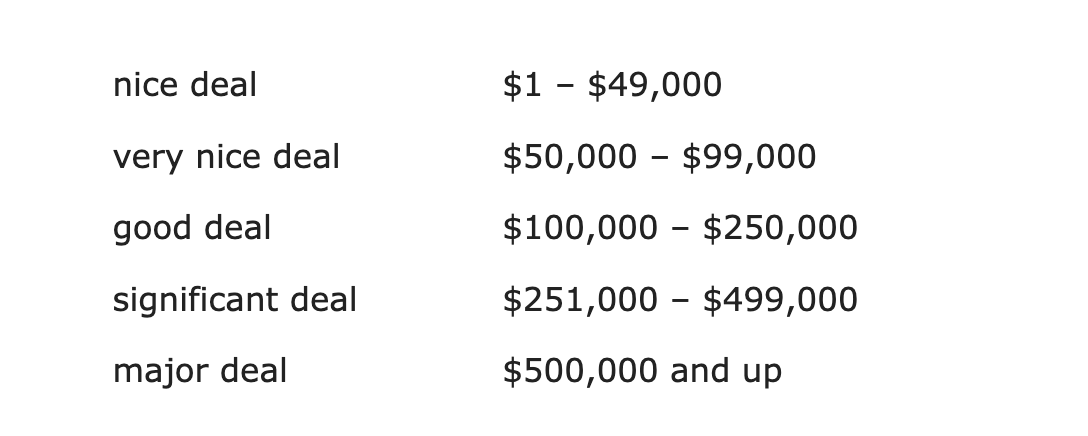
That chart there? That’s the definitions that the writing and industry newsletter Publishers Marketplace uses to gauge its reporting on the latest sales of manuscripts to publishing houses. PM reminds us once a week the guidelines for when it refers to a “nice deal” or a significant or major one.

So to disprove writer William Goldman’s “Nobody knows anything” I quote in the headline – a simplification of Goldman’s sentiments in his 1983 memoir ADVENTURES IN THE SCREEN TRADE – we know two things: Publishers Marketplace means it when they say a major deal is a major deal and if you ever see my name reported next to the phrase “major deal,” I can tell you that’s the last time you will hear from me other than occasional dispatches from my fortified writing tower.

The talk of the day in writing circles is a New York Times story titled, “Writers are making millions selling short stories to Hollywood,” and the story is, in effect, a trend story about how a few writers have had short stories optioned by producers for movies and TV adaptation – and in some cases, the stories haven’t even been published yet.

(I’m not going to link to the story, because my disgust with how the Times has sold its soul to the worst elements of our political life continues, but you can find a gift link to it, I’m sure, on social media. That’s what I did. Be aware that if you want to read the story, you’ll have to jump through a bunch of hoops, including giving the NYT your email address.)

This is the subhead of the NYT story and it really tells you everything you need to know: Publishers generally don’t race to acquire story collections these days, but studios appear eager to shell out for unpublished short works. They give a few examples.

It reminds me of this story I did a few weeks ago for CrimeReads: 7 crime writers talk about novels and short stories and what they love writing most

I’ll link to my CrimeReads piece at the end of this post.

The other piece that writers are talking about today is a GQ article, Will Books Survive? 34 Insiders, Experts, and Icons on the State of Literature in an Age of Uncertainty.

The article is strong from the start:

Something in the literary world isn’t adding up. On the surface, the numbers aren’t looking good. If you’re an American, there’s a roughly 38% chance you’ll read a novel or short story this year. If you’re an American man, that number slips to 28%. By most metrics, it’s a hard time for literature.

And yet.

There’s an undeniable energy bubbling up in New York, Los Angeles, London, and elsewhere. Readings are “sexy” now, supposedly, and a medley of exciting new publications have popped up, both online and in print. Ben Lerner and Emma Cline returned this year, and we’ve been graced with the strongest crop of debut novels in recent memory, from Caro Claire Burke’s culture-conquering Yesteryear to the jagged edges of Madeline Cash’s Lost Lambs to the vibrant energy of Sufiyaan Salam’s Wimmy Road Boyz. People spent the summer reading The Odyssey and crashing The London Review of Books website to read discourse about The Odyssey. So it can’t be all bad, right?

It’s a lengthy State of Books 2026 and worth reading. Here’s a link.

Remember I said the other day that everybody is picking their best books of the year? Here’s the Publishers Weekly list.

My CrimeReads story talking to seven crime writers about what they prefer, novels or short stories:

You’ve somehow stumbled upon the latest of more than 1,100 posts on keithroysdon dot com, stretching back to the early 2010s. Books, writing, movies, TV, obscure pop culture, Halloween, snark and more snark. I’m the author of crime novels THAT OCTOBER and SEVEN ANGELS, co-author of four true crime books including the award-winning THE WESTSIDE PARK MURDERS and hundreds of short stories, news articles and pop culture pieces in spots like CrimeReads, Daily Yonder and elsewhere. You can contact me by leaving a message anywhere on this site or by hollering at me on one of my too many social media outposts.
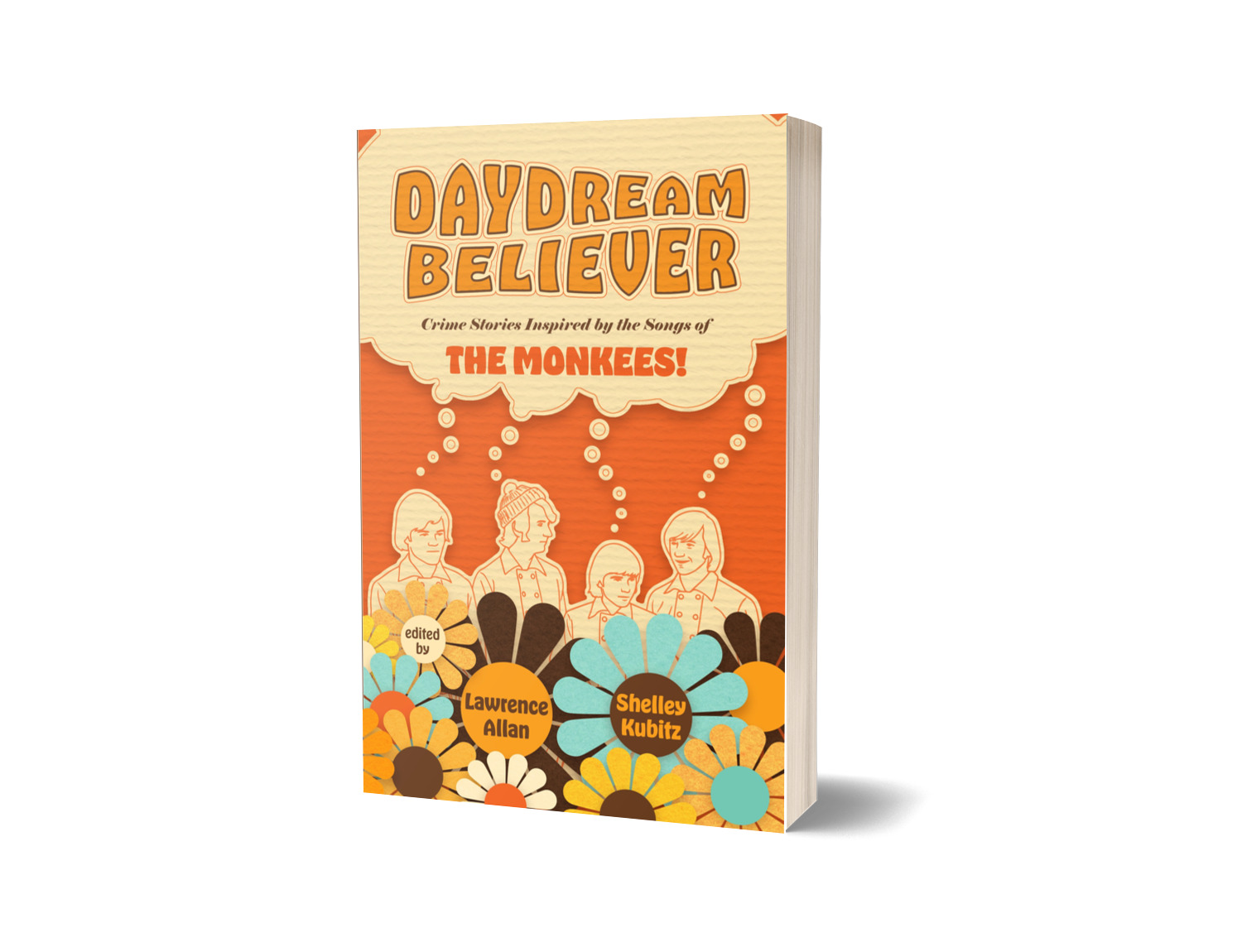
New short story, new anthology: I’ve been looking forward to DAYDREAM BELIEVER all year

Sometimes crime short stories are mean and brutal. Sometimes they’re nostalgic, or at least my story “This Just Doesn’t Seem To Be My Day,” in the new anthology “DAYDREAM BELIEVER: Crime Stories Inspired By the Songs of the Monkees,” is.

When I heard that my friend and author Michelle Kubitz was accepting submissions of short stories for the anthology, which she was co-editing with Lawrence Allan for publication by Ron Earl Phillips and Shotgun Honey, I knew I had to contribute. I even went up to Larry after he appeared on a panel at Bouchercon in Nashville and excitedly told him I had a story I wanted to sub.

As a grade-schooler in the 1960s, I loved the Monkees. The music and the silly TV show definitely, but what made me jump at the chance to submit a story was my association with the Monkees and my brothers.

Before I was certain who the Monkees were exactly – TV actors? TV characters? Musicians? Four cool and funny guys? All of the above? – I spotted their debut album in my oldest brother’s room. I put it on the turntable and immediately loved the music. It wasn’t a new album by that time, but it was still fantastic, with songs that cemented the Monkees in my mind as a favorite band.

My brothers were 10 and 12 years older than me, so it was more like having a couple of uncles around than brothers. But I wanted to be accepted by them, and finding some common ground in music was something I dearly loved. One album cut in particular, “This Just Doesn’t Seem To Be My Day,” stands out in my memories as a fast, funny song that I listened to over and over.

About the time I was 10, my brothers were planning a party in a field our dad and mom owned, south of our 100-year-old farmhouse and south of the equally aged barn, and I really wanted to be a part of it. I wheedled my way into going around town with my brothers as they picked up things they needed for the party: ice, beer, extension cords, probably other things I was too young to understand.

My story in the anthology varies from that real-life day – although both ended in a fairly dramatic manner at the party that night – but both accomplished something I desperately wanted: To be closer to my much older brothers.

Not all of my stories are as nostalgic, or true-to-life, as this one. But thanks to DAYDREAM BELIEVER, I can relive that day and its fairly calamitous ending.

Thanks to Shelley and Larry and Shotgun Honey for the chance to relive that day and that evening.

I think you’ll like DAYDREAM BELIEVER, and not just for my story. The other authors with stories in the anthology are Holly West, Lawrence Allan, Eric Beetner, Lina Chern, Libby Cudmore, Michael Downing, Jeff Esterholm, Michel Lee Garrett, Paul J. Garth, James D.F. Hannah, Sean Patrick Little, Alan Orloff and Raquel V. Reyes. It’s a great group of talented people.

You can find DAYDREAM BELIEVER at

https://shotgunhoney.com/announcements/news-announcements/book-release-daydream-believers-anthology/

The year of anthologies for me – three of ’em, anyway

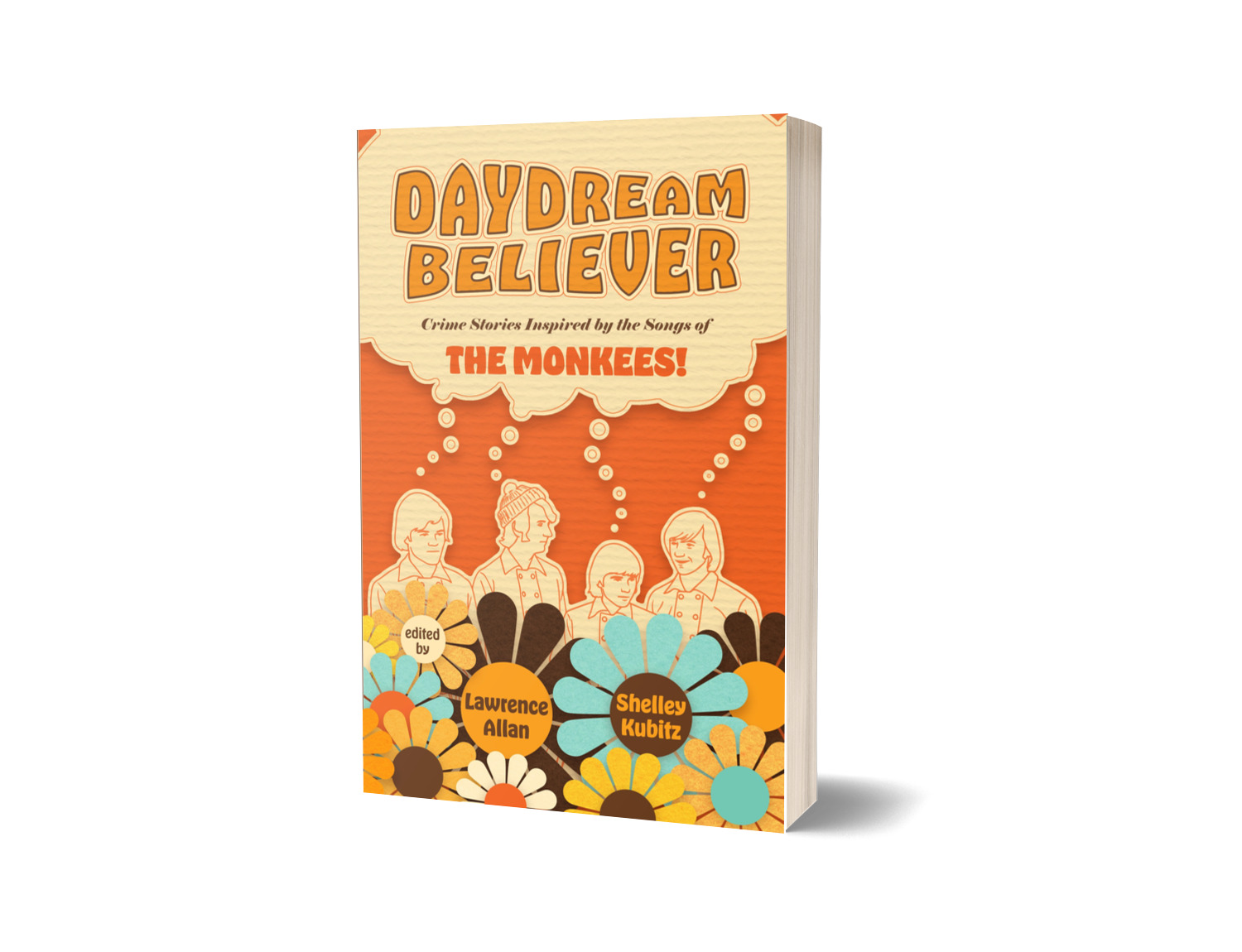
Two of the nicest folks you’d ever want to write for, Shelley Kubitz and Lawrence Allan, today released the cover image for DAYDREAM BELIEVER, an anthology of crime fiction inspired by the music of The Monkees. I’ve got a story in the anthology and I’ll tell you more about it on or before, as they say in legal documents, the book’s publication on September 29. (Or slightly after, depending on how my September goes.)

The table of contents for this anthology is a dream team of crime writers, and I’ll get into that at a later date also.

I’d hoped to have a story in four crime fiction anthologies in 2026, but that was not to be, for reasons too sad to get into here or almost anywhere.

So in 2026, a year in which I definitely de-emphasized short stories to work on novels, I’ve got stories in FIGHTING WORDS, BAD INTENTIONS and DAYDREAM BELIEVER and I couldn’t be happier about that.

The experience of writing short stories in any small bit of spare time I wasn’t working on getting my crime novel SEVEN ANGELS ready for publication by our Constellate Publishing – link at the end of this post – and working on my next three novels, I was inspired me to write an upcoming article for CrimeReads interviewing seven – count ’em! – seven crime writers about what they preferred to write, short stories or novels, and where they love to see their short stories published.

I’ll write more about that and talk about those seven wonderful authors closer to the time the CrimeReads story comes out.

Here’s that link to Constellate Publishing, by the way. We’re still looking for manuscripts of all kinds to consider for publication. We’re offering various editing and marketing services as well.

Kill your darlings? I say writers should resuscitate their darlings: the story behind Door to Door

Writers are always told to “kill your darlings.” That means, of course, that they should learn to be comfortable with cutting lines, paragraphs, chapters and even more if they get in the way of the story. Stephen King famously cut about 400 pages, or 150,000 words, from the manuscript of his magnum opus THE STAND for its original publication. His publisher said the novel was just too long. After THE STAND was hailed as the masterpiece it is, King restored a later edition to something like the original manuscript at 1,152 pages.

I think writers can get in the way of our own success – not only in terms of publication but also story merit – when we’re reluctant to kill our darlings.

That doesn’t make it an easy thing.

I wrote “Door to Door,” published this week by Pistol Jim Press – link at the end of this post – in 2024 for a call for submissions for stories about cults. It got rejected.

So when editor Martine Proctor and Pistol Jim honcho James Maxwell posted a call for stories about doors, portals and gates, it seemed like a good time to revive and sub “Door to Door.”

The only problem? The original was about a third again as long as the 1,000 words or so that the call for subs wanted.

So I cut two or three hundred words. For a story of that length, that’s a lot of dead darlings. It’s not the most I’ve cut from a story, though. I cut some dialogue and I cut a few details, but the point of the story still came through.

I liked the original version of the story and I like the new version. And feedback by people who’ve read it is good.

I should note here that the story was inspired by something that happened in real life: I was home one uncomfortably warm day a few years ago and a young woman came to the door selling magazine subscriptions or something. She literally looked like she was about to faint from the heat and I invited her in and gave her a glass of water.

No murder ensued, however, unlike in the story. No magazine subscriptions ensued either.

I very well might have written some other story for the Pistol Jim call for subs, but it worked out well to give the original, rejected story a shot. Albeit in a slimmed-down version.

Writers should still kill their darlings, especially when it’s necessary. (Says the guy who might publish a 108,000-word novel, GHOST SHOW, in the coming months.)

But even dead darlings can have a new life in some altered form.

Say, that sounds like a story idea …

Here’s my story “Door to Door” for Pistol Jim:

https://pistoljimpress.substack.com/p/door-to-door-by-keith-roysdon

The moral of the story is …

Here’s a mystery for the ages, and one that I’m not going to solve here.

How much is too much for a writer to care about their work? How much is just enough? How much is not enough?

2024 was a good year for my writing in a lot of ways. Several short stories published. The stories were published with some effort on my part but much more luck. Much more.

So toward the end of 2024, as I began to focus on self-publishing my book THAT OCTOBER, my short story production dropped off dramatically. I didn’t chase every call for submissions like I had been for much of 2024. (This followed a LOT of story rejections, by the way.)

Since I hopped off the short-story-submission merry-go-round, I’ve had, unexpectedly, some luck with short stories. A few months into 2025, Shotgun Honey accepted my short story “Trouble, Start to Finish,” submitted in 2024, and it was published in May. (Link below.) Another story that had been held for months is slotted (for now) for publication, this year I think. Another story that had previously been accepted is still set to publish on December 21, 2025, as far as I know.

Then an author I know contacted me and asked if I had a story in a very particular genre that I might be able to contribute to an anthology he was editing. I had had one in mind and pitched it, he said yes, I wrote it in a couple of weeks and it’s going into an upcoming anthology. I’ll be promoting it when I know some details.

So with THAT OCTOBER out and available everywhere, I’m tentatively looking at short-story writing again. A friend sent me a link to a call for subs and I’m sending the super-short story out this afternoon. No idea if it’ll be accepted.

So is the moral of the story that it’s good to take a breather once in a while? That you should focus more narrowly?

Or is the moral of the story that the less you care about something, the more likely you are to achieve it?

That’d be pretty damn twisted, huh?

Falling back into short stories

A while back I wrote here about how I’d taken a break from writing and submitting short stories to concentrate on selling my novel THAT OCTOBER and begin work on a new novel.

Since that time, I’ve found myself back in the short story business.

In 2024, I submitted a sword-and-sorcery story to a call for submissions. It got turned down. I subbed it to another and a curious chain of events followed. This second call for subs resulted in an initial rejection, along with a request to leave my story parked in their hands in case they were able to use it. Then early this year, a definitive “no, we aren’t able to use it.”

Then, about a week ago, a reversal of fortune: They’ll use the story after all, later this year.

I’ll tell you about the story when and if this works out.

And just about the same time, I was contacted by a well-known and respected writer who asked me if I had a short story that might work for an anthology he’s putting together. I didn’t have a story, but I had an idea for a story.

A couple of weeks later, I turned the story in, 7,500 words of it, and it looks like a go. I’m really looking forward to this. I like the story and the anthology should be excellent.

I’m delighted with both of these circumstances.

So next time I decide to shy away from a particular type of writing, I’ll know that it might not be the end. It might not even be a hiatus.