Tag Archives: The Westside Park Murders

Requiem for Muncie Mall: America’s hometown’s second gathering place is fading fast

If you considered our downtowns to once be the gathering places for our cities and towns, then you could consider your local mall to be America’s second gathering place. That’s appropriate, because malls largely killed off downtowns.

Downtowns across the country have staged and are staging something of a comeback. They entered a steep decline in the late 1960s and early 1970s as malls were built and first retailers and then customers moved away from downtowns to the new gathering places, the mall.

In my hometown of Muncie, the mall – Muncie Mall – opened, more or less, in 1970, years later than the first U.S. mall, Southdale Center in Edina, Minnesota, which opened in 1956. Big department stores left Muncie’s downtown, with Sears being the first anchor store to open at the mall. Downtown was, in a decade or less, pretty hollowed out and storefronts along Walnut Street were left empty or occupied by small businesses and, in one instance, an adult bookstore.

Like a lot of cities and a lot of malls, Muncie and Muncie Mall struggled mightily in the first decade of the 21st century. I was covering business at the time and retailers – some with problems nationally, like Sears – closed their doors.

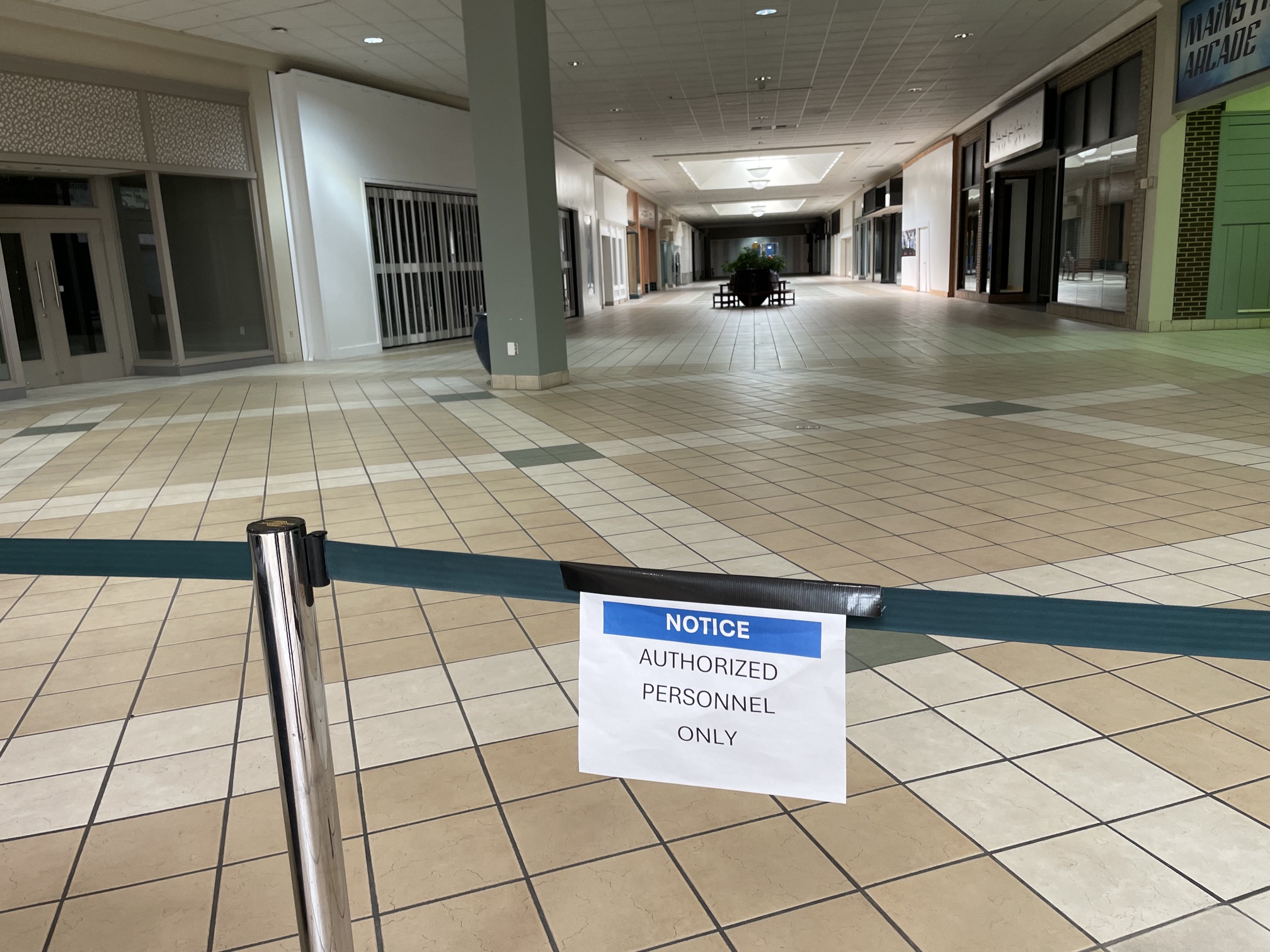
I was back in Muncie over the weekend and we had to check out the mall, which has been the scene of a lot of demolition work in the past year. The three-screen movie theater, where I spent a lot of time as a young movie fan, was razed. More recently, the wings that had been occupied by Sears and J.C. Penney have been or are being demoed.

The photo above is one I took this weekend and it shows that one empty third of the mall is roped off.

There’s still a few tenants in the mall, most notably Books-A-Million, which supposedly has a five-year lease. Does that mean the rest of the structure will be pulled down around and behind it, or will BAM find a spot elsewhere or leave the city entirely? I don’t know.

If you’re interested in the lifetime of a Midwestern mall, you’ll be interested in the timeline by Robin Gibson in The Star Press newspaper that I’ll link to at the end.

I won’t wax on about what malls meant to us or Muncie Mall meant to me. You can probably find my writing about that elsewhere, including as a chapter of our third true crime book, THE WESTSIDE PARK MURDERS. Our book covers a still-unsolved double killing of two teenagers in 1985 and I included a chapter about Muncie Mall because the mall was a big place for us back then.

Here’s that Muncie Mall timeline:

https://www.thestarpress.com/story/news/local/2020/02/12/muncie-mall-50-years-timeline/4466975002

You’ve somehow stumbled upon the latest of more than 1,100 posts on keithroysdon dot com, stretching back to the early 2010s. Books, writing, movies, TV, obscure pop culture, Halloween, snark and more snark. I’m the author of crime novels THAT OCTOBER and SEVEN ANGELS, co-author of four true crime books including the award-winning THE WESTSIDE PARK MURDERS and hundreds of short stories, news articles and pop culture pieces in spots like CrimeReads, Daily Yonder and elsewhere. You can contact me by leaving a message anywhere on this site or by hollering at me on one of my too many social media outposts.
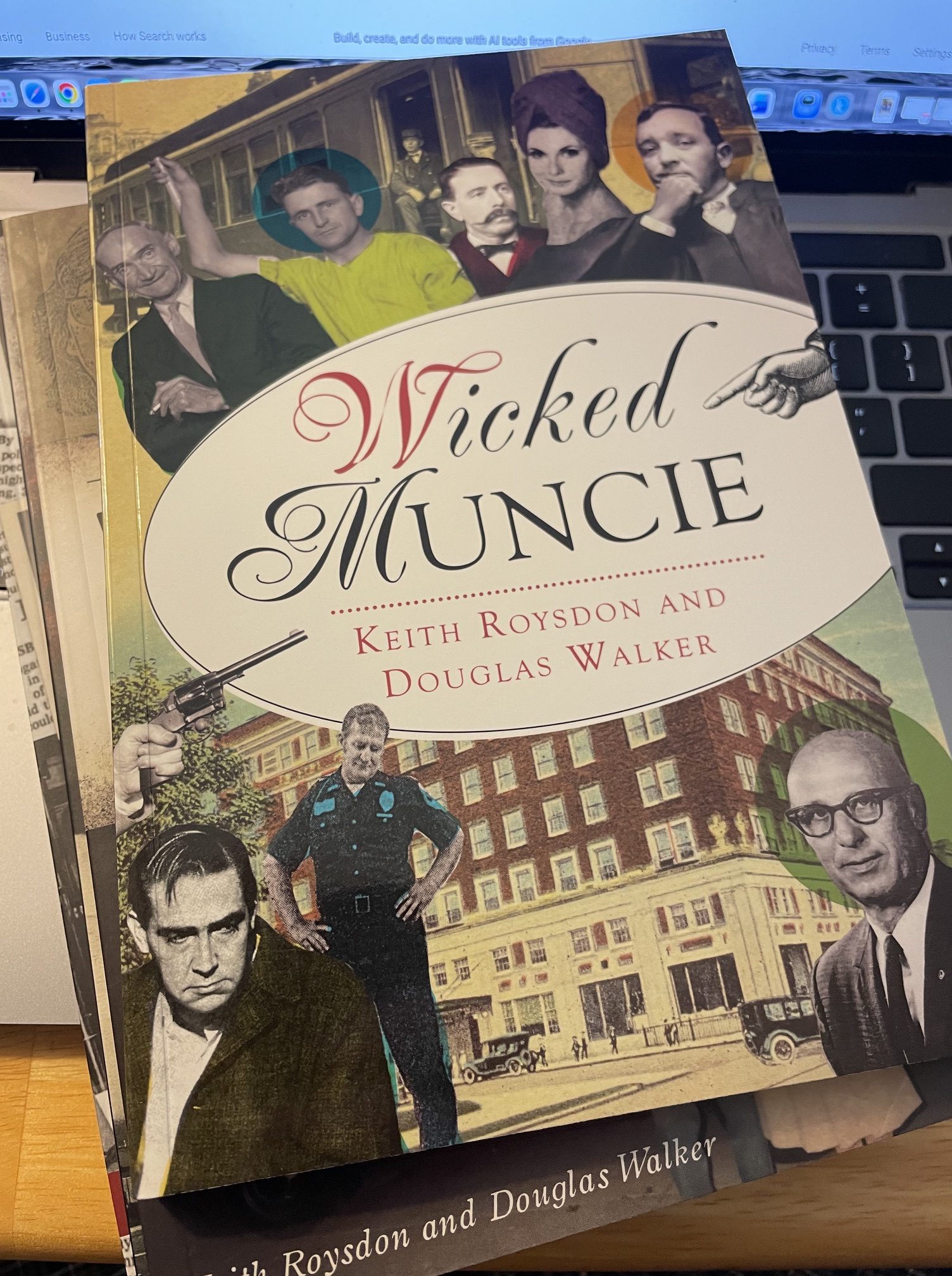
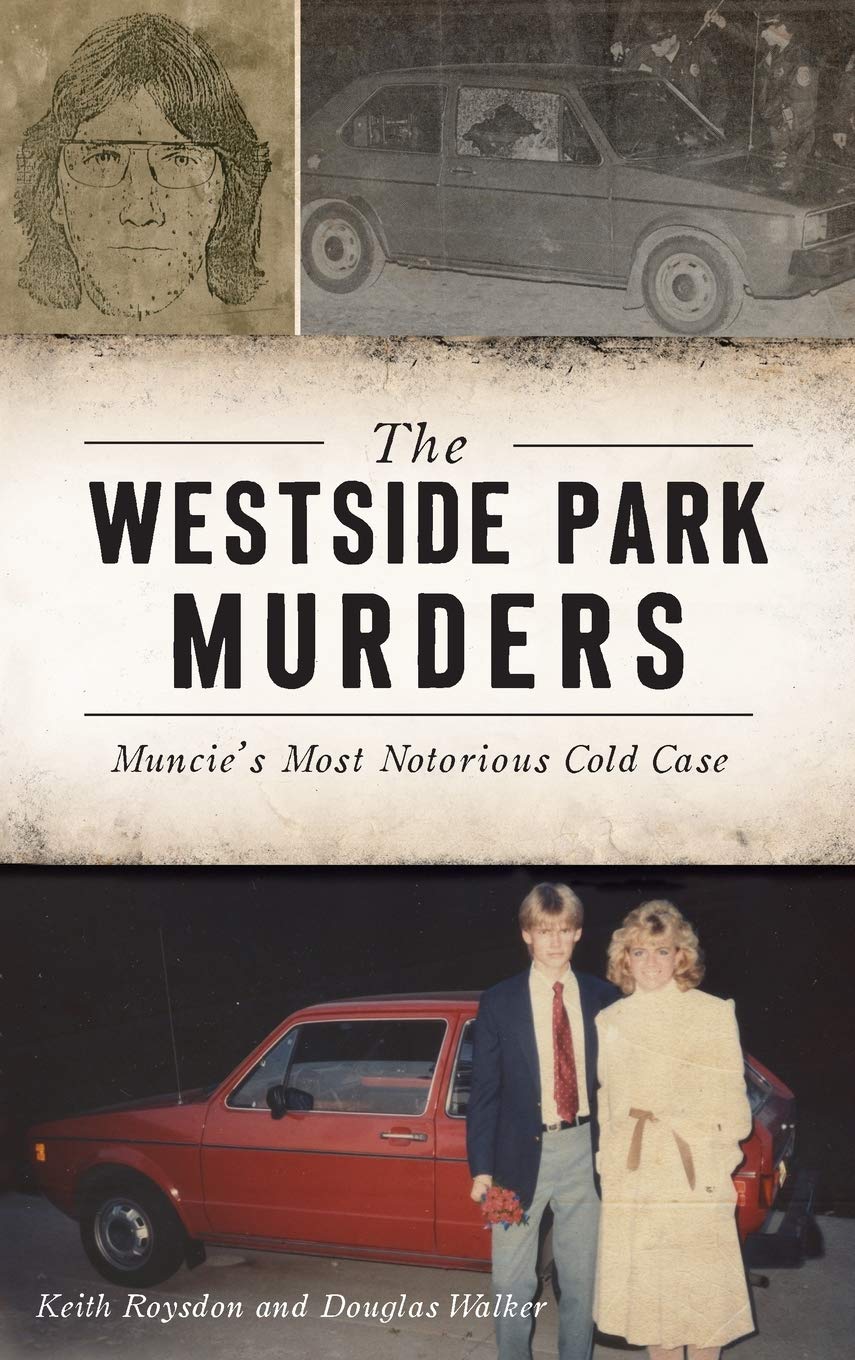
Ten years of true crime books! It’s the anniversary of our book WICKED MUNCIE

Ten years has flown by.

Ten years (and two days) ago, History Press published our first true crime book, WICKED MUNCIE.

My longtime writing collaborator Douglas Walker and I had, in 2015, finished working on long articles detailing the history of our town, Muncie, Indiana, for The Star Press newspaper to mark the city’s 150th anniversary. I’d written about 150 years of facets of the city like the local hospital and local industry and he’d written an article that touched on the city’s long history of crime and murder. (I say touched on because there’s too much crime to fit in one article.)

Walker got a cold call from an editor at History Press, based in South Carolina, who asked him to consider turning the article into a book. History Press was and still is a publisher of books detailing cities and regions’ histories, including colorful characters, businesses and industry and crime and they wanted a history of Muncie crime, which is as colorful as it is gruesome. He asked me to collaborate with him.

Because we’d been newspaper reporters for decades, we knew what kinds of stories we needed to tell, from infamous people to sensational murders to crimes that rocked the community.

We contracted with History Press and, in all of our spare time away from covering crime, corruption and government for the newspaper, wrote WICKED MUNCIE. The book was published on October 17, 2016.

The title, by the way, was mandated by History Press. They had a whole series of “WICKED” books, spotlighting cities all over the country.

We wrote three followups for History Press, MUNCIE MURDER AND MAYHEM in 2018, THE WESTSIDE PARK MURDERS in 2021 and COLD CASE MUNCIE in 2023. The later was named after a series of articles about unsolved murders we’d written for the newspaper.

The books are truly self-produced works; we did all our own research, often working from clipped and yellowed articles in files in the newspaper’s library. We begged and borrowed photos to illustrate the book and dropboxed the photos to our editors at History Press to meet their deadlines.

The books were considerable work, in no aspect more than in finding the illustrations. Muncie newspapers had not kept prints or negatives of photos over 150 years, so we had to make do with what we could find.

With the History Press books, it was not uncommon for me to dropbox 120 or more photos to find a third or half that number that would meet History Press’ technical requirements.

Producing four true crime books focusing on the same city and county was a natural – Muncie was and is a hotbed of crime and corruption; we counted about three dozen unsolved murders as we were writing a Cold Case series of articles – but a lot of work.

As I’ve noted here, the true crime books still sell and sell well for History Press and booksellers like Muncie stores including the Orchard Shop and Aw Yeah Comics and sell well online, everywhere from Amazon to Walmart.

I’m inclined to urge people to buy their copies from bookshop dot org because they contribute to indie booksellers like Ink Drinkers Anonymous in Muncie.

Here’s the link to my books on bookshop, including the four true crime books:

https://bookshop.org/beta-search?keywords=Keith+Roysdon

True Crime: Five years later, ‘The Westside Park Murders’ still draws readers

Version 1.0.0

The past two weekends, I’ve been selling copies of my books at East Tennessee events, first the Harvest Moon Festival at Cumberland Gap, Tennessee, then at the Fall Book Fest put on by the Knoxville Literary Legends book club. I’ve sold some books, happily met some other authors and learned a lot.

What I’ve learned is that true crime sells.

I know you’ll greet that with a “well, duh.” There are millions of true crime books, documentaries and even entire true crime channels/streaming services. I’m told that the latter is the case, at least; I haven’t watched a true crime program since we began writing our first true crime book, WICKED MUNCIE, which was published ten years ago by History Press. (If you’re wondering what Muncie is, it’s the East Central Indiana city where I’m from. It’s famous as where David Letterman went to college, where Ball canning jars were created, where the first half of Steven Spielberg’s CLOSE ENCOUNTERS OF THE THIRD KIND took place (it was not filmed there), where Garfield the cartoon cat was created and produed and for countless pop culture references.)

The Westside Park killings of September 1985 are, as the book’s subtitle says, Muncie’s most notorious cold case. No one has yet been charged in the killings. Our book, for the first time, revealed the name of the police investigators’ main person of interest.

Longtime writing partner Douglas Walker and I wrote four true crime books, WICKED MUNCIE (published 2016), MUNCIE MURDER AND MAYHEM (published 2018), THE WESTSIDE PARK MURDERS (our pandemic baby, published months later than intended, in February 2021) and COLD CASE MUNCIE (published 2023).

I think all the books did pretty well for History Press. For me in particular, they assured me that I could write at book length, which I began doing in earnest in 2019 when I wrote my crime novels SEVEN ANGELS (published June 2026) and THAT OCTOBER (2025).

One of the things I noted Saturday to potential buyers of the Westside book is that the Crime Junkie Podcast did a segment on the case and (thankfully) credited our book and research.

I’m proud of the true crime books, but after moving away from Muncie to East Tennessee in 2022, I couldn’t find a lot of interest in the true crime books down here. I mean, I could understand that, because the four true crime books all took place hundreds of miles and three states north.

But when I talked to fellow members of the Sisters in Crime group here in Knoxville (they’re the Smoking Guns, and they’re a great bunch of accomplished writers) they urged me to bring, in addition to copies of THAT OCTOBER and SEVEN ANGELS, copies of some true crime writing for possible sale at Cumberland Gap and additional festivals.

“True crime always sells,” they told me.

“But they’re true crime books set in Indiana,” I said.

“True crime always sells,” they assured me.

So for two weekends in a row, I’ve sold about as many copies of THE WESTSIDE PARK MURDERS as I’ve sold of THAT OCTOBER or SEVEN ANGELS or anthologies with my short stories.

I didn’t think this would be the case, but the nature of the crime in Westside has drawn attention and continues to draw attention.

On Amazon as I write this, WESTSiDE has 165 reviews or ratings with an average of 4.1 out of 5. (No, I don’t read the reviews.) The other three books have fewer than 100 reviews or ratings and similar ratings out of 5.

In other words, ten years after our first true crime book, the books sell (for History Press and for me, hand-selling copies that I purchased from History Press). They sell to strangers. They sell to people who’ve never been to Muncie or heard of Muncie.

A woman who bought the book on Saturday had been past my table earlier in the afternoon, looked at WESTSIDE and came back to get it later. “I couldn’t stop thinking about it until I came back and got it,” she told me.

It’s pretty fascinating to me. I’m glad to think that, as with all our true crime books, WESTSIDE draws readers and helps keep the case alive for survivors of those killed, who hope that they’ll one day find closure.

If you’re interested, below is a link to WESTSIDE on Amazon and through that you should be able to find other books I wrote or contributed to.

None of them has the appeal of WESTSIDE, however.

The Facebook page I can’t kill

This is NOT a “pity me” post. Poor baby! He’s got a Facebook page that’s so popular he wants to kill it but can’t!

Well, I guess it is a “pity me” post.

My longtime co-author Douglas Walker and I wrote the first of our true crime books, WICKED MUNCIE, for the History Press in 2015 and the book was published in 2016. It did well enough that History Press wanted us to keep writing the books and we complied through our fourth, COLD CASE MUNCIE, published in 2023.

My favorite of the four books is THE WESTSIDE PARK MURDERS, about the most famous unsolved murders in our area, in and around Muncie, Indiana, published in 2021. A pandemic publication, it has done well despite – or because of? – we didn’t get to do our usual talks and signings.

Even before we were unable to talk to people in person because of the pandemic, four years before, in fact, I created a Facebook page named after WICKED MUNCIE, the first book. Over the years since 2016, I populated the page – sometimes on a hit and miss basis – with anecdotes about the four books and their making, plus I told stories that were not included in any of the books.

This year, 10 years after I created it, the WICKED MUNCIE Facebook page is still going strong, adding new followers every day. I haven’t posted much true crime content in a while – hmm maybe people prefer a page that doesn’t have a lot of new content from the likes of me – and now tops 3,600 Facebook followers. Undoubtedly some of those are bots and now-inactive accounts, but it’s a lot of eyeballs to just casually turn away from. Until just recently, it was my largest social media presence. That’s no longer the case as just this week, my Bluesky account reached more than 3,800 followers. That’s about the same number as follow my Twitter account, although I really suspect many of the “people” on that hellsite are not actually people.

So with 3,600 followers on the WICKED MUNCIE page, I don’t feel like I can shutter it or even walk away and neglect it. So I’m cross-posting some of the same stuff I post on my other socials. And of course there’ll be some true crime stuff occasionally. Not as much as in the past, though.

So yes, there’s a word for someone who won’t walk away from a platform that affords them thousands of followers. Several words, really.

It’s like that old joke with the punchline, “We’ve already established what you are. Now we’re just haggling over the price.”

The kids are alright – and interested in cold cases

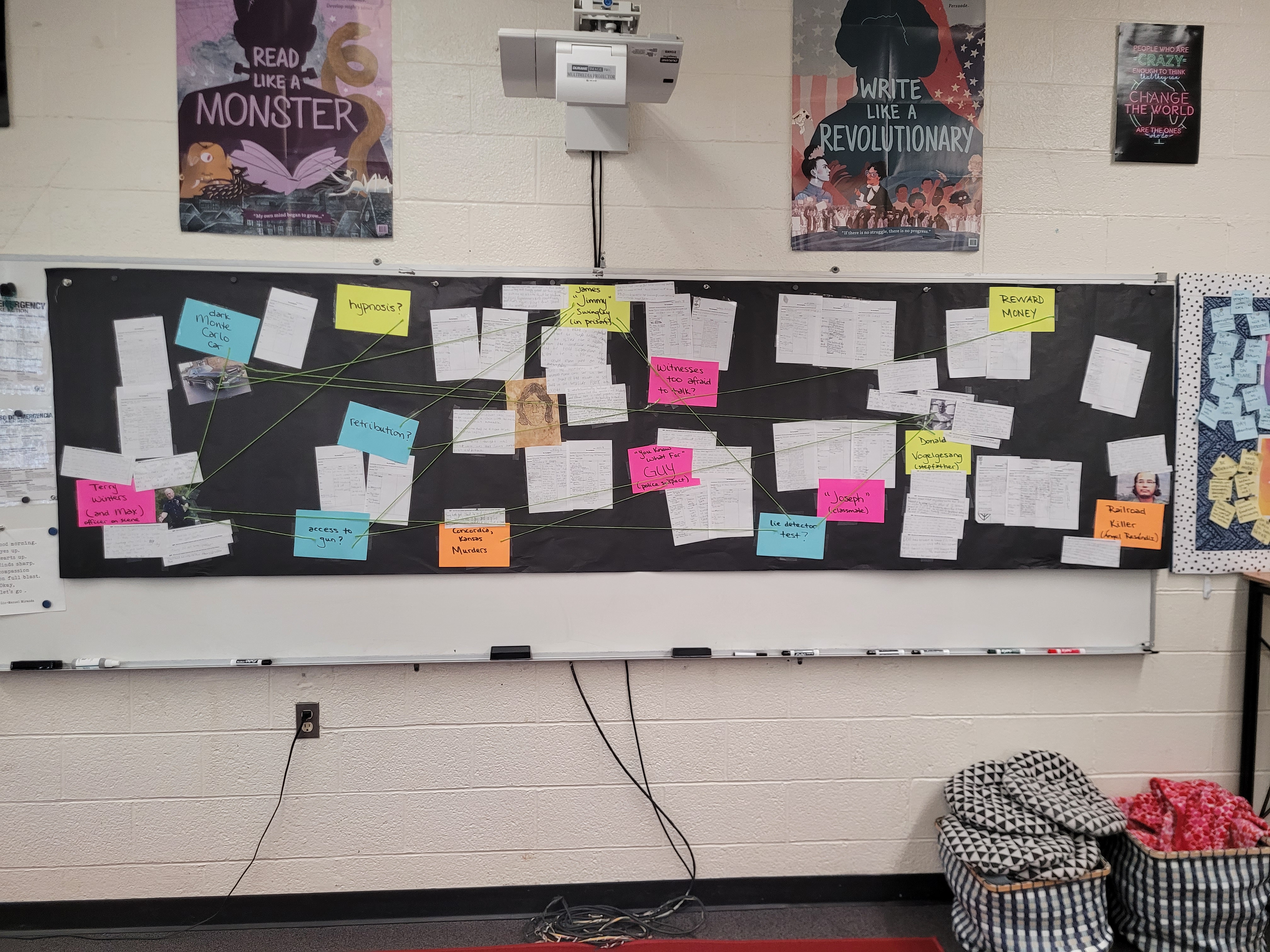
That’s a murder board. You’ve probably seen them in movies and TV shows. You might have made one yourself.

But have you ever seen a murder board, based on two real-life unsolved murders, put together by 13-and-14-year-olds? I didn’t think so.

Earlier this week I spoke to teacher Megan Byard’s middle-school class at Inspire Academy in Muncie, Indiana, my hometown. Ms. Byard had approached me and Douglas Walker, my longtime writing partner at Muncie newspapers and in four true crime books, including “The Westside Park Murders: Muncie’s Most Notorious Cold Case,” published by History Press in 2021, about talking to the class about Westside.

In September 1985, teenagers Ethan Dixon and Kimberly Dowell were shot to death in Muncie’s Westside Park. No one was ever charged with the crime, although police have had a person of interest for a few years now. In our book, we name that person, who is in prison following a conviction for a separate murder years after the Westside slayings. We explain the line of reasoning that prompted police to suspect him. We reached out to him in prison to ask about the case against him. He did not respond to written questions and a self-addressed, stamped envelope. In addition to naming him, our book explores many other theories and suspects connected to the case.

Since it came out, our book has received a lot of attention. Popular podcasts have been based on our book and the crime. On Amazon, the book has 163 ratings for 4 out of 5 stars. It prompted a Peabody-winning producer of non-fiction television to contact us about turning it – and some of our other writing – into a multi-part true crime series, but no networks or channels took the producer up on the pitch.

Of all the attention that our book has received, I think one of the coolest and most interesting was from Ms. Byard’s class. The students, who are interested in journalism and writing and true crime, studied the book and the crime in advance of having me do an online talk for their class. They asked good questions.

I think I was most impressed with the murder board, though. Made me feel like I was working in a police precinct, hoping for a breakthrough.

And I guess all of us are still waiting for a breakthrough.

Thanks to Ms. Byard and her class at Inspire Academy. Your interest and care made my week.

Here’s a link to the book on Amazon, although you can find it anywhere, including many libraries, including the Chicago Public Library.