
Oscar-winning screenwriter William Goldman probably wishes he’d monetized his famous phrase, “Nobody knows anything,” because while Goldman (“Butch Cassidy and the Sundance Kid,” “All the President’s Men,” “The Princess Bride”) painted a wide swath with that statement, he’s surely as correct as correct can be. If we’ve learned nothing from watching movies, books, politics and, well, every damn thing, in the past decade, it’s that uncertainty is the norm.
I’m enjoying paying more attention to the publishing industry lately as I’m doing some editing for Constellate Publishing and working on three – count ’em – three novels. I get a lot of insights from the several-times-daily email from Publishers Marketplace and I’m enjoying learning which books and genres are going to be populating bookstore shelves in a year’s time.
But the more information I have, the more I need. I’ve got a William Goldman-level lack of knowing anything about the book industry and I’m trying to remedy it.
So today I was fascinated with a new piece by editor Sean Delone – link at the end of this post – in which he looks at some trends in publishing, specifically about non-fiction book publishing.
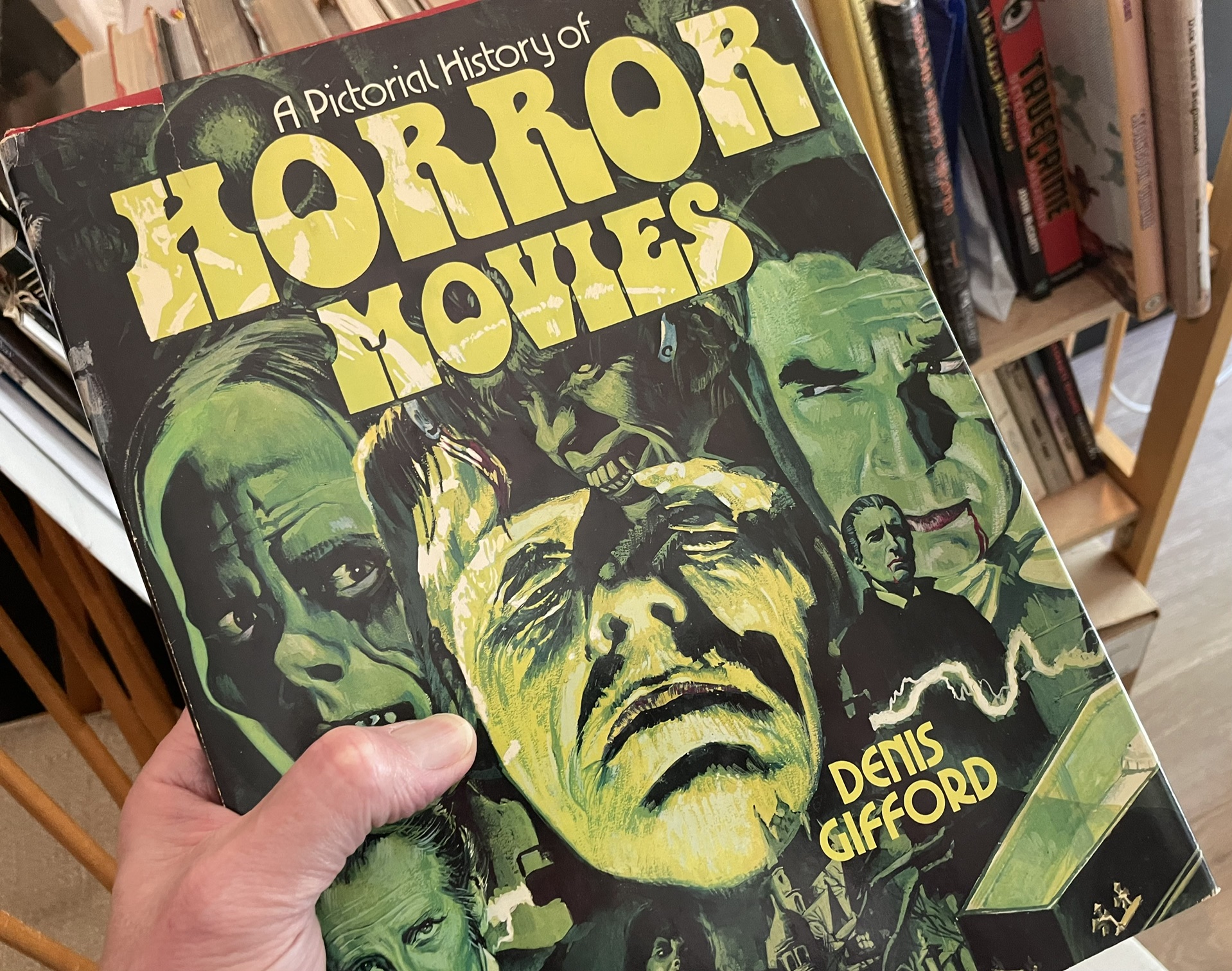
Before I get into details, here’s a picture I just took of one of my several shelves of non-fiction books, very specifically in this case books about movies, TV and entertainment, but we’ve accumulated hundreds of non-fiction books in the past few decades. Pictured above, my copy of Denis Gifford’s “A Pictorial History of Horror Movies” was published in the early 1970s. My copy was published around 1974 and it’s not even the oldest non-fiction book in the house.
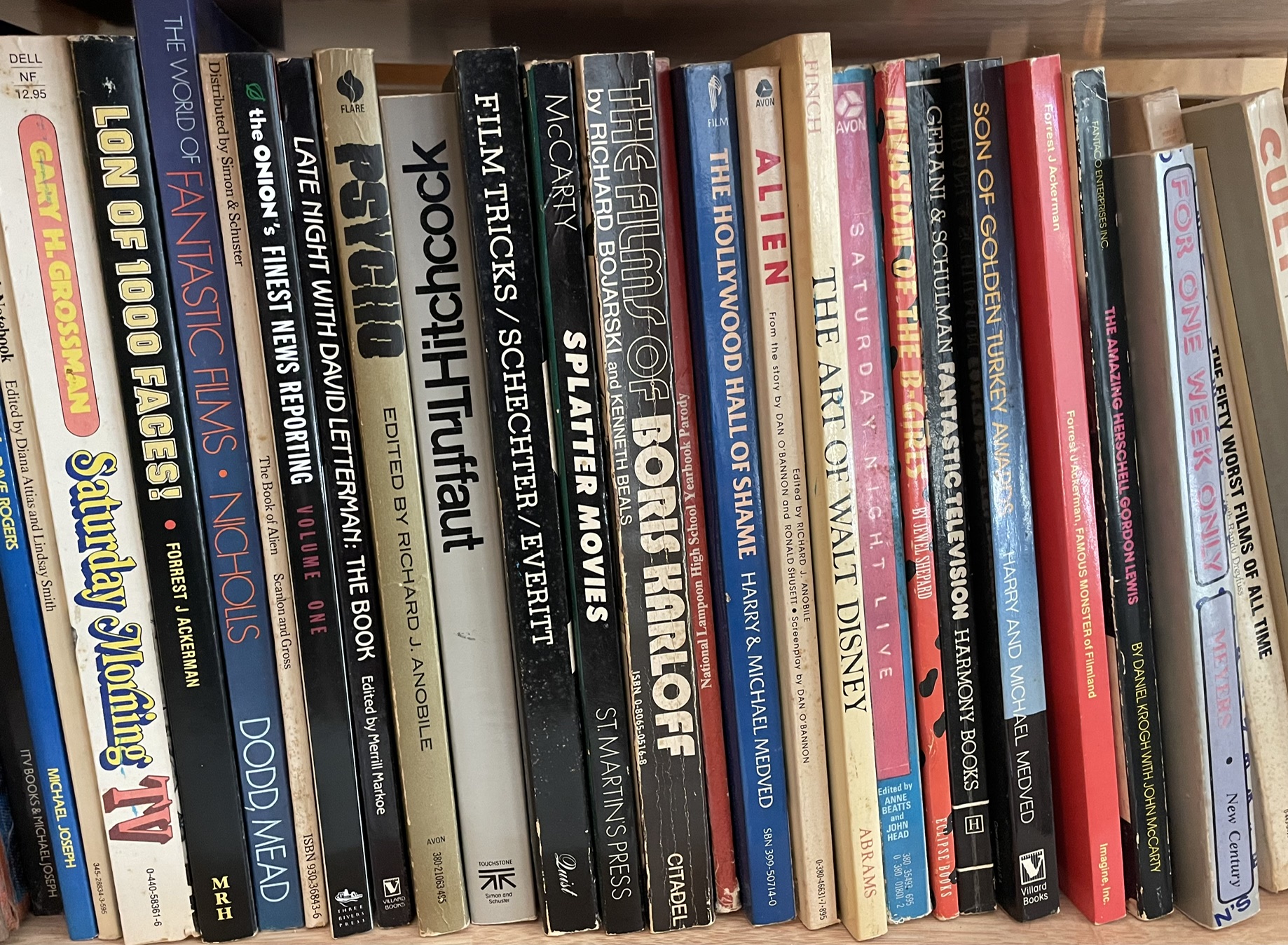
It’s accurate to say that I love non-fiction books, history or news or photography or films or Saturday morning cartoons or whatever, and while I don’t buy as many as I used to – I think my latest might be “TCM Underground,” the cult films book released right before TCM canceled the Saturday night/Sunday morning program – but while dozens of boxes of fiction going back to the 1960s are still stored in boxes here, our non-fiction books are mostly but not entirely displayed. Yeah, I love ’em.
And there’s no doubt that online sites have decimated the need for nonfiction magazines and books. Why buy an authoritative book when you can look something up on some possibly totally erroneous online site?
Anyway, Delone’s article, “The Nonfiction Book Market is Collapsing,” carried disheartening news.
The gist of it:
First, the entire industry boomed in Covid—writing is a hobby and reading for pleasure is, too—and has trudged along as it usually does, staying flat, growing a little over the years since 2020. But for the past decade the market for nonfiction has slowly collapsed. What has happened in the last ten years1 is that the overall industry has grown modestly, but fiction and nonfiction have basically flipped positions. In 2015, 6 of the top 25 bestselling hardcover books—this is a not-perfect but useful proxy for new books published—were fiction. In 2025, 18 of the top 25 hardcover books were fiction, meaning only 7 were nonfiction, almost an exact inversion of ten years ago.
Delone emphasizes he’s not writing an Atlantic-style “end of reading, end of books” essay. If you remember, that one alarmed at lot of writers, editors, publishers and readers a while back.
Delone notes that media – which used to be a few big newspaper book review sections and late-night talk shows, where even a Midwestern rube like me could see important authors interviewed by Johnny Carson – is much more decentralized than it used to be and there’s some emphasis placed on book influencers and book accounts on social media. (I follow a bunch of them, for enjoyment more than education, but information nonetheless.)
But he also notes a colossal fall-off in demand for the kind of information we formerly turned to non-fiction books for:
No amount of platform is going to change that interest across the board in nonfiction from celebrities down to science has been slowly disappearing. Even if nonfiction is stable and more predictable than fiction in the abstract, it’s by far worth taking the risk on an unknown novelist if the return is potentially 4x as much. Let’s bring the nonfiction collapse into current day context. Two weeks ago, the entire hardcover nonfiction bestseller list sold 42,000 copies, whereas just the top two bestselling fiction hardcovers the same week—The Calamity Club in its 15th week on-sale and Yesteryear in its 19th week on-sale—sold 52,000 copies. It’s not inconceivable that on the right week, one fiction hardcover with first week sales could outsell the entirety of the hardcover nonfiction bestseller list.
Welp, as the young people used to say.
Want another gulp moment?
The tide going out on nonfiction sales and reading is entirely reshaping the power balance in the industry. Not overnight, but slowly, the money is flowing to fiction and away from nonfiction. It is causing quite a scramble. Fiction is unpredictable, it requires taste, it does not favor the solid metrics or predictability which, if you are running a publishing company, are much more preferable (businesses tend to prefer predictable growth and low volatility or at least high growth alongside high volatility). Fiction is also an easier category for the big publishers to capture and corner the market on. For instance, a handful of talent agencies represent nearly all A-list actors, and therefore a significant supply of big nonfiction bestsellers. The capture in supply carries over to publishers—when is the last time a big celebrity has published a huge bestseller with an indie press?
Delone has a lot of interesting thoughts on the industry. You can find some very thought-provoking posts here:
Discover more from keithroysdon
Subscribe to get the latest posts sent to your email.
