Don’t be fooled by that headline. 2025 is very much a shit show. I’m talking my writing year so far and that ONLY.
I published my 1984-set high school crime novel THAT OCTOBER in June and the reception so far has been pretty good. I have no complaints about how kind and generous people have been. If you’ve read it, please leave a review on Amazon. But buy it from one of the dozens of sites that sell it, especially bookshop dot org or Ink Drinkers Anonymous, the woman-owned, Black-owned bookstore in my hometown of Muncie, Indiana.
Other than THAT OCTOBER, I’ve been pleased to see a number of short stories published or purchased for upcoming publication, including in a future anthology that I can’t wait to tell you about.
In September, I go to my second Bouchercon, the world convention of mystery and crime writers and readers, and I’ll be on my second Bouchercon panel, with a hugely talented group of authors. This one is at 3 p.m. Wednesday, Sept. 3, the first day of Bouchercon. This Bcon is in New Orleans, which I’m pretty sure should be mild and breezy by September, right? Right?
But very nearly overshadowing all this is that I submitted, earlier today, a short story to the crime fiction genre’s preeminent market. Now I don’t have any great hope that the story will be published. There are a hell of a lot of great writers out there submitting stories.
But the submission was a goal of mine for 2025. Not to get a story published in that magazine, I will note. Nope. Just to submit a story to them again.
I subbed once before, a few years ago, and their rejection was so perfectly justified but so devastating that I didn’t submit to them again for several years. Hell, I didn’t submit anywhere for a year.
So aside from publishing THAT OCTOBER, and attending and speaking at another Bcon and winning a place in this cool anthology that’s coming up in just a few weeks, getting up the nerve to submit to the Big Show again was a 2025 goal realized.
I was interviewed for a podcast recently when I was back in Indiana promoting THAT OCTOBER and I ended a question with an off-hand comment that I’ve verbalized before but this interviewer said she really appreciated it.
“If you write, you’re a writer,” I said.
That seems obvious enough, but I think some writers feel like you’ve got to attain some particular level of success, or something, to consider yourself a real writer:
You’ve got to finish every story or article or book that you begin. You’ve got to publish every story or book or see it published. You’ve got to be paid for every one. You’ve got to be published by a prestigious site or magazine or anthology or publishing house, all to be considered a legitimate writer. (Now that I write that sentence, I can’t imagine what a “legitimate” writer would be anyway.)
None of those things are necessary to being a writer.
For certain, it’s a good thing to finish what you’re writing. That’s good discipline and a sign that you’re able to follow through, even if it’s not your best work. It definitely would be a cool thing to try to get every story or book you write published, but no way in the world does that happen to every writer (maybe to Stephen King or Lee Child, and probably not even them).
Getting paid or being published in some cool place is super and I highly recommend it. But that’s not the definition of being a writer.
Sitting down at your keyboard – that’s mine in the photo; please disregard the random junk in the keys – is part of the definition of being a writer. Or sitting down with your notebook or legal pad and your favorite pen.
You’re also a writer if you’re sitting in a comfortable space, staring out the window, watching random squirrels frisk their way past enjoying the sun, or watching the headlights and taillights of passing cars cutting through the dark. While you’re sitting there, you’re probably thinking about stories or coming up with ideas of ways to execute a scene. Or you might just be letting your imagination roam. You can do the same thing while mowing the lawn or watching TV or listening to music.
There’s enough anxiety and imposter syndrome for writers, and always has been, about writing or what they hope to write or what they have written to feel more of it because they’re not turning out a thousand sterling, perfect words every day.
If you’re exercising your imagination, if you’re mulling over characters or phrases or plots, if you’re making notes or writing it out longhand or you’re dashing out a couple of thousand words every day – even if you go back and start over – you’ve accomplished your goal.
I went viral on social media – two different social media, with two different posts – over the Fourth of July weekend.
(This is not a pat myself on the back post. I think there’s something interesting that’s happened here, beyond the viral-ness.)
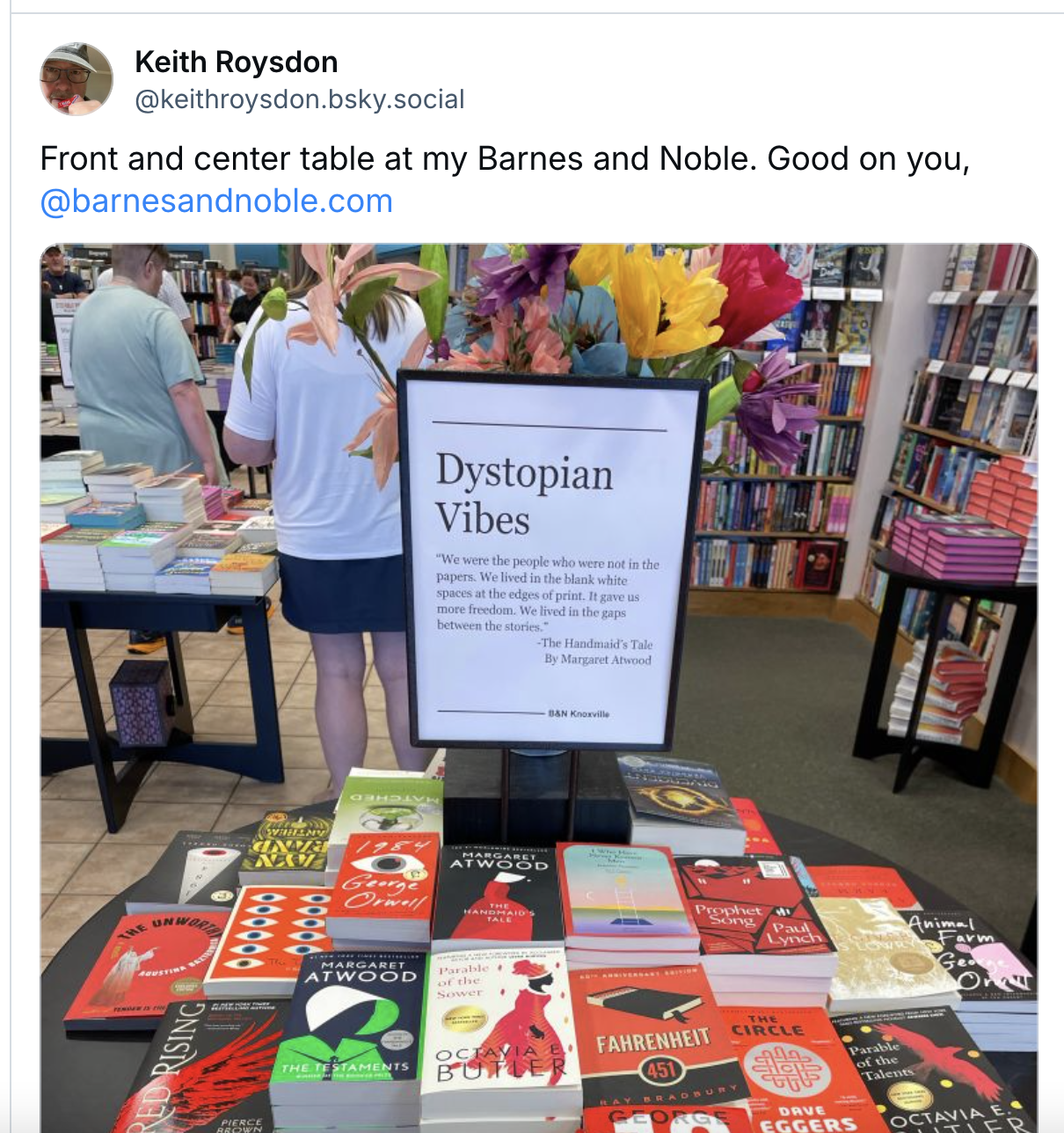
The first post that went viral is the one above. On Saturday, I was in the Barnes & Noble bookstore near me and took a picture of the first table inside the door. If you can’t tell from the picture, it’s a display marked “Dystopian Vibes” and offers books including “1984,” “Animal Farm” and the works of Margaret Atwood and Octavia E. Butler.
I thought I’d snap a picture and post it and thank Barnes & Noble for putting these books out there so prominently. Yes, that placement encourages sales. Yes, it’s ultimately a big corporation trying to move copies of books. But it’s something.
I thought the post might get some traffic, but I never get a lot of engagement, even with 3,000 Bluesky followers.
By Sunday afternoon, this was the response:
380 accounts reposted my post, which got 2,700 likes.
This is a multiple of thousands the reaction I was expecting. I had to mute notifications on the post.
That wasn’t all, though.
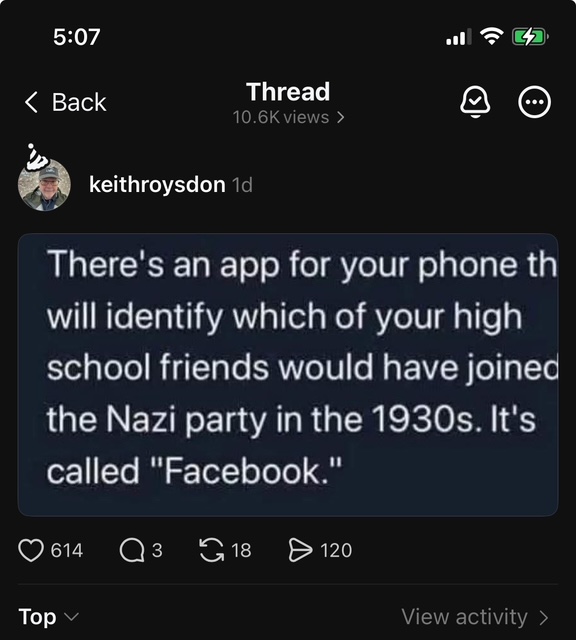
I saw a bitterly amusing meme on a friend’s Facebook account – there was no indication on the account who originally posted it – and I posted it on various social media, including Instagram, which shares posts to the social media app Threads (which I don’t use much).
Here’s the post, and the reaction:
Believe me when I tell you, I usually don’t get 600 likes on Threads, a social media I barely use.
So what’s the upshot to all this, besides a little more engagement and traffic to the companies that own Bluesky and Threads, the latter the detested Meta? (The even more detested Twitter turned up with very little notice of either post, by the way.)
The upshot, it seems to me, is that there’s a lot of interest and engagement in posts about our currently untenable, dangerous and yes, dystopian path.
That’s a good thing, that people are engaging in posts critical or even acknowledging the path this country is on.
And, as a bonus, the Bluesky post shows a ton of engagement about books that forecast, define and address our society.
There’s nothing more encouraging than the realization that people are engaging with literature that calls to light our current peril.
So maybe a small percentage of the frogs in this slowly boiling pot of water are aware they’re in a slowly boiling pot of water. I hope.
Here’s a mystery for the ages, and one that I’m not going to solve here.
How much is too much for a writer to care about their work? How much is just enough? How much is not enough?
2024 was a good year for my writing in a lot of ways. Several short stories published. The stories were published with some effort on my part but much more luck. Much more.
So toward the end of 2024, as I began to focus on self-publishing my book THAT OCTOBER, my short story production dropped off dramatically. I didn’t chase every call for submissions like I had been for much of 2024. (This followed a LOT of story rejections, by the way.)
Since I hopped off the short-story-submission merry-go-round, I’ve had, unexpectedly, some luck with short stories. A few months into 2025, Shotgun Honey accepted my short story “Trouble, Start to Finish,” submitted in 2024, and it was published in May. (Link below.) Another story that had been held for months is slotted (for now) for publication, this year I think. Another story that had previously been accepted is still set to publish on December 21, 2025, as far as I know.
Then an author I know contacted me and asked if I had a story in a very particular genre that I might be able to contribute to an anthology he was editing. I had had one in mind and pitched it, he said yes, I wrote it in a couple of weeks and it’s going into an upcoming anthology. I’ll be promoting it when I know some details.
So with THAT OCTOBER out and available everywhere, I’m tentatively looking at short-story writing again. A friend sent me a link to a call for subs and I’m sending the super-short story out this afternoon. No idea if it’ll be accepted.
So is the moral of the story that it’s good to take a breather once in a while? That you should focus more narrowly?
Or is the moral of the story that the less you care about something, the more likely you are to achieve it?
I’ve noted on social media in recent days that we recently spent a little time in Muncie, Indiana, promoting THAT OCTOBER and getting together with family and friends and looking around the city that was my lifelong home until we moved to Tennessee almost three years ago.
It made perfect sense to promote the book there because 1.) more people know me there than here and B.) the book is set in my version of Muncie as it was in 1984. The novel’s not a documentary, obviously, but it’s got the overall vibe of Muncie more than 40 years ago and the teenage characters do some of the same things my friends and I did in Muncie when we were that age or a little older – going to movies, watching MTV, going to house parties. I never prowled through a junkyard, I admit, but that part of the book was inspired by my late Uncle Si Stewart, who talked about when he took a shortcut home from school through a Muncie junkyard when he was a kid in the 1950s.
We get back to Muncie once or twice a year since we’ve moved down here, and I’m always so grateful that I get to see family and friends there and get to look around the city I knew so well and covered for the newspaper for most of my life.
I always come away with gratitude for the people I get to see, those that I get to meet and the places that are familiar to me.
But I always feel sad when I’m there. I’m nearly swamped with melancholy while I’m there and for a while after.
It’s not just that the city has changed. It has, and not just in the three years we haven’t lived there. It was changing most of the time I lived there too.
I always explain to people who don’t know Muncie as the city where David Letterman went to college, where the first half of “Close Encounters of the Third Kind” was set, where Garfield the cartoon cat was created and is still produced and where Ball canning jars were made dating back to the 1890s.
It’s the city where four true crime books I co-wrote with Douglas Walker, my frequent collaborator at Muncie’s newspapers, are set. There’s no getting around that Muncie – one of several Midwestern cities that were nicknamed “Little Chicago” – was sometimes a violent and murderous place.
It’s a city that in some ways peaked when I was young, as young as the teenage protagonists of THAT OCTOBER. Its population peaked at just over 76,000 in 1980 and has fallen regularly since to an estimated 64,000 now. Most of the big industrial employers went away, some of the most recent in the 2000s, although luckily there’s some stopping of the bleeding thanks to growth in employment in the education and healthcare fields.
Still, Muncie has struggled and is struggling. The city can’t keep the streets paved. The mall is all but dead. Some, not all, of the government leadership seems determined to wipe out all the welcoming efforts that groups and private individuals have made over the years. And at the same time there’s decades-long efforts to bolster downtown, there’s a proposal to pull the last few hundred government workers out of downtown and put them in an ill-advised government center miles to the south, outside the city limits. (When one of the downtown government buildings was being built in the early 1990s, there was discussion of metal detectors inside the doors. An attorney who oversaw the project said it was insulting to frisk people who were on their way to pay their taxes. Yet here we are, decades later, and metal detectors are a way of life because life is cheap and murder is easy. That said, I think it’s insulting to tell people who pay their taxes that they can’t even pay those taxes or go to court or talk to their representatives without leaving the city, ffs.)
It’s depressing to contrast the city currently with the city as it was in the 1970s and 1980s. I don’t even get into a lot about how thriving the city was in 1984 in THAT OCTOBER, but as strange and upsetting as it was for murder and mystery to envelop the city and the young protagonists of my book, 1984 in the real-life Muncie was a boom time. Life in the city had peaked, in some ways, and in the decades since, it has not struggled its way back.
My friend Tammy told me this morning, as I was ruminating on all this, that my hometown’s struggles reflect this country’s stuggles and she’s right, of course. I take that as personally as I take what’s happened to Muncie.
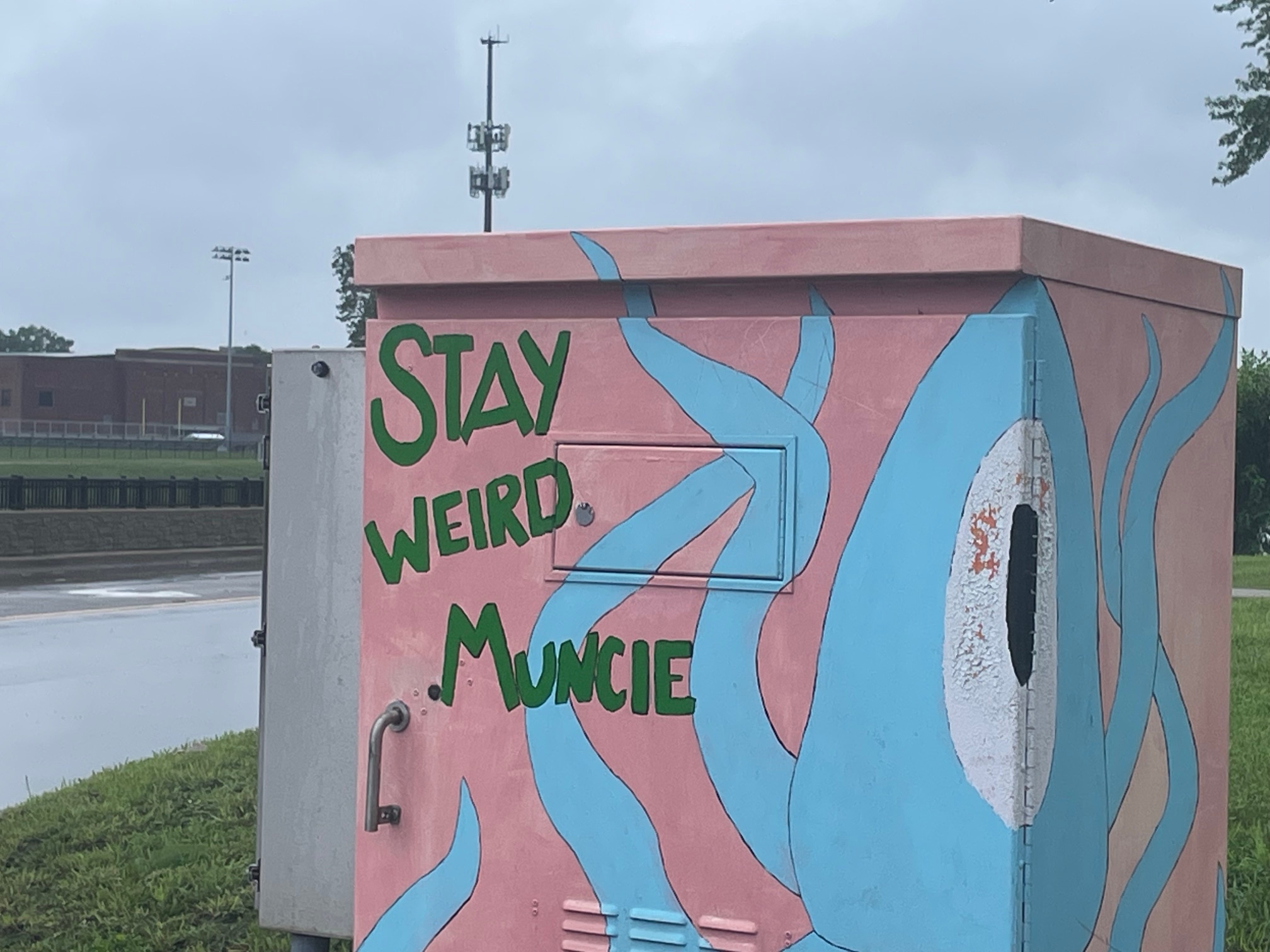
One of the consistently amusing sights around Muncie is a public art project from a few years ago that prompted artists to decorate traffic light control boxes. The art was contributed by a lot of different artists and ranged from the beautiful to the abstract to the whimsical like the “Stay Weird, Muncie,” message above. I took that picture our first day back and I’ve thought about it a lot.
I’d like to think that my hometown can be weird, interesting, welcoming, fulfilling, progressive but comforting and I like to think it can be a good hometown, either for someone who’s still living there, someone who’s just visiting or someone who’s come home again.
I’d like to think that, and maybe take comfort from that once I shake this profound melancholy I feel. But I’m not sure its possible.
Every once in a while, I’m taken aback when a writer who I kinda thought I knew isn’t actually who I thought they were. I’m not talking about any kind of betrayal here, dire or otherwise. I knew them only as a pen name and didn’t realize that fact.
There are a lot of worse identity crises out there, such as what happens when you deadname someone. But I still get surprised when Facebook suggests I send a friend request to someone and I don’t recognize the name but I know the face.
I realize, stupidly, belatedly, that they publish under a pen name.
I am, unfortunately, 50-some years past the time I could have used a pen name. That’s because in a very small circle of people, I’ve been known since I was in high school. That’s when my first article, under my byline, was published in the newspaper. I haven’t been out of print since 1977.
And when you have an unusual last name like mine, you’re pretty easy to find. Remember the days we were all listed in phone books, no less city directories? (The latter, if you don’t remember them at all, were phone book-style directories that let you look someone up not only by name but by address and, in reverse-directory style, by phone number. And when you looked them up, it told what they did for a living. I’m not sure city directories were any worse than the many ways you can find out about someone now, but they were handy tools for newspaper reporters and probably nightmarish for everyone else.)
(I literally remember using the city directory to find people who, according to court records, might have been victimized by a corrupt judge, some willingly. It made for some awkward conversations when someone came to the door, let me tell you.)
So I’ve never been able to take refuge in anonymity. I know this was frustrating for me and for my family, particularly when someone would call on our home phone – remember those? – to give me grief about something I’d written.
My relative high profile, as compared to people who didn’t work for a newspaper, led to some pretty awkward moments. Sometime I’ll recount one for you over a beer or coffee. You might throw your drink in my face when you hear it, though.
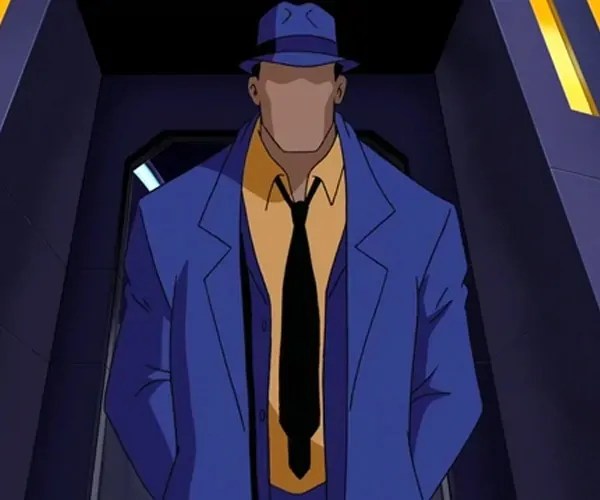
Anyway, it’s too late now for me to adopt an anonymous personna like the superhero the Question, pictured above. Moving to another state has given me some relief from running into people I wrote about, though.
If I get that kind of “hey, it’s that guy” notoriety again, maybe I’ll start wearing a full-face mask and fedora.
A while back I wrote here about how I’d taken a break from writing and submitting short stories to concentrate on selling my novel THAT OCTOBER and begin work on a new novel.
Since that time, I’ve found myself back in the short story business.
In 2024, I submitted a sword-and-sorcery story to a call for submissions. It got turned down. I subbed it to another and a curious chain of events followed. This second call for subs resulted in an initial rejection, along with a request to leave my story parked in their hands in case they were able to use it. Then early this year, a definitive “no, we aren’t able to use it.”
Then, about a week ago, a reversal of fortune: They’ll use the story after all, later this year.
I’ll tell you about the story when and if this works out.
And just about the same time, I was contacted by a well-known and respected writer who asked me if I had a short story that might work for an anthology he’s putting together. I didn’t have a story, but I had an idea for a story.
A couple of weeks later, I turned the story in, 7,500 words of it, and it looks like a go. I’m really looking forward to this. I like the story and the anthology should be excellent.
I’m delighted with both of these circumstances.
So next time I decide to shy away from a particular type of writing, I’ll know that it might not be the end. It might not even be a hiatus.
Anybody who knows me knows that I really enjoy writing stories set in the 1980s.
My new book THAT OCTOBER is set – for the most part – in October 1984, although there’s some exposition in the book that leads readers back 20-plus years before that.
There’s a “Stranger Things” vibe that a couple of writer friends who kindly blurbed the book noted, although there are no monsters – except for the human kind – in “That October.”
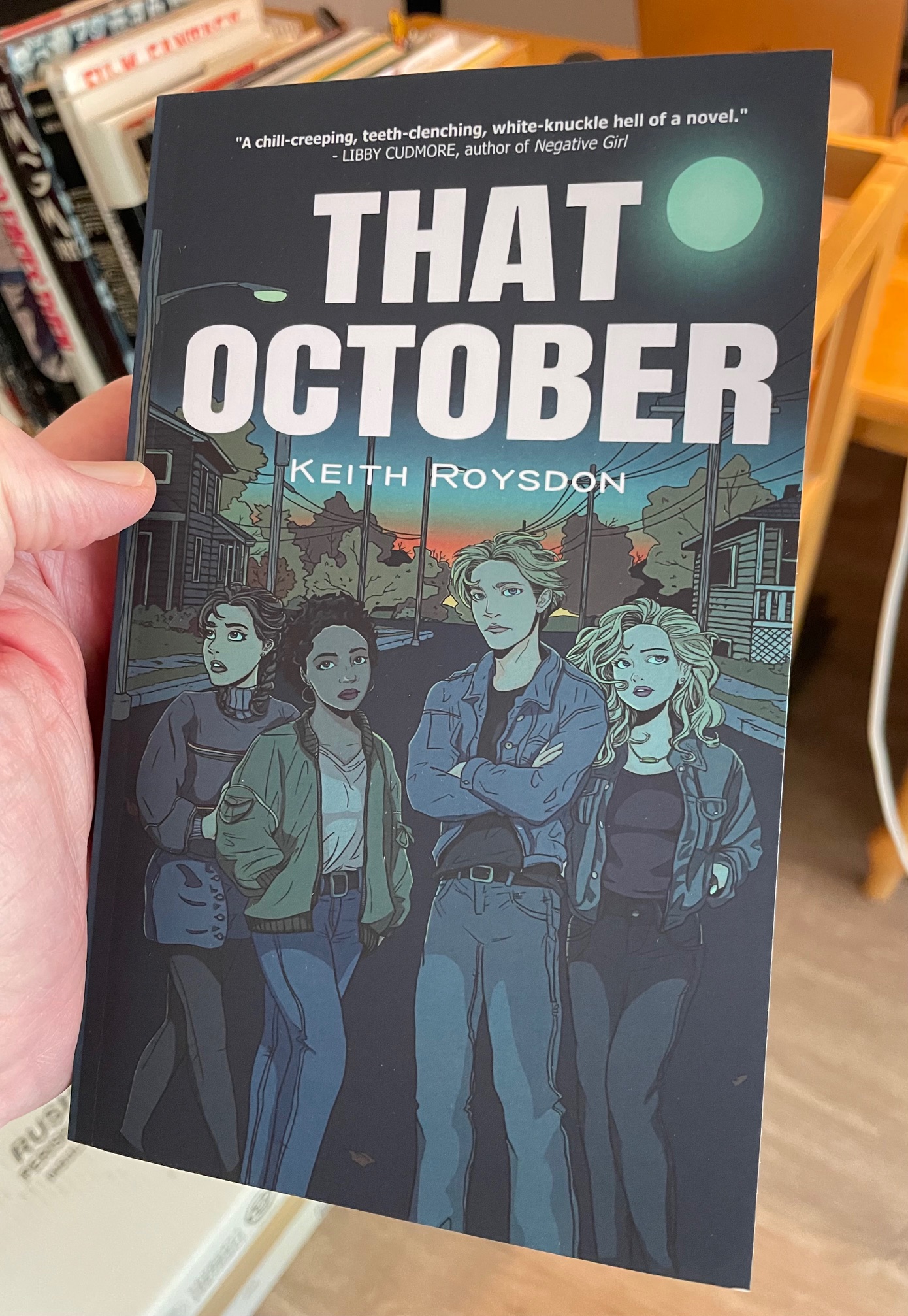
Sara McKinley, my friend who created the wonderful cover for THAT OCTOBER, said she was thinking about “Paper Girls” and other “kids on bikes” stories as she was working on the art. (My kids in the novel are slightly older, although not by much, and more mobile.)
But besides THAT OCTOBER, I wrote another story, “Steel Victory,” which was published in the 2024 Slaughterhouse Press anthology “Maximum Firepower: An ’80s Action Anthology.” The premise behind the Brian G. Berry-created “Maximum Firepower” is that the tales we wrote were inspired by 1980s action movie tropes.
In my story “Steel Victory,” a Captain America-style super soldier escapes from a top-secret lab in 1986 Washington, D.C. This super soldier is no Steve Rogers, however, and when he goes missing he goes on a murder spree.
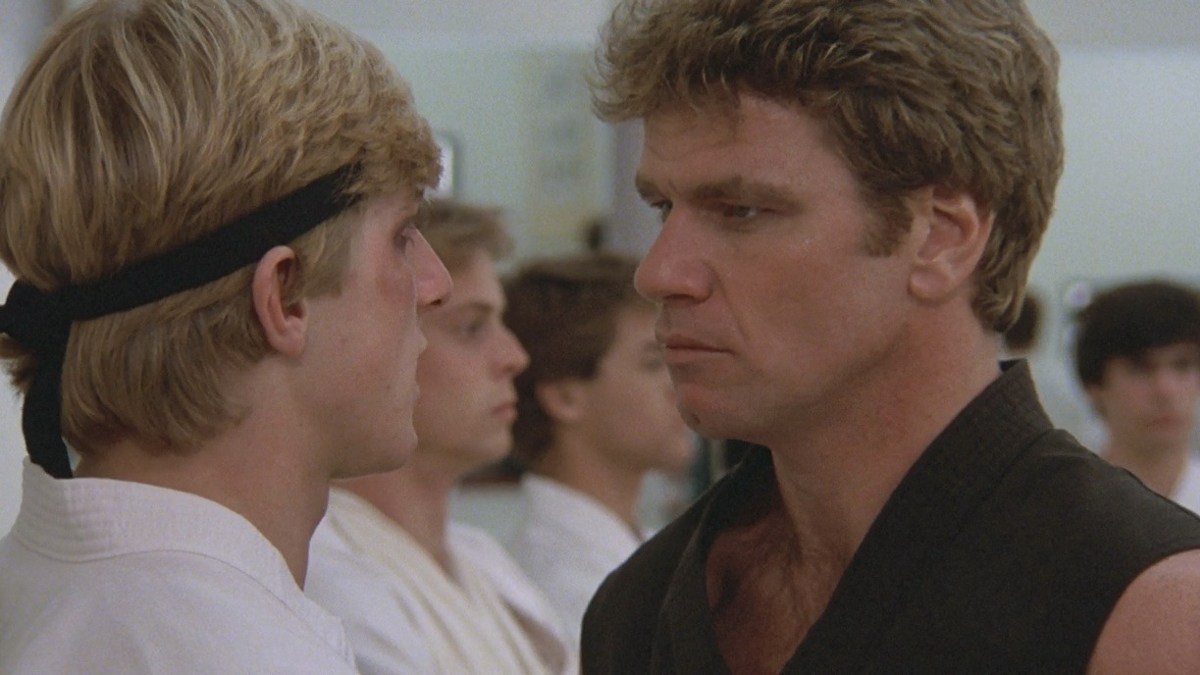
For the look of the missing super soldier, I pictured Martin Kove, the actor who played the bad guy in “The Karate Kid” and other 80s action pictures and recently returned in the “Cobra Kai” series.
It’s up to three women – the doctor who conceived the project, the “lab rat” who knows more about the project than anyone and the project’s head of security – to track him down in the darkness of D.C.
“Steel Victory” and THAT OCTOBER appealed to me because the time period was very defined and familiar to many of us, even those who were too young to experience it. Everybody knows the trappings of the decade, from “Terminator” movies to “Star Wars” on home video to the music of MTV.
As much as I find my cell phone and the Internet indispensable now, there’s something very freeing about writing about a time when the protagonist couldn’t just pull a phone out of their pocket and call or text some crucial information to someone.
I love research, and one of the things I discovered as I wrote “Steel Victory” was that I couldn’t round up a bunch of those government-issue black SUVs for the search party. SUVs, other than Jeep Cherokees, were not in wide use at the time. So my protagonists had to improvise.
It’s an intoxicating thing, to write about a period that’s so close yet so far away. I hope I get to do it again.
Here’s where you can get “Maximum Firepower” and my story “Steel Victory.”
A few random sales can prompt big movement among the lower reaches of Amazon’s sales chart. Believe me, I’ve seen this with our four true crime books, which were published by History Press.
And ultimately this won’t put a lot of money in my pocket or, if you follow this path, yours. We didn’t become writers to make money, did we?
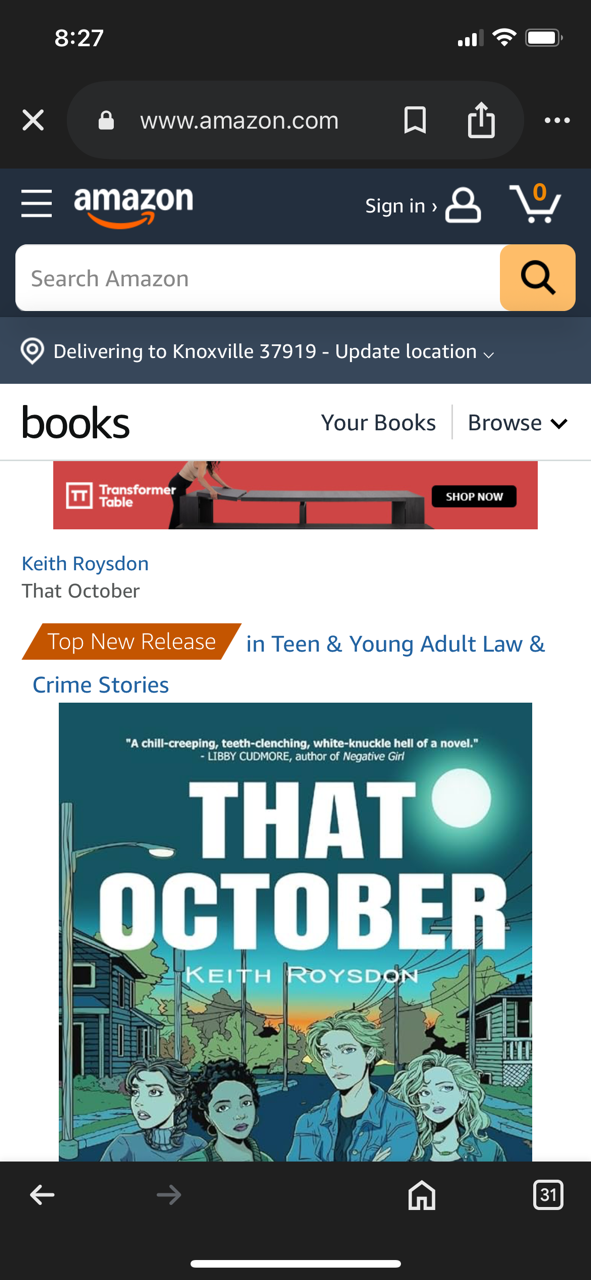
But today I checked the sites selling my novel THAT OCTOBER – Bookshop, Barnes & Noble, Powell’s Books and Amazon among them – and was surprised to see that on Amazon, the book was marked with a “#1 New Release in Teen & Young Adult Law & Crime stories” label.
On the mobile Amazon, this:
A red banner. As opposed to a Bruce Banner.
So I don’t know any more today than I did yesterday about how my book is doing or will do, before or after its June 1 publication date. (That’s five days away as I write this.)
But it looks like it hasn’t hurt to self-publish the book, in paperback, through Ingram Spark.
I can’t tell you what to do. Your scenario is not like mine. I’m a guy who doesn’t have years to take the traditional publishing route. I hadn’t really thought about self-publishing until last fall, when my friend and editor Jill Blocker, who had self-published one language edition of her great book WHAT WAS BEAUTIFUL AND GOOD, suggested I might want to consider it. Jill did all the heavy lifting and my friend and artist Sara McKinley created an incredible cover that has sold at least as many copies of the book as the promise of what’s between the covers.
So should you self-publish? Maybe. There’s no doubt there’s much more prestige in being published by an indie or small press, not to mention a big publishing house, compared to self-publishing. Some people will always look on self-published books as “vanity” books. That doesn’t bother me at all.
I hope you like THAT OCTOBER. I don’t expect to make much, if any, money off it. I encourage you to buy it (the ebook version is coming) or borrow it from your local library. Libraries do a lot of society’s heavy lifting, and I would be thrilled if you read it or any of my books through a library,
But I will say I’m not, not encouraging you to self-publish. This is working so far for me.
If there’s any questions I can answer, look me up on BlueSky or on my Facebook page, which is called, in a blindingly brilliant move, Keith Roysdon author.
I’m not sure I remember the exact details, but when my first true crime book, co-authored with my longtime writing partner Douglas Walker, came out in 2016, it was pretty thrilling to see the book for sale in bookstores, drug stores, gift shops and online.
It’s one thing to have a book out there and to sell it and sign it, but realizing our publisher, History Press, had actually gotten the first book, “Wicked Muncie,” in stores and online sites, was pretty amazing. History Press kicks all kinds of ass in getting books in stores, by the way. All four of our true crime books found a good home with them.
Another highlight was finding our books offered by libraries, which are very nearly my favorite places on the planet. A while back, I realized our third true crime book, “The Westside Park Murders,” was available through the Chicago Public Library. I’m still boggled over that.
So it’s been fun, with THAT OCTOBER, my new 1984-set high school crime novel, finding the book on all kinds of bookselling sites. I wasn’t certain if I would have to take steps to ensure this because THAT OCTOBER is self-published.
But I didn’t have to. At some point recently I was asking the folks at Ingram Spark, the venue I used to publish the book, if they could tell me when it would be available for pre-order. They responded and noted that it already was available and showed me where Amazon was selling it.
Since that time, I’ve been excited to see that not only Amazon, a site I have qualms about, but Barnes & Noble, Bookshop, Powell’s Books and Waterstones, the famous Brit seller of books, all offer it (for pre-order right now, as publication date is June 1).
So I’ve been on social media, posting links to most of those booksellers and screenshots. It was as especially exciting to see that Powell’s, a bookseller I’ve visited in Portland, Oregon, and have done business with online, offered it.
Oddest place I’ve found the book for sale so far: Saxo, where the book is available for about 259 Danish Krone.
It’s silly, I know, to be so excited about this, but I didn’t think it would ever happen.
Next I’ll be telling you how excited I am to find THAT OCTOBER for sale at Half Price Books or McKay’s.




 keithroysdon