Tag Archives: books

It should be obvious, but if you write, you’re a writer

I was interviewed for a podcast recently when I was back in Indiana promoting THAT OCTOBER and I ended a question with an off-hand comment that I’ve verbalized before but this interviewer said she really appreciated it.

“If you write, you’re a writer,” I said.

That seems obvious enough, but I think some writers feel like you’ve got to attain some particular level of success, or something, to consider yourself a real writer:

You’ve got to finish every story or article or book that you begin. You’ve got to publish every story or book or see it published. You’ve got to be paid for every one. You’ve got to be published by a prestigious site or magazine or anthology or publishing house, all to be considered a legitimate writer. (Now that I write that sentence, I can’t imagine what a “legitimate” writer would be anyway.)

None of those things are necessary to being a writer.

For certain, it’s a good thing to finish what you’re writing. That’s good discipline and a sign that you’re able to follow through, even if it’s not your best work. It definitely would be a cool thing to try to get every story or book you write published, but no way in the world does that happen to every writer (maybe to Stephen King or Lee Child, and probably not even them).

Getting paid or being published in some cool place is super and I highly recommend it. But that’s not the definition of being a writer.

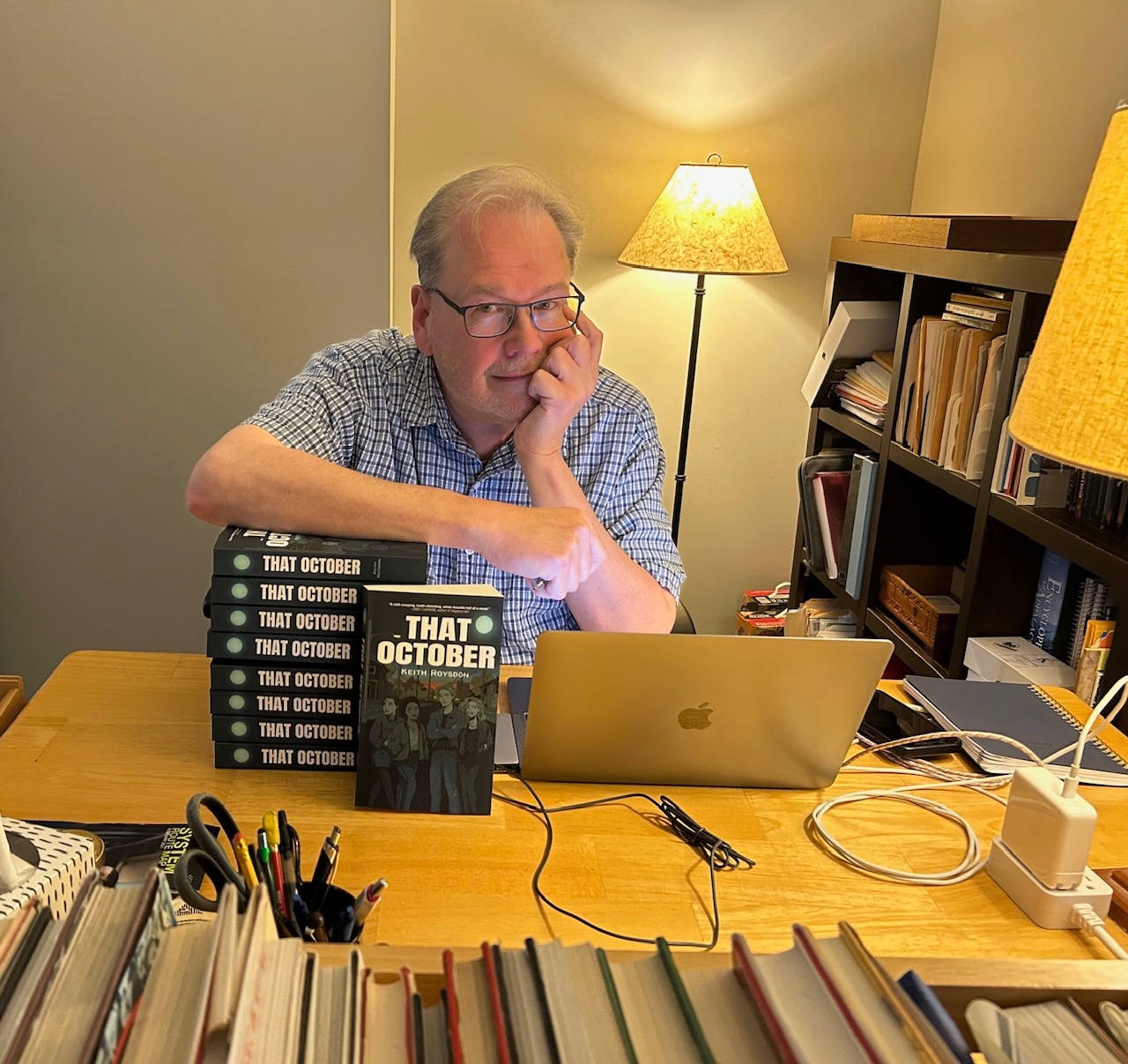
Sitting down at your keyboard – that’s mine in the photo; please disregard the random junk in the keys – is part of the definition of being a writer. Or sitting down with your notebook or legal pad and your favorite pen.

You’re also a writer if you’re sitting in a comfortable space, staring out the window, watching random squirrels frisk their way past enjoying the sun, or watching the headlights and taillights of passing cars cutting through the dark. While you’re sitting there, you’re probably thinking about stories or coming up with ideas of ways to execute a scene. Or you might just be letting your imagination roam. You can do the same thing while mowing the lawn or watching TV or listening to music.

There’s enough anxiety and imposter syndrome for writers, and always has been, about writing or what they hope to write or what they have written to feel more of it because they’re not turning out a thousand sterling, perfect words every day.

If you’re exercising your imagination, if you’re mulling over characters or phrases or plots, if you’re making notes or writing it out longhand or you’re dashing out a couple of thousand words every day – even if you go back and start over – you’ve accomplished your goal.

You’re a writer.

Going viral, social media, dystopia and books

I went viral on social media – two different social media, with two different posts – over the Fourth of July weekend.

(This is not a pat myself on the back post. I think there’s something interesting that’s happened here, beyond the viral-ness.)

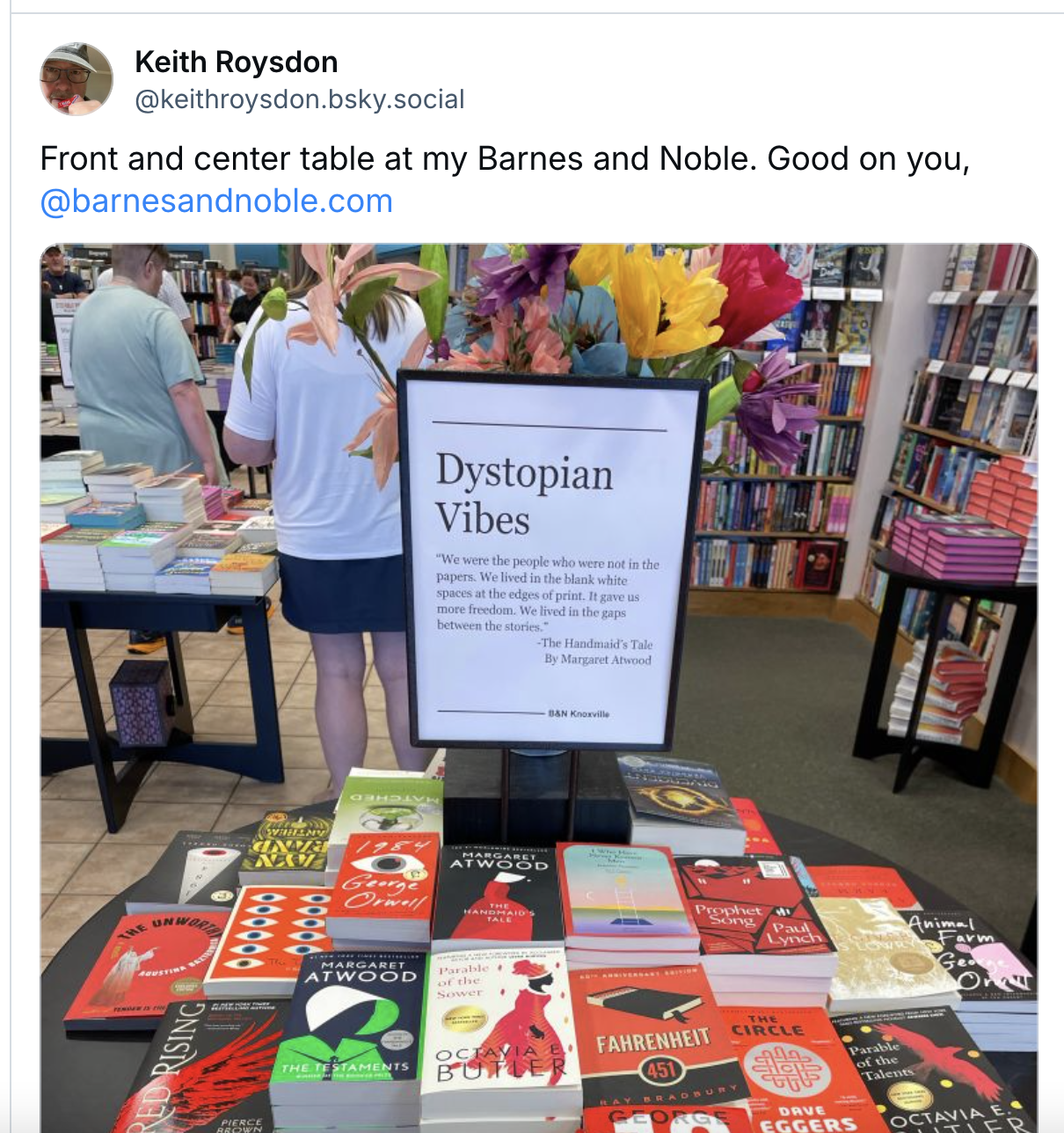
The first post that went viral is the one above. On Saturday, I was in the Barnes & Noble bookstore near me and took a picture of the first table inside the door. If you can’t tell from the picture, it’s a display marked “Dystopian Vibes” and offers books including “1984,” “Animal Farm” and the works of Margaret Atwood and Octavia E. Butler.

I thought I’d snap a picture and post it and thank Barnes & Noble for putting these books out there so prominently. Yes, that placement encourages sales. Yes, it’s ultimately a big corporation trying to move copies of books. But it’s something.

I thought the post might get some traffic, but I never get a lot of engagement, even with 3,000 Bluesky followers.

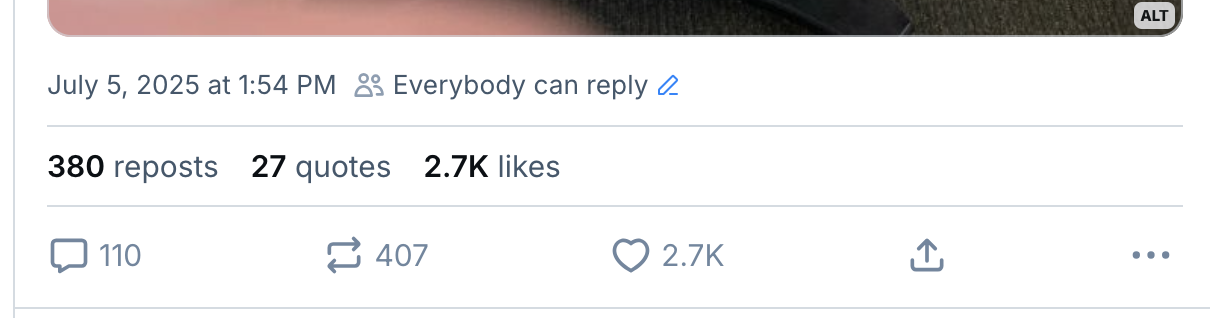
By Sunday afternoon, this was the response:

380 accounts reposted my post, which got 2,700 likes.

This is a multiple of thousands the reaction I was expecting. I had to mute notifications on the post.

That wasn’t all, though.

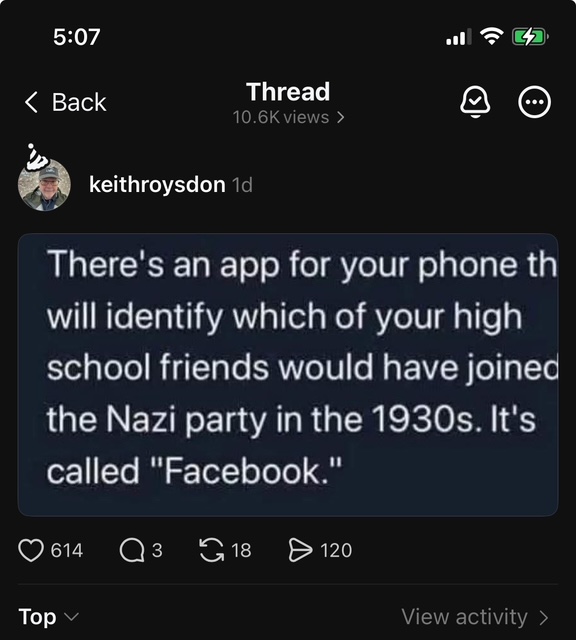
I saw a bitterly amusing meme on a friend’s Facebook account – there was no indication on the account who originally posted it – and I posted it on various social media, including Instagram, which shares posts to the social media app Threads (which I don’t use much).

Here’s the post, and the reaction:

Believe me when I tell you, I usually don’t get 600 likes on Threads, a social media I barely use.

So what’s the upshot to all this, besides a little more engagement and traffic to the companies that own Bluesky and Threads, the latter the detested Meta? (The even more detested Twitter turned up with very little notice of either post, by the way.)

The upshot, it seems to me, is that there’s a lot of interest and engagement in posts about our currently untenable, dangerous and yes, dystopian path.

That’s a good thing, that people are engaging in posts critical or even acknowledging the path this country is on.

And, as a bonus, the Bluesky post shows a ton of engagement about books that forecast, define and address our society.

There’s nothing more encouraging than the realization that people are engaging with literature that calls to light our current peril.

So maybe a small percentage of the frogs in this slowly boiling pot of water are aware they’re in a slowly boiling pot of water. I hope.

The moral of the story is …

Here’s a mystery for the ages, and one that I’m not going to solve here.

How much is too much for a writer to care about their work? How much is just enough? How much is not enough?

2024 was a good year for my writing in a lot of ways. Several short stories published. The stories were published with some effort on my part but much more luck. Much more.

So toward the end of 2024, as I began to focus on self-publishing my book THAT OCTOBER, my short story production dropped off dramatically. I didn’t chase every call for submissions like I had been for much of 2024. (This followed a LOT of story rejections, by the way.)

Since I hopped off the short-story-submission merry-go-round, I’ve had, unexpectedly, some luck with short stories. A few months into 2025, Shotgun Honey accepted my short story “Trouble, Start to Finish,” submitted in 2024, and it was published in May. (Link below.) Another story that had been held for months is slotted (for now) for publication, this year I think. Another story that had previously been accepted is still set to publish on December 21, 2025, as far as I know.

Then an author I know contacted me and asked if I had a story in a very particular genre that I might be able to contribute to an anthology he was editing. I had had one in mind and pitched it, he said yes, I wrote it in a couple of weeks and it’s going into an upcoming anthology. I’ll be promoting it when I know some details.

So with THAT OCTOBER out and available everywhere, I’m tentatively looking at short-story writing again. A friend sent me a link to a call for subs and I’m sending the super-short story out this afternoon. No idea if it’ll be accepted.

So is the moral of the story that it’s good to take a breather once in a while? That you should focus more narrowly?

Or is the moral of the story that the less you care about something, the more likely you are to achieve it?

That’d be pretty damn twisted, huh?

I will not quote ‘You Can’t Go Home Again’ – damn it, I guess I just did

I’ve noted on social media in recent days that we recently spent a little time in Muncie, Indiana, promoting THAT OCTOBER and getting together with family and friends and looking around the city that was my lifelong home until we moved to Tennessee almost three years ago.

It made perfect sense to promote the book there because 1.) more people know me there than here and B.) the book is set in my version of Muncie as it was in 1984. The novel’s not a documentary, obviously, but it’s got the overall vibe of Muncie more than 40 years ago and the teenage characters do some of the same things my friends and I did in Muncie when we were that age or a little older – going to movies, watching MTV, going to house parties. I never prowled through a junkyard, I admit, but that part of the book was inspired by my late Uncle Si Stewart, who talked about when he took a shortcut home from school through a Muncie junkyard when he was a kid in the 1950s.

We get back to Muncie once or twice a year since we’ve moved down here, and I’m always so grateful that I get to see family and friends there and get to look around the city I knew so well and covered for the newspaper for most of my life.

I always come away with gratitude for the people I get to see, those that I get to meet and the places that are familiar to me.

But I always feel sad when I’m there. I’m nearly swamped with melancholy while I’m there and for a while after.

It’s not just that the city has changed. It has, and not just in the three years we haven’t lived there. It was changing most of the time I lived there too.

I always explain to people who don’t know Muncie as the city where David Letterman went to college, where the first half of “Close Encounters of the Third Kind” was set, where Garfield the cartoon cat was created and is still produced and where Ball canning jars were made dating back to the 1890s.

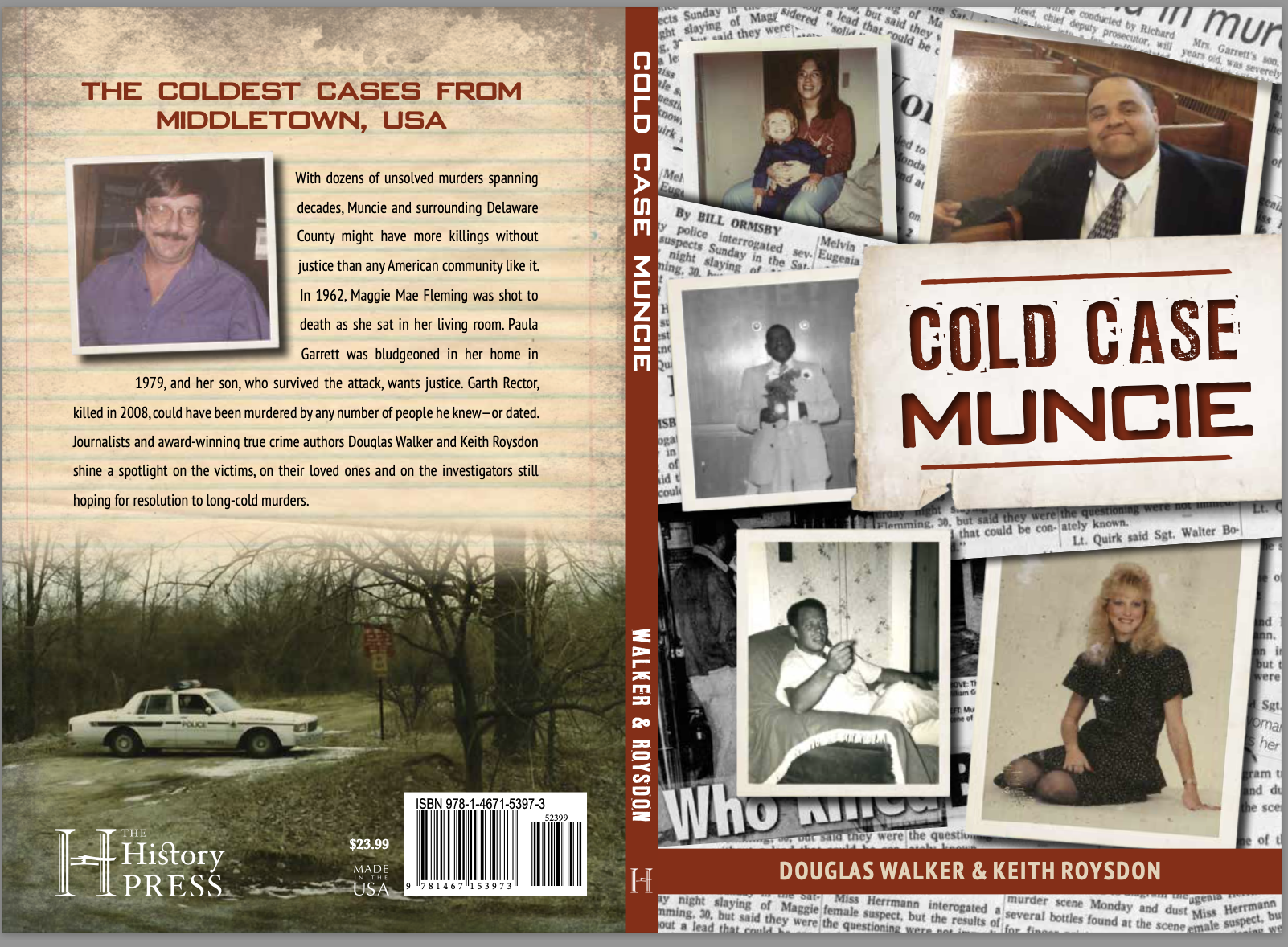
It’s the city where four true crime books I co-wrote with Douglas Walker, my frequent collaborator at Muncie’s newspapers, are set. There’s no getting around that Muncie – one of several Midwestern cities that were nicknamed “Little Chicago” – was sometimes a violent and murderous place.

It’s a city that in some ways peaked when I was young, as young as the teenage protagonists of THAT OCTOBER. Its population peaked at just over 76,000 in 1980 and has fallen regularly since to an estimated 64,000 now. Most of the big industrial employers went away, some of the most recent in the 2000s, although luckily there’s some stopping of the bleeding thanks to growth in employment in the education and healthcare fields.

Still, Muncie has struggled and is struggling. The city can’t keep the streets paved. The mall is all but dead. Some, not all, of the government leadership seems determined to wipe out all the welcoming efforts that groups and private individuals have made over the years. And at the same time there’s decades-long efforts to bolster downtown, there’s a proposal to pull the last few hundred government workers out of downtown and put them in an ill-advised government center miles to the south, outside the city limits. (When one of the downtown government buildings was being built in the early 1990s, there was discussion of metal detectors inside the doors. An attorney who oversaw the project said it was insulting to frisk people who were on their way to pay their taxes. Yet here we are, decades later, and metal detectors are a way of life because life is cheap and murder is easy. That said, I think it’s insulting to tell people who pay their taxes that they can’t even pay those taxes or go to court or talk to their representatives without leaving the city, ffs.)

It’s depressing to contrast the city currently with the city as it was in the 1970s and 1980s. I don’t even get into a lot about how thriving the city was in 1984 in THAT OCTOBER, but as strange and upsetting as it was for murder and mystery to envelop the city and the young protagonists of my book, 1984 in the real-life Muncie was a boom time. Life in the city had peaked, in some ways, and in the decades since, it has not struggled its way back.

My friend Tammy told me this morning, as I was ruminating on all this, that my hometown’s struggles reflect this country’s stuggles and she’s right, of course. I take that as personally as I take what’s happened to Muncie.

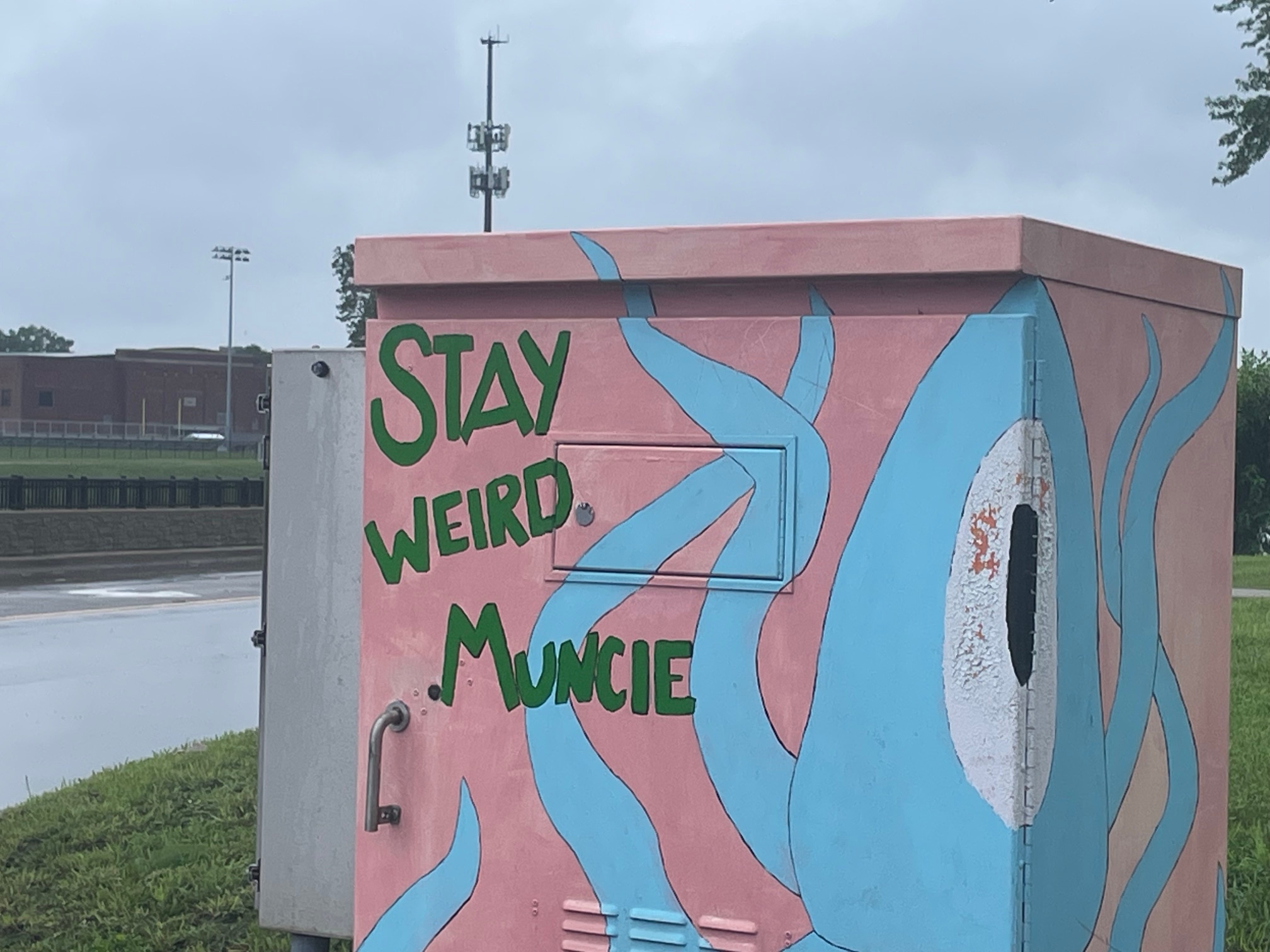
One of the consistently amusing sights around Muncie is a public art project from a few years ago that prompted artists to decorate traffic light control boxes. The art was contributed by a lot of different artists and ranged from the beautiful to the abstract to the whimsical like the “Stay Weird, Muncie,” message above. I took that picture our first day back and I’ve thought about it a lot.

I’d like to think that my hometown can be weird, interesting, welcoming, fulfilling, progressive but comforting and I like to think it can be a good hometown, either for someone who’s still living there, someone who’s just visiting or someone who’s come home again.

I’d like to think that, and maybe take comfort from that once I shake this profound melancholy I feel. But I’m not sure its possible.

Am I telling you to self-publish your novel? Well …

Okay, this post comes with SO MANY caveats.

It’s very, very early in this process.

A few random sales can prompt big movement among the lower reaches of Amazon’s sales chart. Believe me, I’ve seen this with our four true crime books, which were published by History Press.

And ultimately this won’t put a lot of money in my pocket or, if you follow this path, yours. We didn’t become writers to make money, did we?

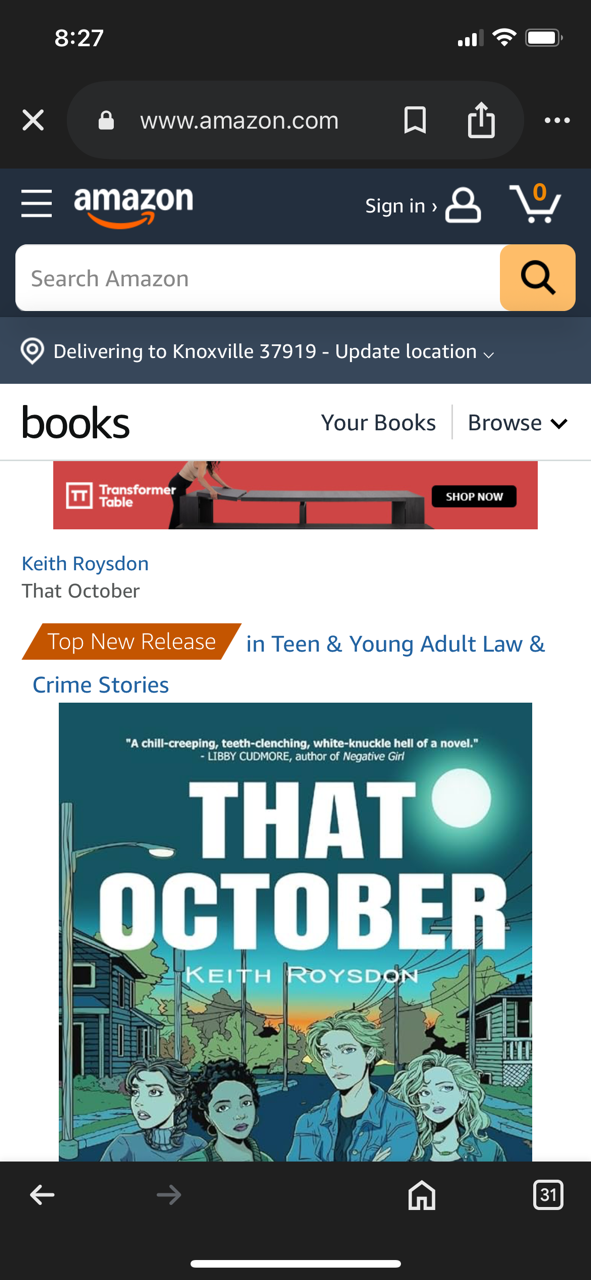
But today I checked the sites selling my novel THAT OCTOBER – Bookshop, Barnes & Noble, Powell’s Books and Amazon among them – and was surprised to see that on Amazon, the book was marked with a “#1 New Release in Teen & Young Adult Law & Crime stories” label.

On the mobile Amazon, this:

A red banner. As opposed to a Bruce Banner.

So I don’t know any more today than I did yesterday about how my book is doing or will do, before or after its June 1 publication date. (That’s five days away as I write this.)

But it looks like it hasn’t hurt to self-publish the book, in paperback, through Ingram Spark.

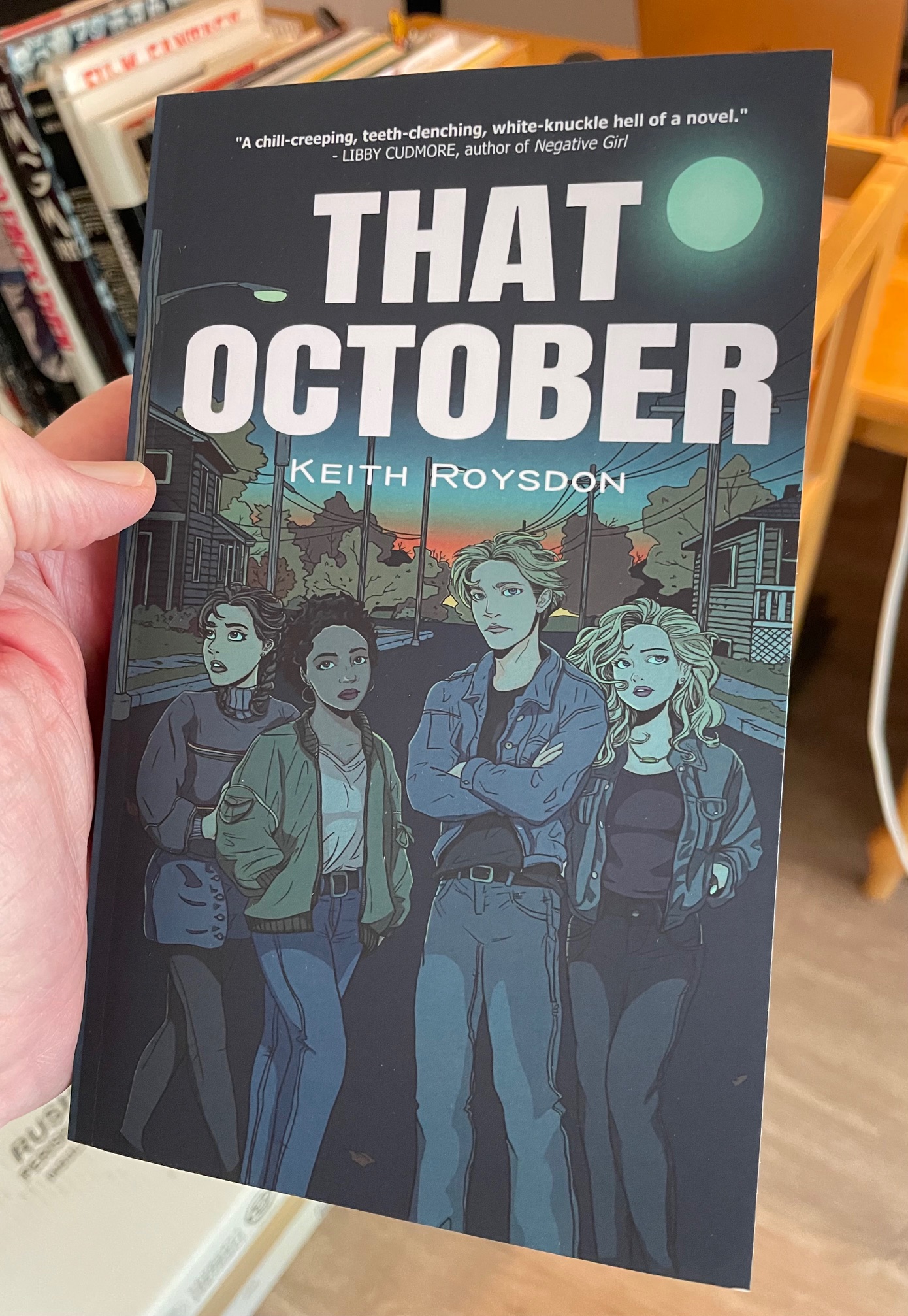
I can’t tell you what to do. Your scenario is not like mine. I’m a guy who doesn’t have years to take the traditional publishing route. I hadn’t really thought about self-publishing until last fall, when my friend and editor Jill Blocker, who had self-published one language edition of her great book WHAT WAS BEAUTIFUL AND GOOD, suggested I might want to consider it. Jill did all the heavy lifting and my friend and artist Sara McKinley created an incredible cover that has sold at least as many copies of the book as the promise of what’s between the covers.

So should you self-publish? Maybe. There’s no doubt there’s much more prestige in being published by an indie or small press, not to mention a big publishing house, compared to self-publishing. Some people will always look on self-published books as “vanity” books. That doesn’t bother me at all.

I hope you like THAT OCTOBER. I don’t expect to make much, if any, money off it. I encourage you to buy it (the ebook version is coming) or borrow it from your local library. Libraries do a lot of society’s heavy lifting, and I would be thrilled if you read it or any of my books through a library,

But I will say I’m not, not encouraging you to self-publish. This is working so far for me.

If there’s any questions I can answer, look me up on BlueSky or on my Facebook page, which is called, in a blindingly brilliant move, Keith Roysdon author.

The pleasure of finding your book for sale – especially unexpected places

I’m not sure I remember the exact details, but when my first true crime book, co-authored with my longtime writing partner Douglas Walker, came out in 2016, it was pretty thrilling to see the book for sale in bookstores, drug stores, gift shops and online.

It’s one thing to have a book out there and to sell it and sign it, but realizing our publisher, History Press, had actually gotten the first book, “Wicked Muncie,” in stores and online sites, was pretty amazing. History Press kicks all kinds of ass in getting books in stores, by the way. All four of our true crime books found a good home with them.

Another highlight was finding our books offered by libraries, which are very nearly my favorite places on the planet. A while back, I realized our third true crime book, “The Westside Park Murders,” was available through the Chicago Public Library. I’m still boggled over that.

So it’s been fun, with THAT OCTOBER, my new 1984-set high school crime novel, finding the book on all kinds of bookselling sites. I wasn’t certain if I would have to take steps to ensure this because THAT OCTOBER is self-published.

But I didn’t have to. At some point recently I was asking the folks at Ingram Spark, the venue I used to publish the book, if they could tell me when it would be available for pre-order. They responded and noted that it already was available and showed me where Amazon was selling it.

Since that time, I’ve been excited to see that not only Amazon, a site I have qualms about, but Barnes & Noble, Bookshop, Powell’s Books and Waterstones, the famous Brit seller of books, all offer it (for pre-order right now, as publication date is June 1).

So I’ve been on social media, posting links to most of those booksellers and screenshots. It was as especially exciting to see that Powell’s, a bookseller I’ve visited in Portland, Oregon, and have done business with online, offered it.

Oddest place I’ve found the book for sale so far: Saxo, where the book is available for about 259 Danish Krone.

It’s silly, I know, to be so excited about this, but I didn’t think it would ever happen.

Next I’ll be telling you how excited I am to find THAT OCTOBER for sale at Half Price Books or McKay’s.

Music and my playlist for THAT OCTOBER

I know writers – and readers – who want absolute quiet when they’re writing or reading.

For me, maybe because I spent decades working in a newsroom, with overlapping conversations, police scanners and all manner of noise competing for attention, I can usually tune out the noise when I want to. Or maybe it’s that I like some noise while I’m writing.

However it works, I like having music playing when I’m writing, especially with novels. When I was writing my first novel, SEVEN ANGELS – not yet published; maybe someday? – in 2019, I played non-stop the music of the Highwomen, the Chicks, Bonnie Raitt and other artists. It’s music I like and the main character is a strong woman, which really fit with the music. When I was writing my second novel, GHOST SHOW, in 2020, I played artists of the 1940s because the book is set in 1948. This wasn’t as conducive to writing for me. I knew the music and artists but didn’t get into the right headspace during it.

When I was writing THAT OCTOBER 2021-2023, I played music of the early 1980s non-stop for a year and a half. The story takes place mostly in October 1984, so I kept my playlist – almost exclusively youtube posts of music videos – limited to songs that predated that month and year.

I incorporated some of that music into the book, making references in some cases by having the high-school-age characters mentioning or singing or dancing to the songs. I didn’t include lyrics in the novel because it can be expensive or nearly impossible to get the rights to print lyrics.

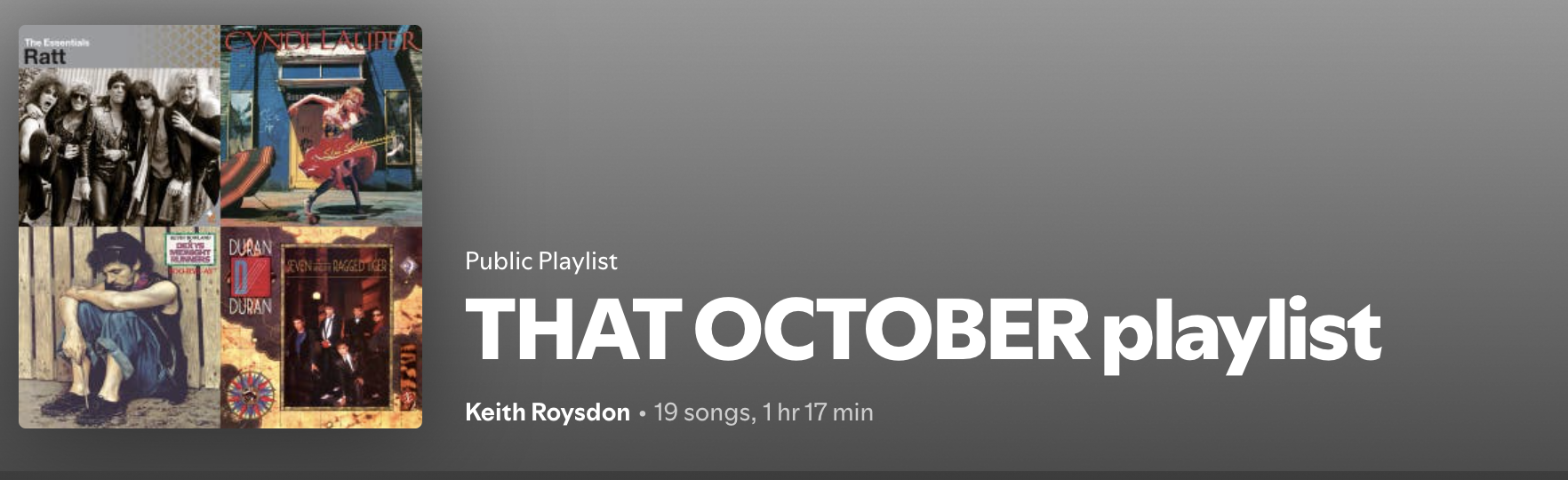
When I readied the book for publication this year, working with my friend and editor Jill Blocker, I decided to get on Spotify and make a THAT OCTOBER playlist. I used songs that I listened to during writing, songs that are cited specifically in the book and songs that just work well with the story.

Duran Duran, Ratt, Cyndi Lauper and more than a dozen others are on the playlist. I’ll probably tinker with it at some point and add some more.

THAT OCTOBER publishes June 1 and you can pre-order it now through most of the usual online booksellers. Hopefully it can be found and purchased from one of the booksellers that aren’t among the very worst on the planet.

In the meantime, here’s a link to the THAT OCTOBER playlist on Spotify. I hope you enjoy it, and the book.

Social media and selling books

You think that guy looks insufferable there, wait until a few more weeks pass. You’ll be sick to death of him.

My 1984-set crime novel THAT OCTOBER publishes June 1. It’s available now for pre-order on the usual bookselling sites, although I encourage you to purchase it through the least harmful to society one.

I hope you like the book. The authors who were kind enough to read it and give me some comments that I could blurb seemed to like it, citing the 1980s nostalgia content and the twists and turns of the plot.

Although THAT OCTOBER is self-published, there’s nothing especially straightforward about marketing a book these days. Unless you’re a huge author, you have to flog your book to potential readers. That’s usually done through social media.

There are a lot of authors who innovate in how they market their books. Some include odd tidbits they came across while researching and writing their book, and I’ll probably do some of that. Some authors post recipes true to the time period or story. Others, notably Beau Johnson, make and post creative videos to publicize their work. Beau’s videos are hilarious and effectively promote his books, including LIKE MINDED INDIVIDUALS, which continues Beau’s multi-book storyline of anti-heroes who punish the worst criminals on Earth.

Since social media is important to promoting our books, it’s especially tricky to do so in a manner that doesn’t promote some of the worst humans around, including the owners of the former twitter and Facebook and related platforms.

I don’t spend a lot of time on the former twitter anymore, mostly just to check on friends who still post there as opposed to a slightly more “clean hands” site like BlueSky. For the past week, I’ve tried to observe a week-long boycott of Facebook-related platforms, breaking that only to note a rare earthquake in East Tennessee and a Mother’s Day post about my mom, who left us nearly 20 years ago.

But I’ll continue to post on my author page on Facebook to publicize my writing. It’s not a decision I’m entirely comfortable with, but Facebook is still a place where people go, and authors are expected to have a social media presence there.

Anyway, god go with you in the next few weeks (months? years?) as you see me posting here and on social media to promote THAT OCTOBER. I hope you tolerate me and I hope you like the book.

October – actually THAT OCTOBER – arrives a month from today

I promise I won’t give you a daily countdown, but how could I resist a nice round period of time like one month?

On June 1, my 1984-set crime novel THAT OCTOBER will be available. My editor Jill Blocker and artist Sara McKinley and I have really reached the finish line in this self-publishing journey – don’t all journeys have finish lines? – and all that remains now it to get the word out.

The paperback is available for pre-order on various sites now. Before June 1, we should have the electronic version available also.

I’m doing a couple of talks back in my hometown of Muncie, Indiana – inspiration for the city of Middletown, where THAT OCTOBER takes place – in June. although I don’t expect that to be of interest to many of you unless you’re in the Muncie area or somewhere in the Midwest with a lot of time on your hands.

In the next month, I’ll tell you a little about THAT OCTOBER and the world when it takes place: A time when high school students should have been spending all their time thinking about dates, football, seeing the biggest movies – “The Terminator” was new in October 1984, and “A Nightmare on Elm Street” would come out within a couple of weeks – MTV and Halloween.

Instead, the six high school friends in THAT OCTOBER are thinking about the murder of one of their classmates and the taking of another.

And they don’t understand why the adults in town seem unconcerned or, at best, evasive when the friends urge them to DO SOMETHING to solve their friend David’s murder and bring Lee Ann home.

Jackie and Michael, new siblings in a blended family, and their friends Sammi, Toni, Elmer and William push forward with their own investigation, which follows a trail rooted half-way around the world, in a time before any of them were born.

I’ll share a bit more as we move forward. I hope you come along for the ride.

‘Jesus Land,’ a poignant memoir from a friend and fellow Hoosier, headed for the big screen

The bright young faces in this photo belong to David and Julia.

The bright young faces in this photo are of Julia and David as portrayed by Ella Anderson and Xavier Jones.

My friend Julia Scheeres’ 2005 memoir, “Jesus Land,” is being made into a movie. If it’s anything like Julia’s book, the movie – directed by Saila Kariat – will be poignant and harrowing and heartfelt and, yes, controversial. Julia’s memoir is routinely banned because she tells the truth about the fundamentalist Christian life.

I’ll give you the shorthand version of why we should all care about “Jesus Land,” and why you should read Julia’s book and see the movie when it comes out. First, a little background.

Julia and I grew up in Indiana at about the same time. In the 1980s. I lived in Muncie and she lived in the Lafayette area. Her parents were abusive religious fundamentalists – my family was Baptist but never abusive when I was growing up. Julia’s parents ended up sending Julia and David to the Dominican Republic to a teen concentration camp run by an Indiana church.

I didn’t know Julia until about 20 years ago, when she contacted me from her home in California to ask if that church was undergoing a rebirth in Indiana.

I spoke with Julia and other survivors of the church gulag and, along with a small group of reporters and editors, wrote extensively about their experiences and the modern-day church and whether it was still sending, at parents’ expense, kids out of the country to hellholes, where they were abused and made to work.

I disappointed Julia back then because my editor at the time was so afraid of upsetting the church and the local chamber of commerce that they gutted our stories.

Julia’s “Jesus Land” had come out the year before, and it told the story better than we could have anyway.

Julia and I became friends – we never met but kept up to date on each other’s families and kids on Facebook – and I wrote about “Jesus Land” again in 2021, when I interviewed Julia for an article about fundamentalist groups that were pressuring Indiana schools to ban the book. It’s something that Julia has grown accustomed to: “Jesus Land” is among books regularly banned because it dares to tell the truth about the religion-based “troubled teen industry,” and how there’s money to be made by pseudo-religious organizations that incarcerate “troubled” young people.

The two of us also spoke while I was working on, shortly after that time, another story about money flowing to the troubled teen industry in Indiana. Julia encouraged me to pursue the story and read drafts of it, which I worked on on a freelance basis for more than a year. Ultimately, the cowardly editors of a major newspaper spiked my story but kept all my research – legal documents, video depositions, reports – and, a year later, did their own story. It remains a very bitter end to my newspaper career.

I’ve moved on from those disappointments to other forms of writing, and Julia has moved on in spectacular fashion: She’s written and published two more books, and now “Jesus Land” will move from the realm of New York Times bestseller to big-screen film.

Julia and David’s story, so movingly told in “Jesus Land,” will find a whole new audience.

Julia, always gracious and kind, was the first person I thought of when I thought of writers who could read my new 1984-set crime novel THAT OCTOBER. I hoped she would appreciate its story of Indiana teenagers grappling with injustice and forces beyond their control. Her comments about the book are prominently displayed on the back cover.

Thank you, Julia. I’m so happy for the movie version of your book.