
Tag Archives: newspaper industry

It’s time for another edition of FORGOTTEN TALES OF THE NEWSPAPER BUSINESS … business … business (that’s supposed to be an echo effect)

The best quality of the internet is that anybody with malicious intent can pretend to be somebody else, I think we’d all agree, right? (Sarcasm mode turned up to 11 here.)

So what if I told you that in the late 1970s and early 1980s, I was involved in a stone-age version of what would later become the internet’s bestest feature: someone sounding off with their views ESPECIALLY under an assumed name?

A little background first: I’ve related on here before that I began writing for the Muncie Evening Press newspaper when I was still in high school. I was originally the “teen” columnist. When I graduated from high school and began college, the newspaper editors found other things for me to freelance for them. That started out as movie reviews but later grew to include live performance reviews, record album reviews and news, entertainment-related interviews, a little bit of everything.

I was young and they paid me maybe $10 or $15 per piece, so there wasn’t much I wouldn’t write for them.

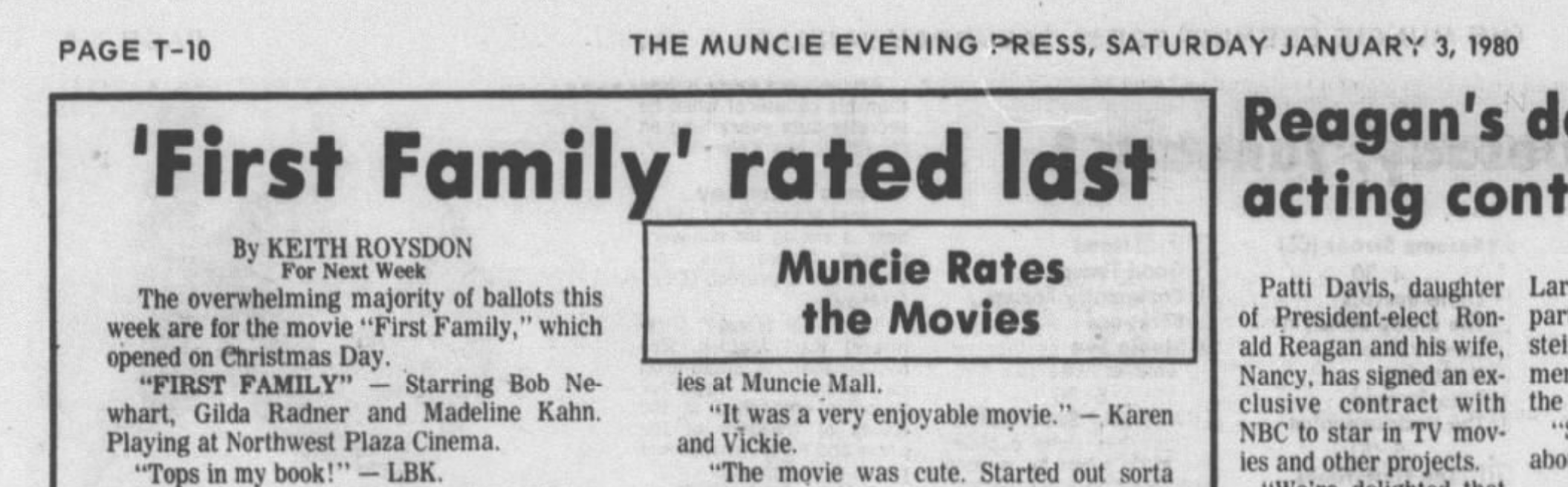
In April 1978, in the early days of my freelancing for them and independently of me, the newspaper editors started a weekly column called “Muncie Rates the Movies,” in which moviegoers could sound off on what they thought of movies playing at Muncie’s four (I believe) movie theaters.

How did they sound off? The newspaper placed a “Muncie Rates the Movies” ballot box at the concession stand at each theater. Some newspaper staffer had to go around to each theater once a week and open the ballot boxes and collect the ballots/movie opinions that had been deposited over the previous week. (A pad of ballots was located next to each box so people could come out of the theater and fill one out.)

A lot of the opinions were pretty simple – “That Sally Field is beautiful” – and some were more complex and included some thoughtful reviews – or at least as thoughtful as could be written in pencil in the blanks on a ballot.

Around March 1979, the editors assigned me to oversee the “Muncie Rates the Movies” column. I became the person who went from theater to theater each week to pick up ballots, then sort through them and write a column based on the thoughts of local moviegoers. (An editor, although I don’t remember who, had done this for the first year and wrote the column under the pen name “Harley Wood.”)

This early example of crowdsourcing was usually pretty easy. I had my choice of dozens of ballots each week and knew which ones not to quote in the column. (Opinions that included vulgar language, of course, but also obviously ballots that were not germane, like rants about Dwight Eisenhower – no I don’t remember any about Eisenhower, the former president; but. you get the idea.)

The best intentions of the editors who created “Muncie Rates the Movies” ultimately came crashing down around the head of your humble narrator.

In February 1981, one of the movies that moviegoers reviewed via our ballot boxes was “Altered States,” director Ken Russell’s earnest and odd science fiction film that might have been the trippiest film since “2001.”

One of the reviews that week (and published but not under my byline) noted about “Altered States,” “Convinced me of Biblical falseness and scientific truth regarding evolution.”

And that comment was signed by a person – no, even nearly a half-century later, I’m not going to cite him by name – who was director of secondary education for the city school system.

And, to add insult to injury, this man also taught a Bible literature class.

The correction that ran four days after what turned out to be the final “Muncie Rates the Movies” column was short and to the point and noted that the respected educator on matters Biblical had not seen the movie and didn’t express an opinion of it. The newspaper went on to express regret for any embarrassment that might have arisen from the column.

The column was discontinued – as a freelancer in my early 20s I was not part of that discussion – and hopefully the educator got over it.

And to the prankster who submitted the phony review: I’d like you to know that you cost me 10 or 15 bucks a week for who knows how many more months?

You’ve somehow stumbled upon the latest of more than 1,100 posts on keithroysdon dot com, stretching back to the early 2010s. Books, writing, movies, TV, obscure pop culture, Halloween, snark and more snark. I’m the author of crime novels THAT OCTOBER and SEVEN ANGELS, co-author of four true crime books including the award-winning THE WESTSIDE PARK MURDERS and hundreds of short stories, news articles and pop culture pieces in spots like CrimeReads, Daily Yonder and elsewhere. You can contact me by leaving a message anywhere on this site or by hollering at me on one of my too many social media outposts.
Confessions of a former newspaper obituary editor

I subscribe to two newspapers – three if you count the Washington Post, which I haven’t looked at in a few years – so I can’t tell you the state of the art for various newspaper departments, especially in print. I rarely see the print editions of any newspapers.

I certainly can’t tell you what newspaper obituary sections look like these days. I’d imagine they’re a lot less extensive than they were in the mid-1980s, when I was a young newspaper reporter who, among other things, covered news events, wrote feature stories, wrote about entertainment and, for a couple of years, was the obituary editor of The Muncie Evening Press.

(My thoughts revert to the business of newspaper obituaries today because of a new practice originated by the Baltimore Beat newspaper, which is offering bargain-priced obituaries at prices as low as $5 for a simple online death notice. Link at the bottom of this post.)

Back in the day, newspapers would on some days be inundated with obits. We’d get a dozen or a couple of dozen – you couldn’t plan for those numbers, of course, even if you asked local funeral homes how many obits we could expect from them, because in some cases surviving family members would show up abruptly at the funeral home to make arrangements – and a sudden increase in quantity would mean we’d have to jump the obit page to another page, where it would sometimes crowd out news stories. Sometimes it would jump more than one page. Too many obits was chaos. Frankly, obits were considered chaos by some of us. There was a considerable amount of pressure involved with obituaries, especially for an afternoon paper that published just after noon. We’d rush like madmen all morning to get a newspaper put together, including the obits.

At the time, newspapers did not get paid for obituaries. That changed maybe 10 or 15 years ago, when newspaper advertising departments, rather than newsrooms, started handling obits and funeral homes, which had almost certainly always passed along the “cost” of a newspaper obituary to survivors, made an obit a line item in the total funeral bill.

But back then, newspapers didn’t charge for obits and considered it a public service. As such, obits were considered news articles and were subject to editing for accuracy. For instance, if someone’s obit claimed the deceased person had been president of the United States and they had not actually been POTUS, we’d cut that reference.

During the couple of years I was obit editor, that task fell to me, a 20-something who’d rather have been writing important or at least entertaining newspaper stories. That’s why they paid me the big bucks: A few years ago I saw a record of my Social Security-eligible earnings over the decades and it indicated that one of those first couple of years when I was doing obits I was paid about $14,000 in annual pay. Google tells me that would be a salary of about $45,000 today, but it was enough money even then to persuade me to shut up and do the job.

My couple of years editing obits were made much worse than they might have been by the top executive at the local newspaper, who was a horrible bully. He did have knowledge of the local community and issued style sheets listing the correct names of local factories. Without those, I would never have known the correct name of the local business we all referred to as Frank’s Foundry was The Frank Foundry. But for all the usefulness of his knowledge and his style sheets, we all had to put up with someone who was horribly abusive to the staff, including the top editors.

I still vividly remember how much we all dreaded the time around 1 p.m. each day, when our afternoon newspaper was published and all of us – who had seen proofs of pages but it was hard to catch every error – waited for this top executive, up in his office, to look through the fresh newspaper, find an error and call down to the newsroom and rage about how stupid and incompetent we all were. (That’s not an exaggeration.) I’ll never forget one day when he found a typo in a story – not one of my obits, luckily, that day – and made each of three editors get on the phone with him and correctly spell some common word that had been misspelled in a typo. Like “please” or “elephant” or something.

Being obit editor was not fun and I was happy when, within a few years, I was given an actual beat, county government, to cover. Writing about elected officials who lied and wasted our tax dollars was less stressful than editing obits.

Doing obits for a couple of years was a genuine education in humanity and human behavior. Nothing – nothing – brings out the worst traits in people as readily as the death of a family member. This was most obvious when a family that had been torn apart by some feud or falling out was then hit by the death of a parent or adult child. The family members who were making funeral arrangements – and paying the funeral home for them – would simply leave out an estranged family member. All of a sudden, the family had only two children, as the black sheep offspring was forgotten.

At the time, when obits were considered news stories and not paid advertisements, I hated this. It meant that the obit was not an accurate historical record because children or estranged parents were omitted. But we couldn’t accept the word of a person who called and said, “Hey, I was left out of my mom’s obituary.” What if the call had been a hoax? We had to refer them to the funeral home that supplied the information and tell them that if the funeral home verified them to us, we’d run the obituary again.

Dealing with the funeral homes was usually fine but sometimes odd. The funeral directors were usually under enormous pressure from the families – especially in times of split families – and they didn’t always treat obit editors very well.

On the flip side, the funeral homes were, like a lot of businesses, in the holiday practice of distributing gifts. More than a few times, I was the recipient of a bottle of whiskey (I’d usually pass it along to an editor at the newspaper since beer and vodka were my poison).

The former obit editors at the paper would laughingly recall the year that one funeral home gifted the newspaper – and presumably others in the community – with something other than booze: a jar of pickles.

Given the preserving/embalming nature of the funeral business, the gifts of pickles were mostly regifted to people who didn’t know they came from a mortuary, I’m told.

Here’s the link to the Baltimore Beat story about bargain-basement obits: