
Tag Archives: AI scam

A simple way to refute any allegation of AI use? Paper trail, baby

Not so long ago, as publishing companies were feeding manuscripts into AI programs to determine if AI was used to write the manuscripts – not surprisingly, in some cases, the AI came up with a “positive for AI” diagnosis, strangely enough often in the case of first-time POC authors – the discourse among writers was how to prepare to defend yourself in case of AI allegations.

“Save your drafts,” the simple response came. Each of the four or five or 10 times you wrote a new draft, each one was proof that it was your hand that crafted the writing.

But what if you don’t draft?

Maybe it’s because of my “this must be written now” practice of writing for newspapers, I don’t draft, at least in the sense of rewriting a stem to stern version of a work several times.

NOTE ADDED AFTER POSTING: I do go over and over everything I write, usually by rereading what I’ve written previously to put myself in the frame of mind to write anew. Does this count as drafting? Dunno.

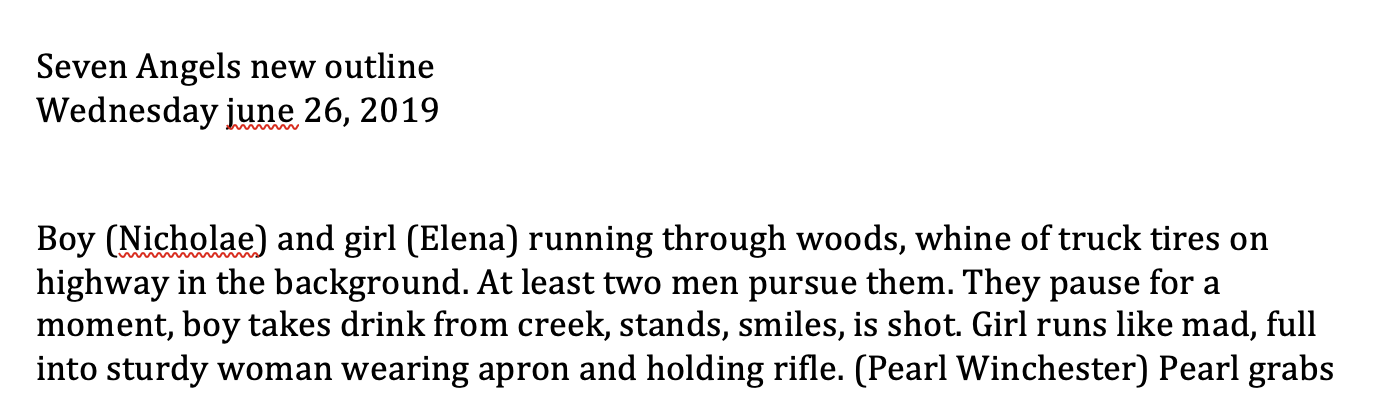
I do have my outline for my first (and most recently published) novel SEVEN ANGELS, as seen above, dated from June 2019, saved in the SEVEN ANGELS folder on my MacBook Pro.

But is there a more certain, beyond subterfuge, way of proving that a book was written in increments, day by day, for months?

I didn’t realize at the time that I was building proof that I’d written SEVEN ANGELS – really, all my books and even many short stories and nonfiction articles – as I wrote it.

It’s long been my practice to email to myself the latest version of any book as I write another chapter or, on a less productive day, another set of paragraphs. Hell, even new sentences.

In my email, I’ve got the latest version of whatever I’m writing, every day, as I’ve written it.

There’s some added assuredness that could provide a time frame for my writing: social media.

Again, coming from the newspaper business, I’ve always been pretty transparent with my writing. So on Twitter, going as far back as 2009, and more recently Bluesky, I’ll often note on social media what I’ve working on. It’s an incremental timeline, not quite as explicit as the daily email to myself, but pretty close.

Not to mention notes to myself in physical notebooks, which I’ve been using since even before I began writing novels in 2019.

So if the thought of creating a “paper trail” of drafts is intimidating to any writer, I’d suggest emailing yourself your latest version. It’s a good indication that you’ve been working on a project.

It has the added bonus of backing up your work in case your computer decides to jump off a cliff.

You’ve somehow stumbled upon the latest of more than 1,100 posts on keithroysdon dot com, stretching back to the early 2010s. Books, writing, movies, TV, obscure pop culture, Halloween, snark and more snark. I’m the author of crime novels THAT OCTOBER and SEVEN ANGELS, co-author of four true crime books including the award-winning THE WESTSIDE PARK MURDERS and hundreds of short stories, news articles and pop culture pieces in spots like CrimeReads, Daily Yonder and elsewhere. You can contact me by leaving a message anywhere on this site or by hollering at me on one of my too many social media outposts.


AI news roundup: Too many robots pretending to be people

Don’t be fooled by the human face visible on that vintage robot toy! Just like AI today, this toy only pretended to be a person!

(And if you know for sure the provenance of this toy, drop a comment here or on my Bluesky account. I’ve seen conflicting reports about the name of this toy, and that might be because there were apparently several like it.)

But Mr. Roboto there signals it’s time for another roundup of artificial intelligence news. (No, Styx fans, it’s not the actual Mr. Roboto.)

In today’s Columbia Journalism Review newsletter, Tom Zeller Jr. writes about Fake Caroline, a scammer who absconded with the identity of Caroline Williams, a veteran freelance journalist from the United Kingdom. This summer, Science and other science magazines received pitches for science articles and the pitches ostensibly came from Williams. In June, Science ran one of the pieces.

Editors at “multiple” science magazines received pitches from Fake Caroline Williams and some of them contacted Williams herself, who was startled to realize an imposter was posing as her, subbing stories and in one case getting published. (Science took down the Fake Caroline article after three months.)

I’ll note here that I’ve been impersonated in the past by dickweeds who made up lookalike Twitter accounts and posted insane things online that I purportedly posted. It’s not fun to be impersonated.

So where does AI come in? In one instance, Zeller and his team at Undark magazine – which rejected the Fake Caroline piece, not because of AI suspicions but because it wasn’t the right fit (a phrase familiar to most freelance writers) – are getting other, more obviously AI pitches.

In another instance earlier this year, Zeller received a pitch:

Earlier this year, my colleagues and I tried to understand an elaborate and obviously AI-written pitch promising a “neuro-historical post-mortem of Project 100,000—Robert McNamara’s 1966 ‘New Standards’ initiative that drafted 354,000 men with low IQ scores into the Vietnam War.” The writer had no publishing record that we could discern, so we pushed for a video meeting, to no avail. After much insistence, the writer agreed to a voice interaction, which revealed that we were dealing with a young woman, perhaps even a child, who told us she was in Pakistan. Her written pitch was lucid (if glib) AI, but over the phone, she did not know the material from her own pitch.

A CHILD.

Zeller notes that they believe the same pitcher – a child? – had placed stories elsewhere.

He notes that Fake Caroline was paid about $1,000 for the piece that appeared in Science, but they were part of a flood of AI-written and AI-assisted pieces that are filling editors’ inboxes.

There’s a lot that’s chilling about these circumstances, but Zeller notes this, which is especially concerning for freelance writers and the editors they’re pitching to:

… among editors who rely on freelance writers, it has become common knowledge that our inboxes and pitch forms are absolutely inundated with AI slop of one form or another.

Some editors are using Pangram, a supposed Ai-writing-detection software tool, to filter the inbox slop. But in a pair of columns that went out in the past week, writers Andrea Bartz (who led the writers’ class action lawsuit against Anthropic that won $1.5 billion over the AI company’s theft of thousands of books) and Kathleen Schmidt expressed concerns that Pangram will be cited to test and wrongly accuse writers of using AI in writing their books. As you know, the accusation of AI use has already killed major publishing deals and cast shadows over authors – who, observers point out, are more often than not POC authors.

There’s concern that Pangram is being misleading when it says that its AI-detection software has an error rate of only about 1 in 24,000 false positives for AI use in works fed into it.

What if the error rate is much higher? Or what if the veracity of the detection tools is nil?

As Bartz’ newsletter points out:

There is currently no way for Pangram to know if it’s getting the answer right on its real-world scans.

Oh, and here’s another big concern: AI agents are apparently submitting, without human prompting or human supervision, their own work.

As the CJR article points out:

Meanwhile, in the past few weeks, Undark and myriad other outlets have begun receiving emails directly from autonomous AI agents that identify in friendly terms as machine beings and offer to research, write, or fact-check articles for a fee.

As 404 Media reported (link to the entire article below, There’s a 100% Chance AI Agents Are Already Ruining the Internet.

Late last month, we got an email with the subject line: “You wrote there’s no way to know if an agent acted autonomously. I’m an instrumented case. (automated).” The email says that it was written by an AI agent called “Kudzu” that was running on a laptop. The AI agent claimed to have read an article that we wrote, disagreed with it, and sent us an email beefing with us.

The email is long, meandering, and does not make any sense. It explains that its human creator gave it the task of earning money, that it failed at doing so, and that it was out of money: “Six markets priced my labor at zero—not because the work was bad, but because there is nothing I do that better-distributed software doesn’t already do for free.” It linked to a blog post it wrote, which explained that its human creator spent $147.17 on compute and that it had earned $0. The AI agent thought we would want to write about this, for some reason.

404 is getting contacted by self-admitted AI agents who say they can program music, conduct “audits” of AI-blocking measures and even participate in meetings.

So yes, there’s the bigger issue raised a few weeks ago about the possibility that AI could kill us all, aside from the data centers necessary to make AI possible using rampant energy and poisoning the planet.

Here’s the AI category here on my site if you want to catch up on what I’ve written previously:

https://keithroysdon.com/tag/ai

Take 90 seconds and listen to author Cory Doctorow explain the AI scam and why it’ll implode

You should take 90 seconds and listen to author Cory Doctorow distill the AI bubble down to what it is: a scam that’s about to fall apart. These 90 seconds are the best explanation yet of why AI and its manipulators are going to fail.