Tag Archives: books

If you write, you’re a writer … and maybe you could use a boost

It’s been observed by smarter people than me that writing can be a daunting profession and avocation because of the isolation inherent in sitting at a desk all day, typing on your laptop or making notes in your journal.

It can be a challenge, and I’m not talking about writer’s block, although there is that, too.

The bigger challenge can be the feeling of working in a vacuum, the feeling that you’re writing and writing and rewriting and aren’t sure if you’re getting where you want to be with your story, your article or your book.

I’m known to say, “If you write, you’re a writer.” It doesn’t matter if you’ve been published or not, if you’ve had short stories or books published, to great acclaim or total *cricket noise.*

Cause I believe if you’re writing, or making notes, or thinking about writing and sending yourself ideas in texts and emails … well, you’re writing.

Sometimes you need a boost. I know I do. I’m lucky to have writer friends who read my stuff, from flash fiction to novels, and tell me what they think. I’m lucky to provide the same kind of support for my writer friends.

So a small group of us are now offering a boost to writers, no matter what stage they’re in.

I joined up with Constellate Creatives a while back and just the other day announced my affiliation with CC, which is owned and overseen by longtime friends of mine who are writers but also know other aspects of the writing life, from editing (developmental and copy editing) to publishing to marketing and everything in between.

Our goal is to help writers.

There’s a contact button on the Constellate Creatives site that I’m linking to below.

And I’ll tell you more in the weeks and months ahead.

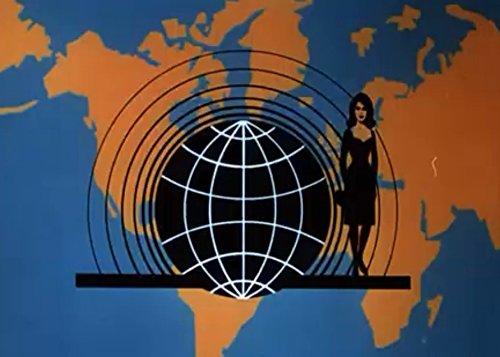
The image above isn’t the Constellate Creatives logo. It’s an image from the 1960s spy TV series “The Girl from UNCLE.” But it’s a pretty nifty bit of art and sort of communicates the international foundation of Constellate.

More info:

https://constellatecreatives.com/

My world and welcome to it: Seven Angels and Middletown, my fictional places

When my short story “A Fighting Life” was published in the past couple of weeks in the FIGHTING WORDS anthology, it contained the latest reference to the fiction worlds I operate in.

Since I wrote four or five novels back in the early 2000s – books that’ll probably never be seen, unless radically rewritten with what I’ve learned about writing in the meantime – I’ve enjoyed writing in a universe where, despite some timey-wimey variations, most of my characters and storylines play out in a shared world mostly consisting of the small city of Middletown, Indiana – based on my hometown of Muncie, Indiana, which was referred to in 20th century sociological studies as Middletown – and Seven Angels, a Tennessee town based on Jamestown, the small town my parents came from.

The early 2000s books featured Jack Richmond, a Middletown newspaper reporter, and a group of friends including Jess Peterson, an affable cop on the Middletown police force. There are lots of other characters too, including Luna, a topless dancer Jack falls in love with. By the end of the series of books, the two are married and have a son, Cody, and the final, still-to-be-completed book features Jack and Peterson’s desperate efforts to get Cody back after Luna’s ex brutally assaults her and kidnaps the boy.

When I wrote SEVEN ANGELS in 2019, my first crack at writing a novel in 15 years or more, I set it in the titular small Tennessee town with a side trip to Middletown and a pivotal appearance by Peterson.

My next novel, the also unpubished GHOST SHOW, is set in Middletown, but in 1948 and follows the Anderson family, who came to the big industrial town from the small Tennessee town of Seven Angels. No crossover characters, though.

My third novel, THAT OCTOBER, which was just published in June 2025, is set in 1984 Middletown and includes, among secondary characters, Richmond and Peterson at the beginning of their newspaper and police careers, respectively.

I won’t detail it all here, but I’ve returned to the Middletown and Seven Angels wells numerous times in short stories. The foul-mouthed, fightin’ siblings in “A Fighting Life” are pulled from GHOST SHOW. My very first published short story, “Independence” from the MOTEL anthology, is set in little Seven Angels, complete with the sheriff/main bad guy from the SEVEN ANGELS novel.

The seeding of characters from my earlier stories – like Butcher Crabtree, who I posted about here recently – throughout my fiction just goes on and on.

And so do I. To quote one of my (hopefully) self-deprecating quotes, “Enough about me. What do you think of me?”

The kids are alright – and interested in cold cases

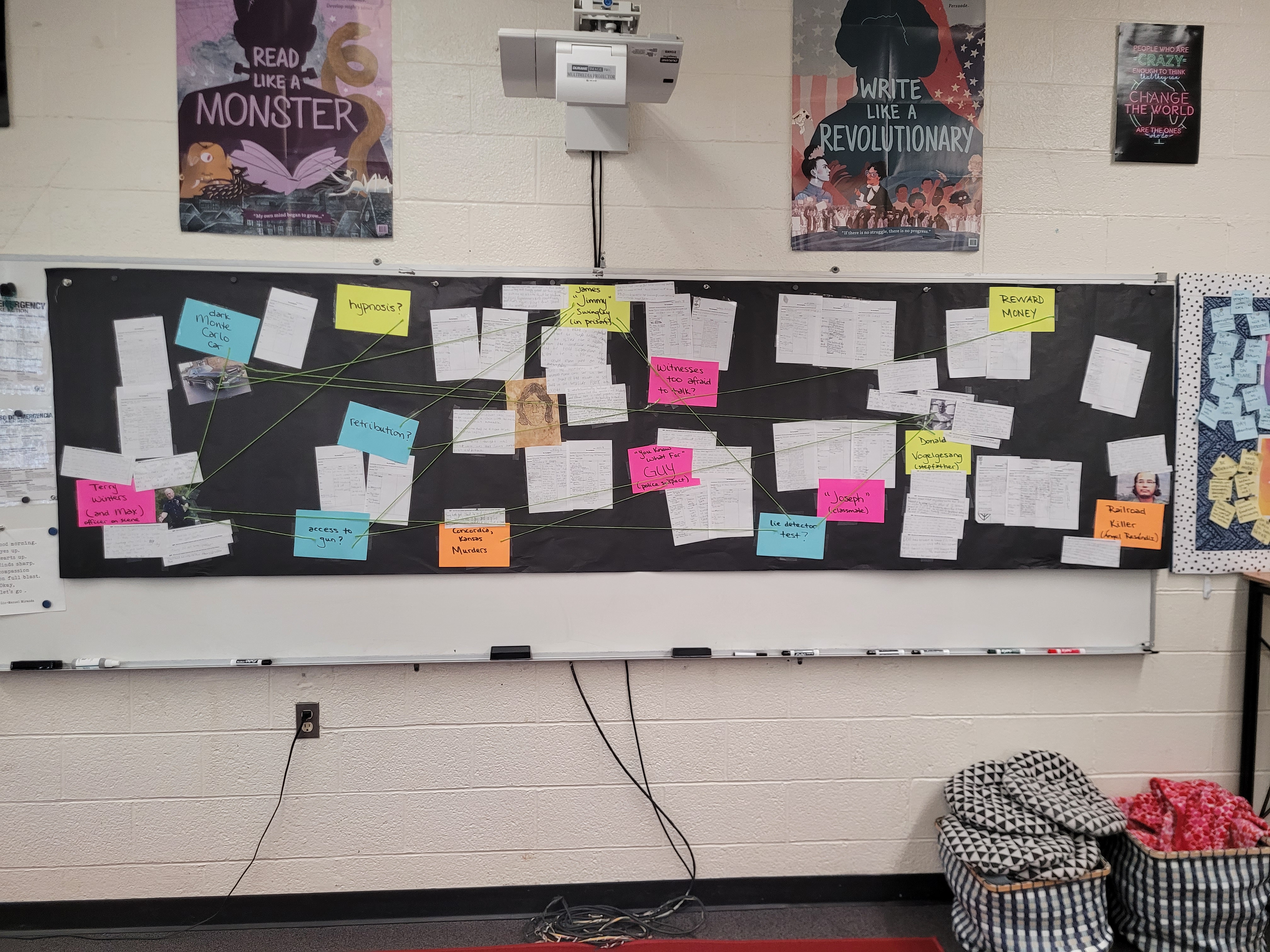
That’s a murder board. You’ve probably seen them in movies and TV shows. You might have made one yourself.

But have you ever seen a murder board, based on two real-life unsolved murders, put together by 13-and-14-year-olds? I didn’t think so.

Earlier this week I spoke to teacher Megan Byard’s middle-school class at Inspire Academy in Muncie, Indiana, my hometown. Ms. Byard had approached me and Douglas Walker, my longtime writing partner at Muncie newspapers and in four true crime books, including “The Westside Park Murders: Muncie’s Most Notorious Cold Case,” published by History Press in 2021, about talking to the class about Westside.

In September 1985, teenagers Ethan Dixon and Kimberly Dowell were shot to death in Muncie’s Westside Park. No one was ever charged with the crime, although police have had a person of interest for a few years now. In our book, we name that person, who is in prison following a conviction for a separate murder years after the Westside slayings. We explain the line of reasoning that prompted police to suspect him. We reached out to him in prison to ask about the case against him. He did not respond to written questions and a self-addressed, stamped envelope. In addition to naming him, our book explores many other theories and suspects connected to the case.

Since it came out, our book has received a lot of attention. Popular podcasts have been based on our book and the crime. On Amazon, the book has 163 ratings for 4 out of 5 stars. It prompted a Peabody-winning producer of non-fiction television to contact us about turning it – and some of our other writing – into a multi-part true crime series, but no networks or channels took the producer up on the pitch.

Of all the attention that our book has received, I think one of the coolest and most interesting was from Ms. Byard’s class. The students, who are interested in journalism and writing and true crime, studied the book and the crime in advance of having me do an online talk for their class. They asked good questions.

I think I was most impressed with the murder board, though. Made me feel like I was working in a police precinct, hoping for a breakthrough.

And I guess all of us are still waiting for a breakthrough.

Thanks to Ms. Byard and her class at Inspire Academy. Your interest and care made my week.

Here’s a link to the book on Amazon, although you can find it anywhere, including many libraries, including the Chicago Public Library.

The most famous shirt at Bouchercon

At some point I’ll write a little bit about Bouchercon, held last week (as of this writing) in New Orleans. Many of you know this is the annual worldwide convention/conference of crime writers and readers. This was my second Bouchercon and they’re a lot of fun because they’re a chance for writers like me and many much more accomplished to meet with other writers and readers.

I’ll write more about Bouchercon in the coming days, or I intend to, but a quick anecdote:

On Saturday, I was one of the authors at the debut authors’ breakfast at Bouchercon. The annual event was sponsored by Lee (“Reacher”) Child and his brother Andrew, who now writers most of the Reacher books. Another sponsor is Michael Connelly, creator of Harry Bosch and Renee Ballard and other great crime fiction characters.

Connelly also kindly hosted the breakfast.

At some point I’ll tell you how I had a quick breakfast with Connelly, but today I’ll talk about the shirt you see me wearing in the photo above.

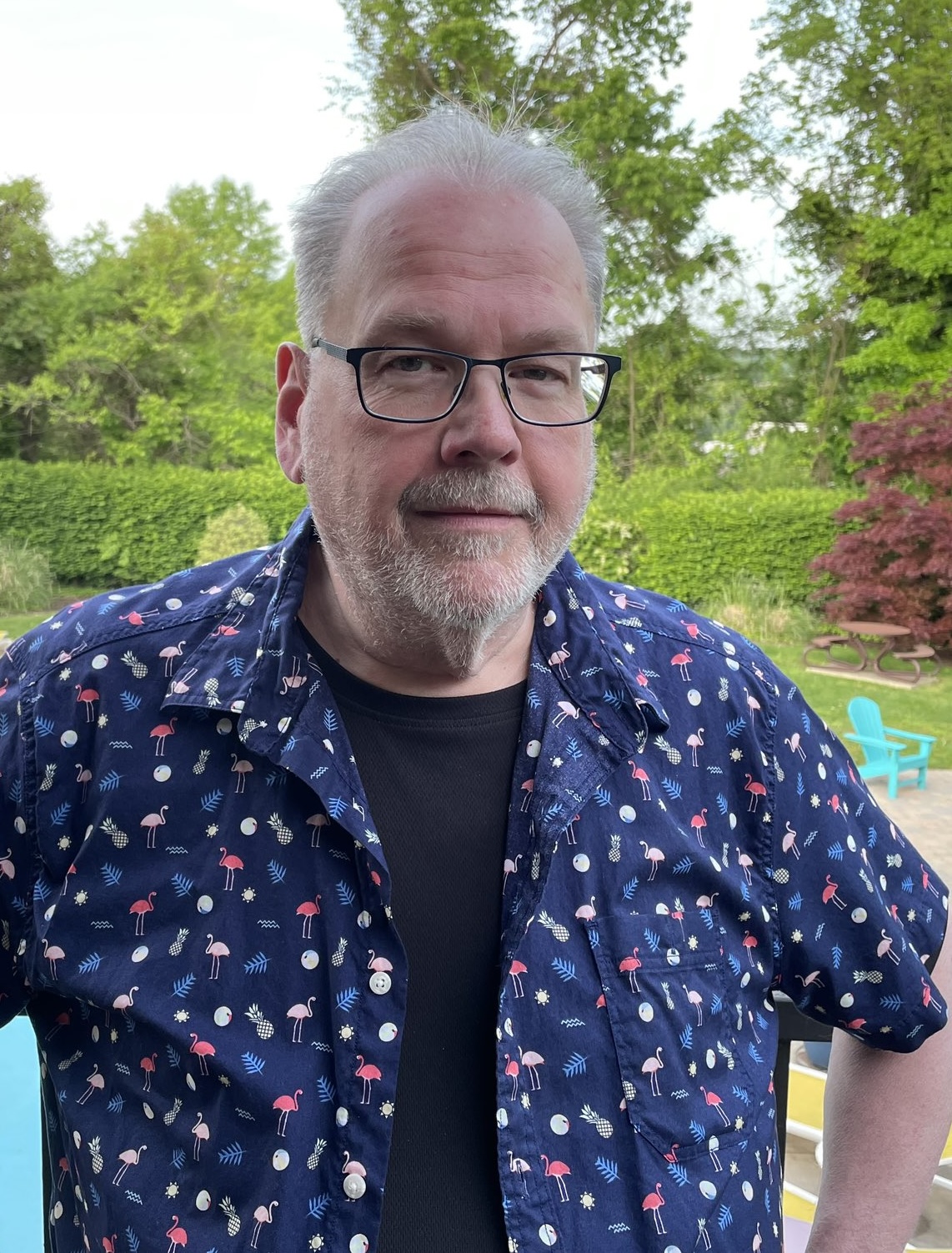
In the photo, I’m wearing a colorful shirt with pink flamingoes and other images and it’s pretty memorable. This was the photo of me that I submitted weeks or months ago for them to use in the program book for the breakfast.

This was also the shirt I managed to wear that day to the breakfast.

I realized this only after I’m sitting at the table and about to be introduced by Connelly to speak for one minute about myself and my book, THAT OCTOBER.

So, in the interest of transparency, I opened my one minute of remarks by noting the coincidence.

“If you notice, in the our program book, I’m wearing a particular shirt and I’m wearing it today as well.

“You could assume from that that I apparently have a favorite shirt.”

I went on to talk about my book briefly but the line about my favorite shirt got a good laugh.

And I had people come up to me afterward and later in the day remarking, “Your favorite shirt!”

And it apparently is.

It’s an e-book kind of day!

It’s Labor Day and the beginning of fall – don’t argue – and the beginning of Spooky Season – that cannot be argued with – and it’s e-book day here on the ranch.

Just a quick note that THAT OCTOBER, my 1984-set high school crime novel, is available for quick and easy download beginning today on Kindle.

Here’s the link:

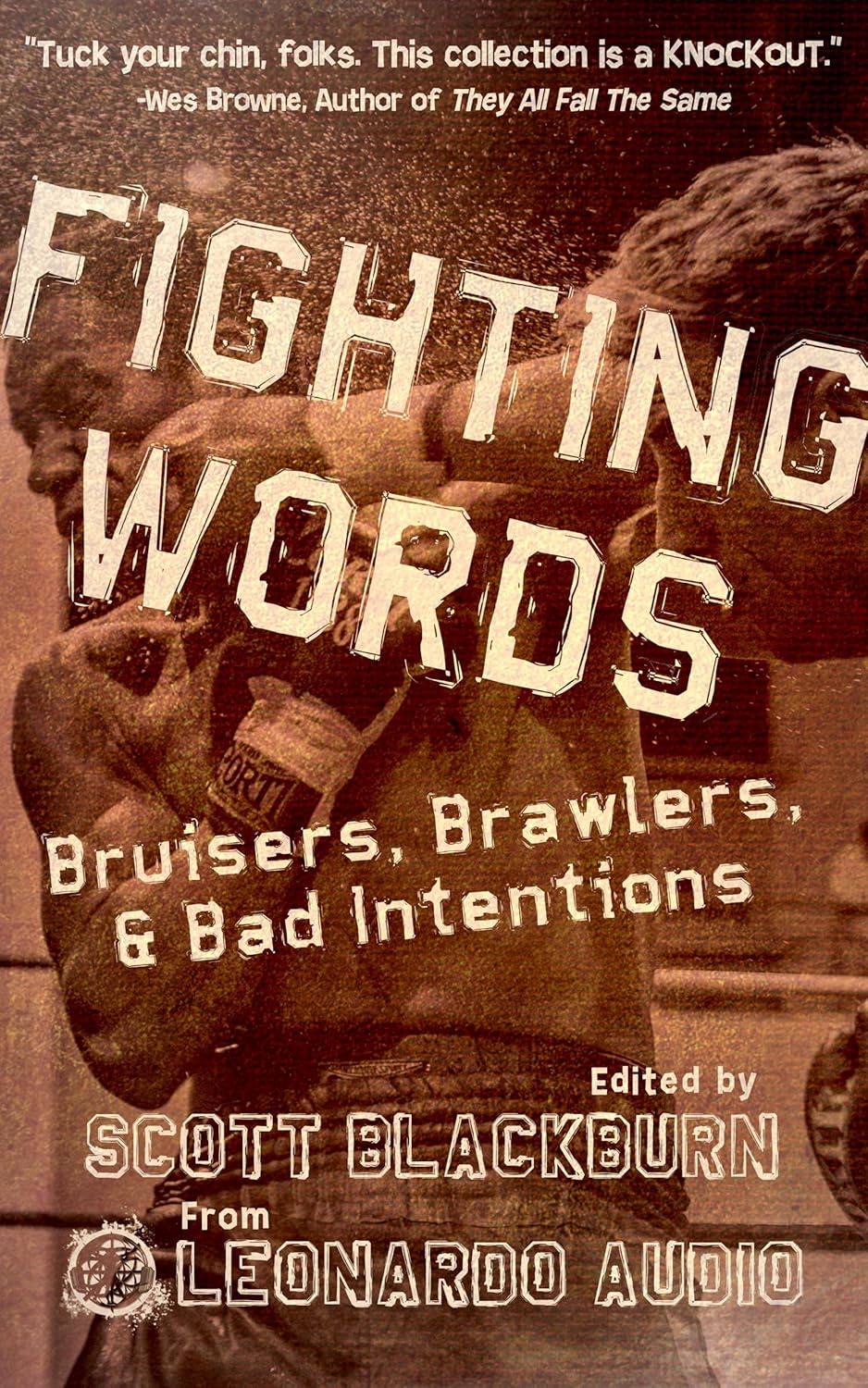
Also today, FIGHTING WORDS: BRUISERS, BRAWLERS AND & BAD INTENTIONS is out on Kindle.

The anthology, put together by writer and editor Scott Blackburn, features stories about fighting, fracases, brawlers, pugs and the sweet science, especially when it’s not so sweet.

My story, “A Fighting Life,” begins in 1948 and follows three young siblings – Marie, Peter and Saul – as they discover there’s money to be made, a nickel at a time, taking on other neighborhood kids in bare-knuckle challenges in vacant lots and abandoned buildings.

But besides my story, there are nine other great stories from some of the hottest authors today, including:

Saint Bullethead by Nick Kolakowski, narrated by Chris Andrew Ciulla

Where the River Breaks by L.S. Goozdich, narrated by Victor Clarke

Pure Wrath by A.M. Adair, narrated by Linda Jones

Fight Club by David Moloney, narrated by Chris Andrew Ciulla

Conor McGregor Was a Friend of Mine by J.B. Stevens, narrated by Michael Orenstein

Call Me Mina by Laura Brashear, narrated by Stacy Gonzalez

A Fighting Life by Keith Roysdon, narrated by Courtney Fabrizio

The Grit by Meredith R. Lyons, narrated by Suzanne Elise Freeman

Bourbon BrawI by Ashley Erwin, narrated by Matt Godfrey

The Cleaner by Jason Allison, narrated by Chris Andrew Ciulla

And what’s that “narrated by” element there? That’s because in addition to the e-book, which is available now, there’s an audiobook edition coming right away.

I got to work a little bit with Courtney Fabrizio, who narrated my story, and she is fabulous.

The e-book was upon its debut the Number One new release in martial arts books and it’s a firecracker.

Here’s a link:

2025 so far, so good … ?

Don’t be fooled by that headline. 2025 is very much a shit show. I’m talking my writing year so far and that ONLY.

I published my 1984-set high school crime novel THAT OCTOBER in June and the reception so far has been pretty good. I have no complaints about how kind and generous people have been. If you’ve read it, please leave a review on Amazon. But buy it from one of the dozens of sites that sell it, especially bookshop dot org or Ink Drinkers Anonymous, the woman-owned, Black-owned bookstore in my hometown of Muncie, Indiana.

Other than THAT OCTOBER, I’ve been pleased to see a number of short stories published or purchased for upcoming publication, including in a future anthology that I can’t wait to tell you about.

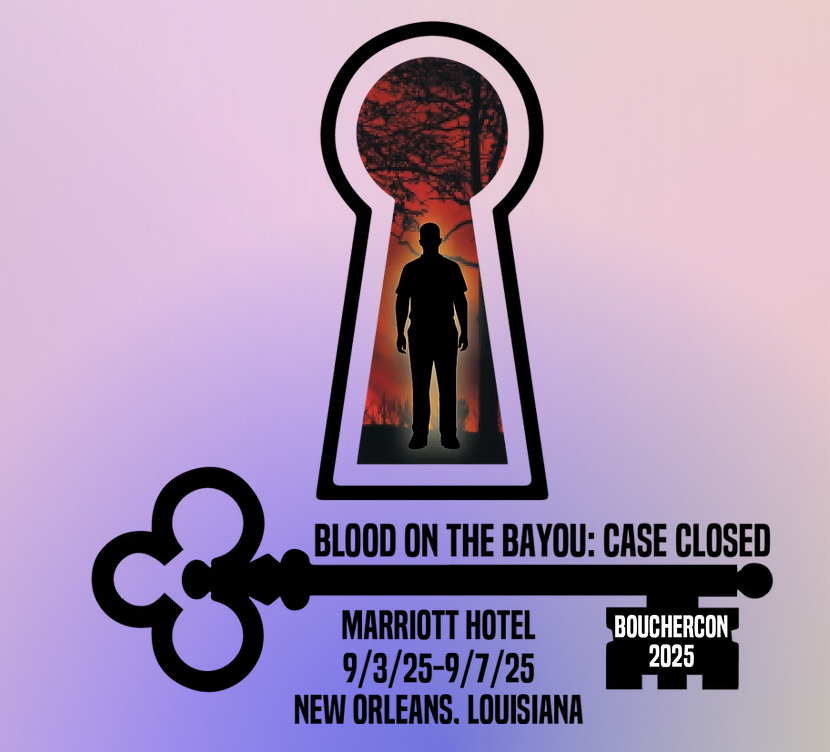
In September, I go to my second Bouchercon, the world convention of mystery and crime writers and readers, and I’ll be on my second Bouchercon panel, with a hugely talented group of authors. This one is at 3 p.m. Wednesday, Sept. 3, the first day of Bouchercon. This Bcon is in New Orleans, which I’m pretty sure should be mild and breezy by September, right? Right?

But very nearly overshadowing all this is that I submitted, earlier today, a short story to the crime fiction genre’s preeminent market. Now I don’t have any great hope that the story will be published. There are a hell of a lot of great writers out there submitting stories.

But the submission was a goal of mine for 2025. Not to get a story published in that magazine, I will note. Nope. Just to submit a story to them again.

I subbed once before, a few years ago, and their rejection was so perfectly justified but so devastating that I didn’t submit to them again for several years. Hell, I didn’t submit anywhere for a year.

So aside from publishing THAT OCTOBER, and attending and speaking at another Bcon and winning a place in this cool anthology that’s coming up in just a few weeks, getting up the nerve to submit to the Big Show again was a 2025 goal realized.

It’s all gravy from here,

As Homer Simpson would say, “Mmmm … gravy.”

The many lives – and deaths – of Butcher Crabtree

A lot of writers, maybe most of us, have characters that we love to play with. They might be heroes or villains, but we love to return to them again and again.

Mine is Butcher Crabtree, a character I created back in the early 2000s in DEATH AND TAXES, the first novel I wrote. It was the first of a series of books I wrote about Middletown, Indiana, my version of my hometown, Muncie, Indiana. That first book was about Jack Richmond, a newspaper reporter who investigates the death of the head of the local chamber of commerce and finds that the chamber chief was involved in shenanigans with some unsavory characters.

One of them was Butcher Crabtree, at the time a muscled and menacing, fire hydrant-shaped tough guy who was working as the bouncer at the Gilded Cage, the strip bar in Middletown. In his spare time, Butcher was up for committing murder on behalf of his bosses.

I’ve returned, in the past few years, to some of those characters. Reporter Jack Richmond was a novice newshound in 1984, the time period for my novel THAT OCTOBER, which was published just this past June.

Butcher is in that book, too, although in a blink-and-you’ll-miss-him cameo at a Halloween party. He’s referred to as “Uncle Butcher,” but it’s good old Butcher. Complete with his characteristic baseball bat.

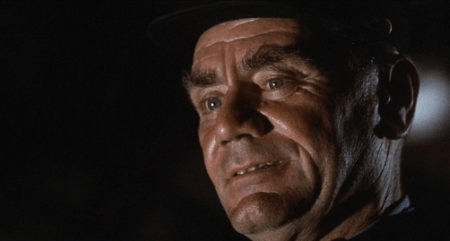
(By the way, that’s not Butcher above, but it is Ernest Borgnine in the great 1973 thriller “Emperor of the North.” In that movie, Borgnine is a vindictive and murderous Depression Era-railroad guard. I didn’t have Borgnine in mind when I created Butcher, but at least in that movie, he’s a pretty good illustration of Butcher. George Kennedy is also a passable doppleganger.)

But Butcher isn’t just a tough guy. I’ve enjoyed casting him in a variety of roles, from the threatening old uncle in THAT OCTOBER to his role in my story “Rousting,” published just recently by Pistol Jim Press. In that one, Butcher is a racist sheriff’s deputy who pushes his luck too far.

Butcher also showed up in “The Devil’s Cut,” my story in HOOSIER NOIR 7. In that one, Butcher is once again a sheriff’s deputy and is again murderous.

Is Butcher ever a good guy? Well, in my book SEVEN ANGELS – winner of the 2021 Hugh Holton Award for Best Unpublished Novel from Mystery Writers of America Midwest – he’s a mentor figure for Travis King, a troubled young man trying to make sense of his violent life.

I’ve included Butcher in a couple of other stories, too, and those – like SEVEN ANGELS – might see the light of day sometime, as THAT OCTOBER has.

Butcher often meets his end in my stories. He did way back more than 20 years ago in DEATH AND TAXES and he has since.

I don’t mind that Butcher’s lives and deaths conflict and contradict and that he seems to move back and forth through time at my whim.

When you’ve got a fun character, you don’t want to let them go.

Cold cases still pull at the heartstrings

I was watching “Ballard” the other week – it’s a good series, by the way, and a very valid follow-up to the “Bosch” series and it’s own streaming sequel, “Bosch Legacy” – and it got me thinking about the cold cases I’ve written about over the decades.

“Ballard,” which stars Maggie Q as Renee Ballard, Los Angeles police detective who is featured in her own series of crime novels by author Michael Connelly, creator of “Bosch,” is about how the Ballard character is “demoted” to the LAPD’s under-funded and over-scrutinized cold case unit.

The unit, comprised of police officers and reserves and a handful of volunteers and interns, huddles in a cluttered series of rooms that look more like storage than an office. The cold case squad is the definition of an effort that is nothing like a priority for LAPD leadership but is an essential thing to the squad members.

Ballard is initially leery of the assignment – punishment, really, for daring to report another cop for assaulting her – but grows to find satisfaction in solving long-unsolved murders, bringing killers to justice and giving closure to survivors.

Along with my longtime writing collaborator Douglas Walker, I wrote about cold cases for many years for the newspaper in my hometown of Muncie, Indiana. The most notable cold case to many was the killing of two teenagers in Westside Park in 1985. Walker and I wrote about it in our third true crime book, “The Westside Park Murders,” released by History Press in 2021.

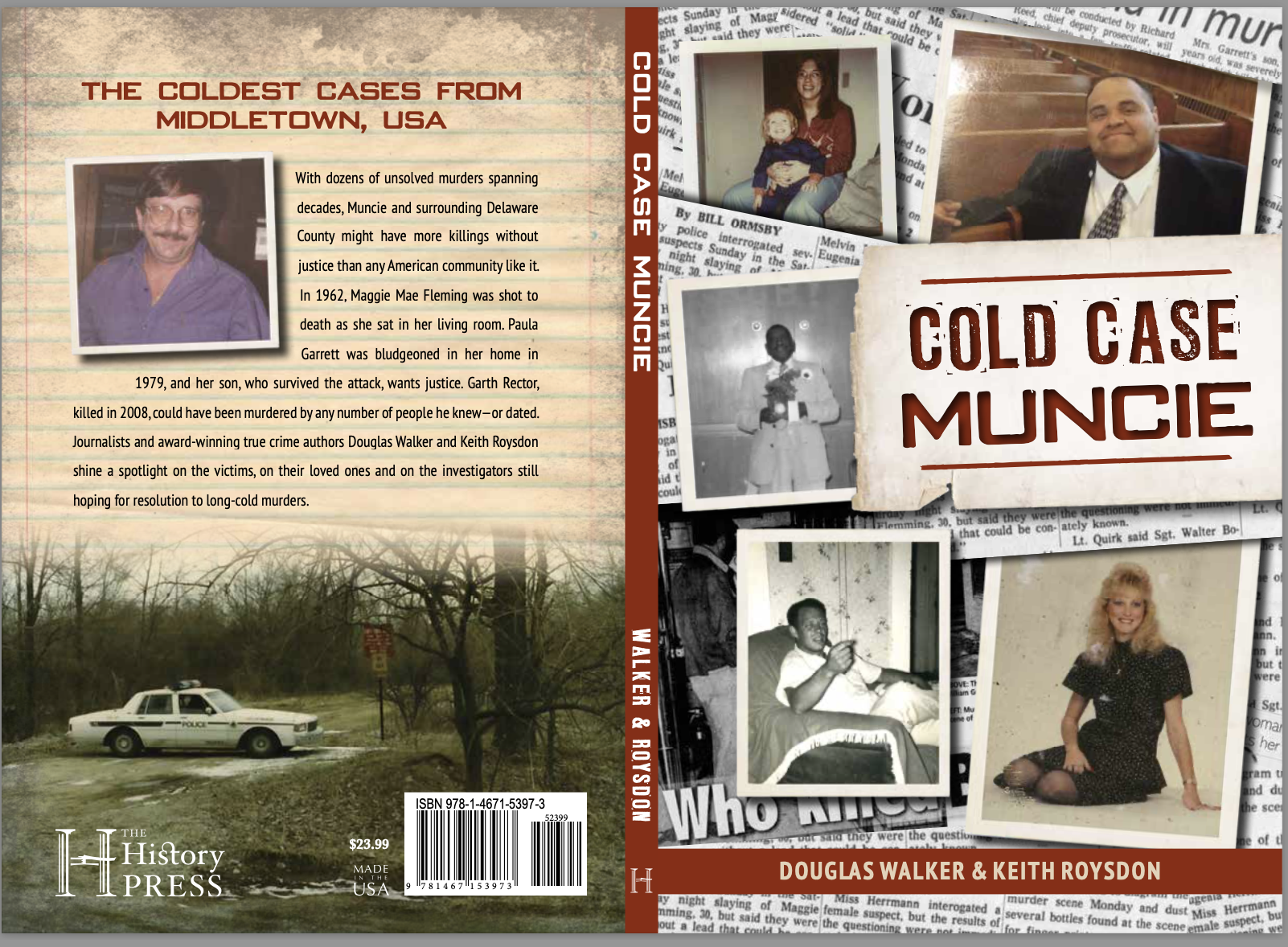
But our fourth book, “Cold Case Muncie,” released in 2023, is an entire book of cold cases, still-unsolved murders in the Muncie and East Central Indiana area.

We had identified more than 30 cold cases, some dating back to the 1960s or even earlier, during a regular series of newspaper articles beginning in 2010. We went back and re-examined many of those cases for the book.

We interviewed surviving loved ones of the victims and revisited the murder scenes.

We put an emphasis on soliciting any new information about the murders, including a point of contact for each of the police departments responsible for resolving those cases.

And we placed emphasis on the survivors. Many of the cases are illustrated by photographs I took of those people who, today, are still waiting for someone to bring closure for the killing of their loved ones.

I’ve noted before that closure is an elusive thing, even harder to achieve than it seems, and that’s pretty damn hard.

I’m glad “Ballard” has taken up the case of cold cases and I’m glad to have brought some attention to them too.

It should be obvious, but if you write, you’re a writer

I was interviewed for a podcast recently when I was back in Indiana promoting THAT OCTOBER and I ended a question with an off-hand comment that I’ve verbalized before but this interviewer said she really appreciated it.

“If you write, you’re a writer,” I said.

That seems obvious enough, but I think some writers feel like you’ve got to attain some particular level of success, or something, to consider yourself a real writer:

You’ve got to finish every story or article or book that you begin. You’ve got to publish every story or book or see it published. You’ve got to be paid for every one. You’ve got to be published by a prestigious site or magazine or anthology or publishing house, all to be considered a legitimate writer. (Now that I write that sentence, I can’t imagine what a “legitimate” writer would be anyway.)

None of those things are necessary to being a writer.

For certain, it’s a good thing to finish what you’re writing. That’s good discipline and a sign that you’re able to follow through, even if it’s not your best work. It definitely would be a cool thing to try to get every story or book you write published, but no way in the world does that happen to every writer (maybe to Stephen King or Lee Child, and probably not even them).

Getting paid or being published in some cool place is super and I highly recommend it. But that’s not the definition of being a writer.

Sitting down at your keyboard – that’s mine in the photo; please disregard the random junk in the keys – is part of the definition of being a writer. Or sitting down with your notebook or legal pad and your favorite pen.

You’re also a writer if you’re sitting in a comfortable space, staring out the window, watching random squirrels frisk their way past enjoying the sun, or watching the headlights and taillights of passing cars cutting through the dark. While you’re sitting there, you’re probably thinking about stories or coming up with ideas of ways to execute a scene. Or you might just be letting your imagination roam. You can do the same thing while mowing the lawn or watching TV or listening to music.

There’s enough anxiety and imposter syndrome for writers, and always has been, about writing or what they hope to write or what they have written to feel more of it because they’re not turning out a thousand sterling, perfect words every day.

If you’re exercising your imagination, if you’re mulling over characters or phrases or plots, if you’re making notes or writing it out longhand or you’re dashing out a couple of thousand words every day – even if you go back and start over – you’ve accomplished your goal.

You’re a writer.

Going viral, social media, dystopia and books

I went viral on social media – two different social media, with two different posts – over the Fourth of July weekend.

(This is not a pat myself on the back post. I think there’s something interesting that’s happened here, beyond the viral-ness.)

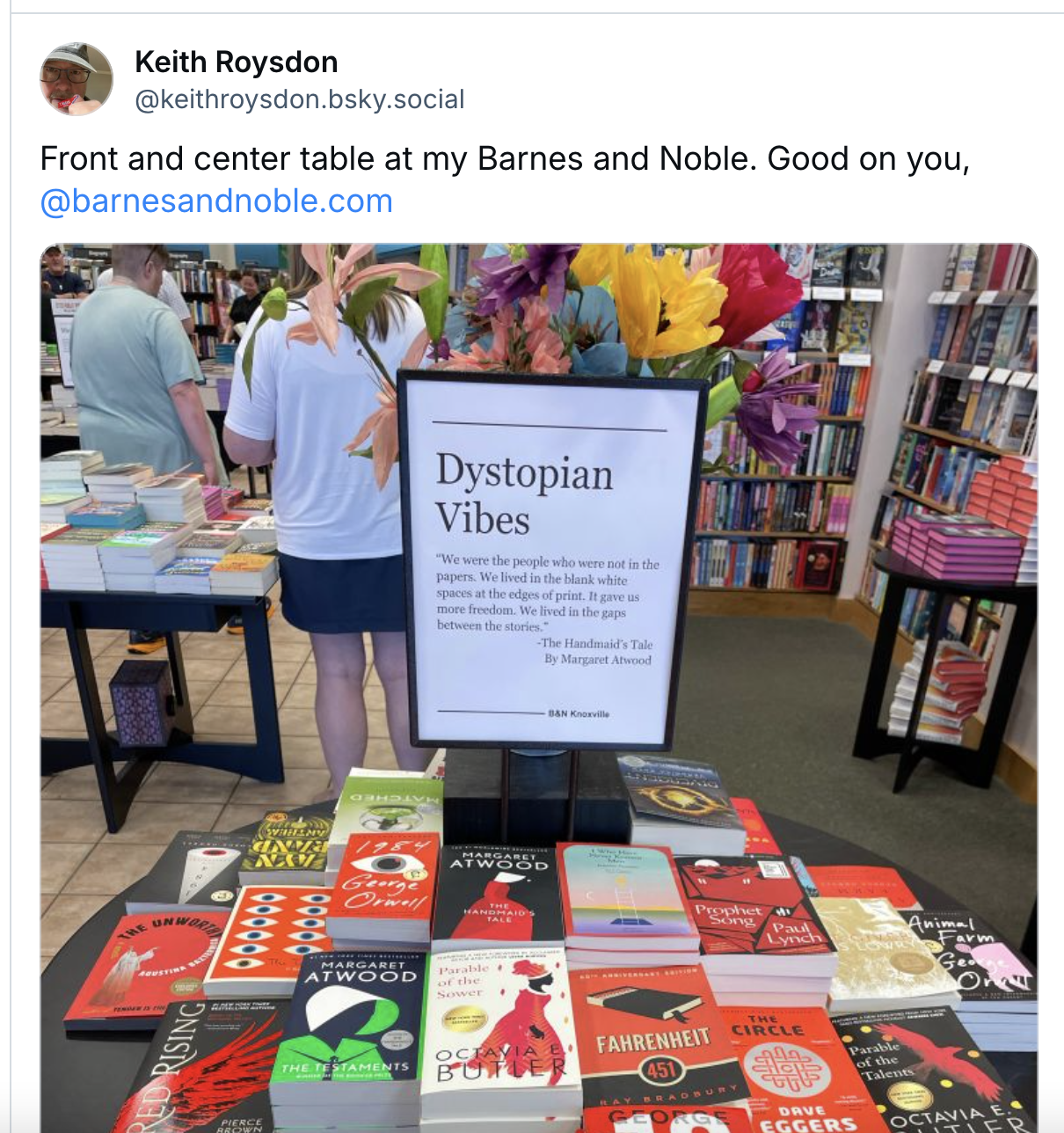
The first post that went viral is the one above. On Saturday, I was in the Barnes & Noble bookstore near me and took a picture of the first table inside the door. If you can’t tell from the picture, it’s a display marked “Dystopian Vibes” and offers books including “1984,” “Animal Farm” and the works of Margaret Atwood and Octavia E. Butler.

I thought I’d snap a picture and post it and thank Barnes & Noble for putting these books out there so prominently. Yes, that placement encourages sales. Yes, it’s ultimately a big corporation trying to move copies of books. But it’s something.

I thought the post might get some traffic, but I never get a lot of engagement, even with 3,000 Bluesky followers.

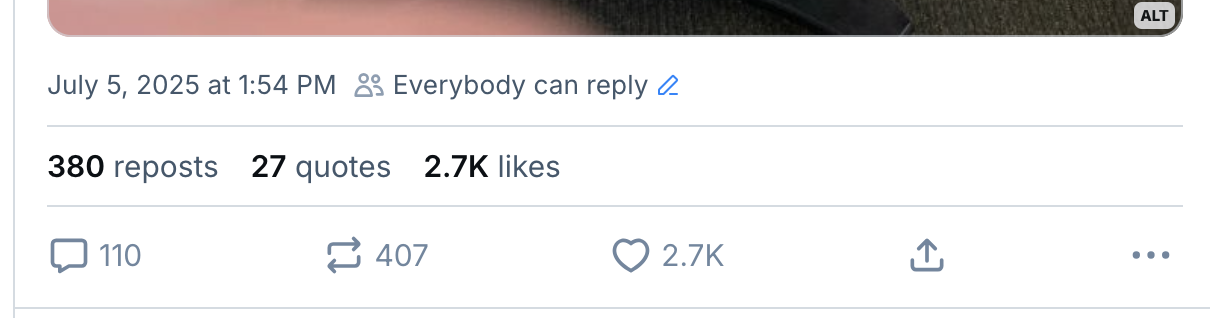
By Sunday afternoon, this was the response:

380 accounts reposted my post, which got 2,700 likes.

This is a multiple of thousands the reaction I was expecting. I had to mute notifications on the post.

That wasn’t all, though.

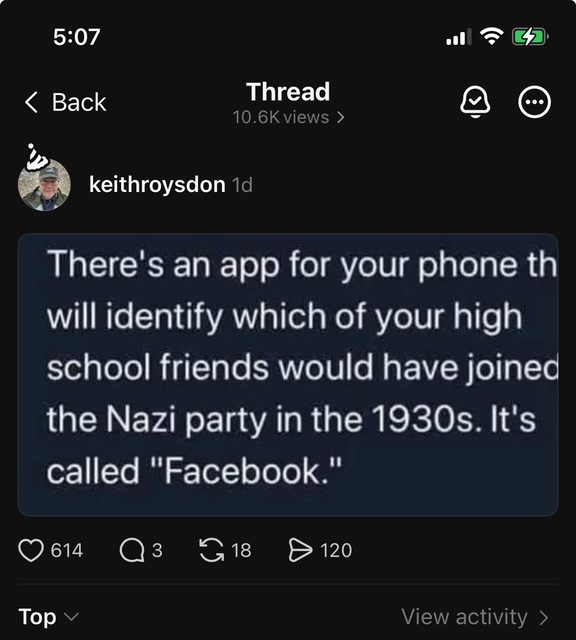
I saw a bitterly amusing meme on a friend’s Facebook account – there was no indication on the account who originally posted it – and I posted it on various social media, including Instagram, which shares posts to the social media app Threads (which I don’t use much).

Here’s the post, and the reaction:

Believe me when I tell you, I usually don’t get 600 likes on Threads, a social media I barely use.

So what’s the upshot to all this, besides a little more engagement and traffic to the companies that own Bluesky and Threads, the latter the detested Meta? (The even more detested Twitter turned up with very little notice of either post, by the way.)

The upshot, it seems to me, is that there’s a lot of interest and engagement in posts about our currently untenable, dangerous and yes, dystopian path.

That’s a good thing, that people are engaging in posts critical or even acknowledging the path this country is on.

And, as a bonus, the Bluesky post shows a ton of engagement about books that forecast, define and address our society.

There’s nothing more encouraging than the realization that people are engaging with literature that calls to light our current peril.

So maybe a small percentage of the frogs in this slowly boiling pot of water are aware they’re in a slowly boiling pot of water. I hope.