
Monthly Archives: November 2026

It’s time for another edition of FORGOTTEN TALES OF THE NEWSPAPER BUSINESS … business … business (that’s supposed to be an echo effect)

The best quality of the internet is that anybody with malicious intent can pretend to be somebody else, I think we’d all agree, right? (Sarcasm mode turned up to 11 here.)

So what if I told you that in the late 1970s and early 1980s, I was involved in a stone-age version of what would later become the internet’s bestest feature: someone sounding off with their views ESPECIALLY under an assumed name?

A little background first: I’ve related on here before that I began writing for the Muncie Evening Press newspaper when I was still in high school. I was originally the “teen” columnist. When I graduated from high school and began college, the newspaper editors found other things for me to freelance for them. That started out as movie reviews but later grew to include live performance reviews, record album reviews and news, entertainment-related interviews, a little bit of everything.

I was young and they paid me maybe $10 or $15 per piece, so there wasn’t much I wouldn’t write for them.

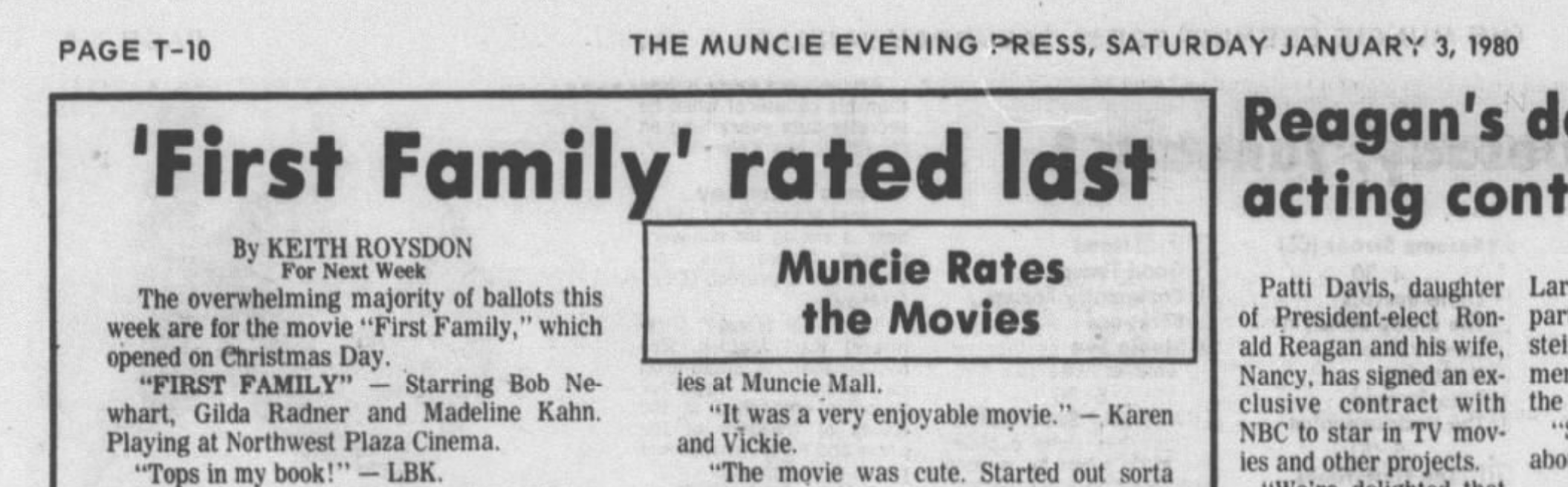
In April 1978, in the early days of my freelancing for them and independently of me, the newspaper editors started a weekly column called “Muncie Rates the Movies,” in which moviegoers could sound off on what they thought of movies playing at Muncie’s four (I believe) movie theaters.

How did they sound off? The newspaper placed a “Muncie Rates the Movies” ballot box at the concession stand at each theater. Some newspaper staffer had to go around to each theater once a week and open the ballot boxes and collect the ballots/movie opinions that had been deposited over the previous week. (A pad of ballots was located next to each box so people could come out of the theater and fill one out.)

A lot of the opinions were pretty simple – “That Sally Field is beautiful” – and some were more complex and included some thoughtful reviews – or at least as thoughtful as could be written in pencil in the blanks on a ballot.

Around March 1979, the editors assigned me to oversee the “Muncie Rates the Movies” column. I became the person who went from theater to theater each week to pick up ballots, then sort through them and write a column based on the thoughts of local moviegoers. (An editor, although I don’t remember who, had done this for the first year and wrote the column under the pen name “Harley Wood.”)

This early example of crowdsourcing was usually pretty easy. I had my choice of dozens of ballots each week and knew which ones not to quote in the column. (Opinions that included vulgar language, of course, but also obviously ballots that were not germane, like rants about Dwight Eisenhower – no I don’t remember any about Eisenhower, the former president; but. you get the idea.)

The best intentions of the editors who created “Muncie Rates the Movies” ultimately came crashing down around the head of your humble narrator.

In February 1981, one of the movies that moviegoers reviewed via our ballot boxes was “Altered States,” director Ken Russell’s earnest and odd science fiction film that might have been the trippiest film since “2001.”

One of the reviews that week (and published but not under my byline) noted about “Altered States,” “Convinced me of Biblical falseness and scientific truth regarding evolution.”

And that comment was signed by a person – no, even nearly a half-century later, I’m not going to cite him by name – who was director of secondary education for the city school system.

And, to add insult to injury, this man also taught a Bible literature class.

The correction that ran four days after what turned out to be the final “Muncie Rates the Movies” column was short and to the point and noted that the respected educator on matters Biblical had not seen the movie and didn’t express an opinion of it. The newspaper went on to express regret for any embarrassment that might have arisen from the column.

The column was discontinued – as a freelancer in my early 20s I was not part of that discussion – and hopefully the educator got over it.

And to the prankster who submitted the phony review: I’d like you to know that you cost me 10 or 15 bucks a week for who knows how many more months?

You’ve somehow stumbled upon the latest of more than 1,100 posts on keithroysdon dot com, stretching back to the early 2010s. Books, writing, movies, TV, obscure pop culture, Halloween, snark and more snark. I’m the author of crime novels THAT OCTOBER and SEVEN ANGELS, co-author of four true crime books including the award-winning THE WESTSIDE PARK MURDERS and hundreds of short stories, news articles and pop culture pieces in spots like CrimeReads, Daily Yonder and elsewhere. You can contact me by leaving a message anywhere on this site or by hollering at me on one of my too many social media outposts.
A simple way to refute any allegation of AI use? Paper trail, baby

Not so long ago, as publishing companies were feeding manuscripts into AI programs to determine if AI was used to write the manuscripts – not surprisingly, in some cases, the AI came up with a “positive for AI” diagnosis, strangely enough often in the case of first-time POC authors – the discourse among writers was how to prepare to defend yourself in case of AI allegations.

“Save your drafts,” the simple response came. Each of the four or five or 10 times you wrote a new draft, each one was proof that it was your hand that crafted the writing.

But what if you don’t draft?

Maybe it’s because of my “this must be written now” practice of writing for newspapers, I don’t draft, at least in the sense of rewriting a stem to stern version of a work several times.

NOTE ADDED AFTER POSTING: I do go over and over everything I write, usually by rereading what I’ve written previously to put myself in the frame of mind to write anew. Does this count as drafting? Dunno.

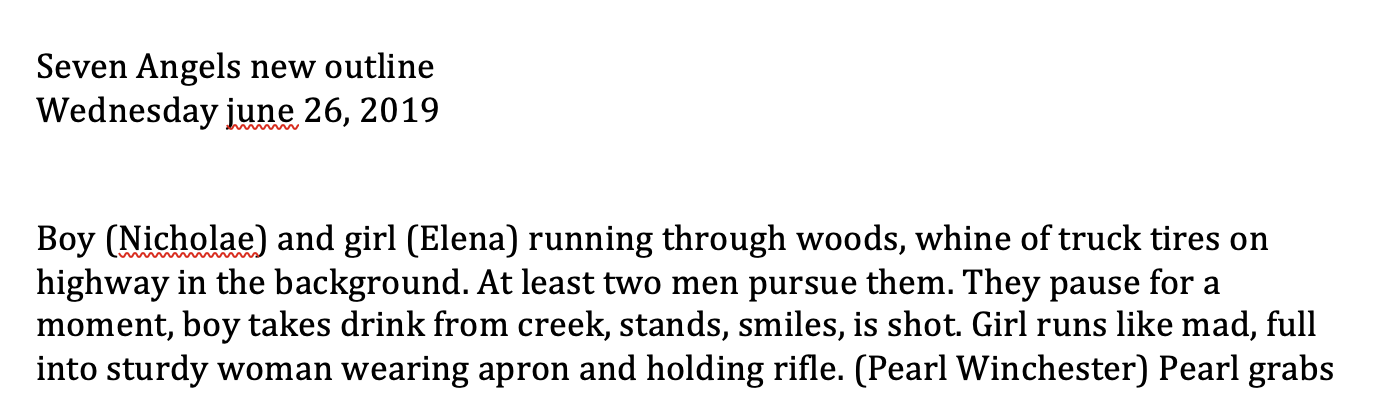
I do have my outline for my first (and most recently published) novel SEVEN ANGELS, as seen above, dated from June 2019, saved in the SEVEN ANGELS folder on my MacBook Pro.

But is there a more certain, beyond subterfuge, way of proving that a book was written in increments, day by day, for months?

I didn’t realize at the time that I was building proof that I’d written SEVEN ANGELS – really, all my books and even many short stories and nonfiction articles – as I wrote it.

It’s long been my practice to email to myself the latest version of any book as I write another chapter or, on a less productive day, another set of paragraphs. Hell, even new sentences.

In my email, I’ve got the latest version of whatever I’m writing, every day, as I’ve written it.

There’s some added assuredness that could provide a time frame for my writing: social media.

Again, coming from the newspaper business, I’ve always been pretty transparent with my writing. So on Twitter, going as far back as 2009, and more recently Bluesky, I’ll often note on social media what I’ve working on. It’s an incremental timeline, not quite as explicit as the daily email to myself, but pretty close.

Not to mention notes to myself in physical notebooks, which I’ve been using since even before I began writing novels in 2019.

So if the thought of creating a “paper trail” of drafts is intimidating to any writer, I’d suggest emailing yourself your latest version. It’s a good indication that you’ve been working on a project.

It has the added bonus of backing up your work in case your computer decides to jump off a cliff.

You’ve somehow stumbled upon the latest of more than 1,100 posts on keithroysdon dot com, stretching back to the early 2010s. Books, writing, movies, TV, obscure pop culture, Halloween, snark and more snark. I’m the author of crime novels THAT OCTOBER and SEVEN ANGELS, co-author of four true crime books including the award-winning THE WESTSIDE PARK MURDERS and hundreds of short stories, news articles and pop culture pieces in spots like CrimeReads, Daily Yonder and elsewhere. You can contact me by leaving a message anywhere on this site or by hollering at me on one of my too many social media outposts.
Requiem for Muncie Mall: America’s hometown’s second gathering place is fading fast

If you considered our downtowns to once be the gathering places for our cities and towns, then you could consider your local mall to be America’s second gathering place. That’s appropriate, because malls largely killed off downtowns.

Downtowns across the country have staged and are staging something of a comeback. They entered a steep decline in the late 1960s and early 1970s as malls were built and first retailers and then customers moved away from downtowns to the new gathering places, the mall.

In my hometown of Muncie, the mall – Muncie Mall – opened, more or less, in 1970, years later than the first U.S. mall, Southdale Center in Edina, Minnesota, which opened in 1956. Big department stores left Muncie’s downtown, with Sears being the first anchor store to open at the mall. Downtown was, in a decade or less, pretty hollowed out and storefronts along Walnut Street were left empty or occupied by small businesses and, in one instance, an adult bookstore.

Like a lot of cities and a lot of malls, Muncie and Muncie Mall struggled mightily in the first decade of the 21st century. I was covering business at the time and retailers – some with problems nationally, like Sears – closed their doors.

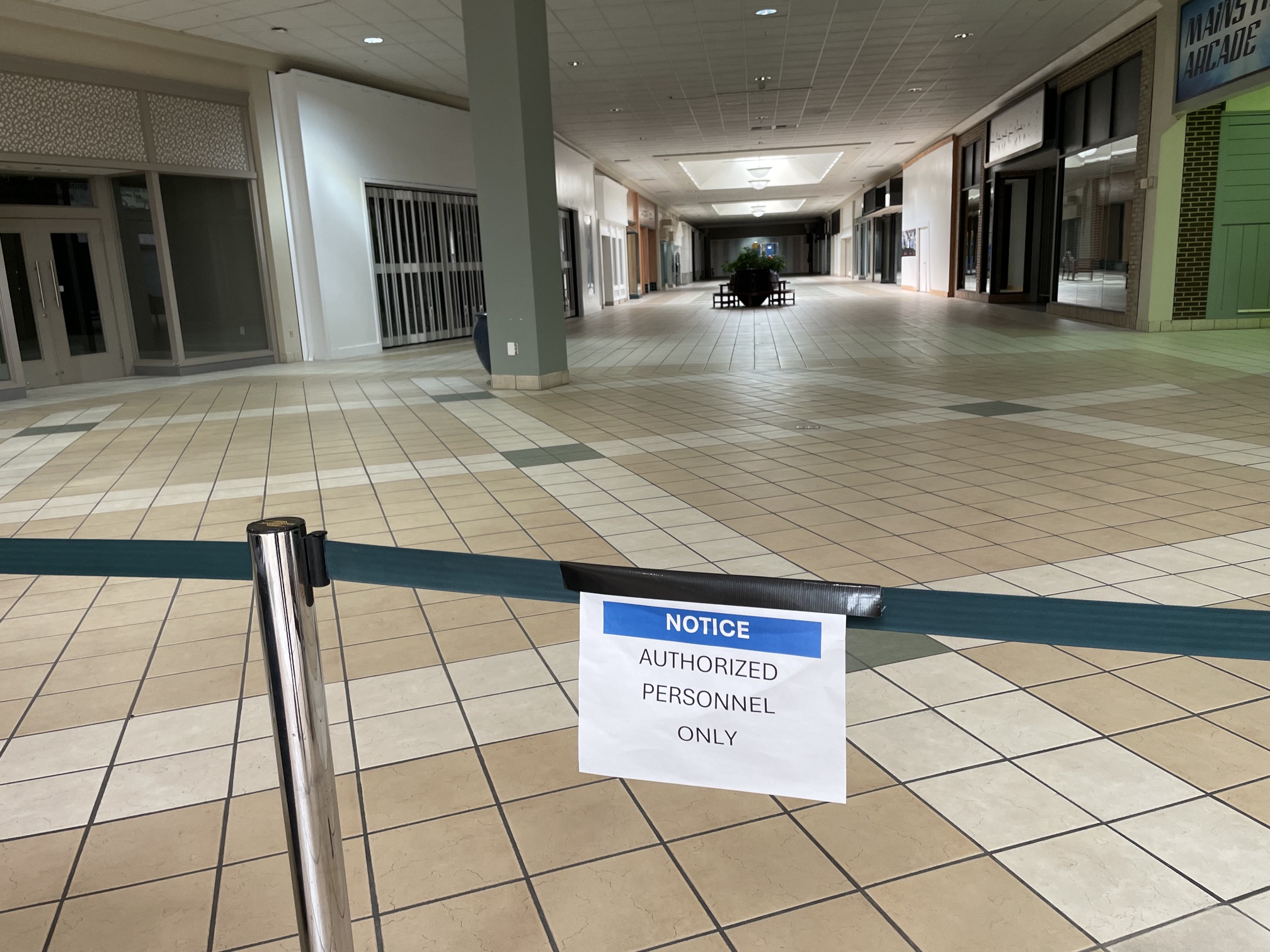
I was back in Muncie over the weekend and we had to check out the mall, which has been the scene of a lot of demolition work in the past year. The three-screen movie theater, where I spent a lot of time as a young movie fan, was razed. More recently, the wings that had been occupied by Sears and J.C. Penney have been or are being demoed.

The photo above is one I took this weekend and it shows that one empty third of the mall is roped off.

There’s still a few tenants in the mall, most notably Books-A-Million, which supposedly has a five-year lease. Does that mean the rest of the structure will be pulled down around and behind it, or will BAM find a spot elsewhere or leave the city entirely? I don’t know.

If you’re interested in the lifetime of a Midwestern mall, you’ll be interested in the timeline by Robin Gibson in The Star Press newspaper that I’ll link to at the end.

I won’t wax on about what malls meant to us or Muncie Mall meant to me. You can probably find my writing about that elsewhere, including as a chapter of our third true crime book, THE WESTSIDE PARK MURDERS. Our book covers a still-unsolved double killing of two teenagers in 1985 and I included a chapter about Muncie Mall because the mall was a big place for us back then.

Here’s that Muncie Mall timeline:

https://www.thestarpress.com/story/news/local/2020/02/12/muncie-mall-50-years-timeline/4466975002

You’ve somehow stumbled upon the latest of more than 1,100 posts on keithroysdon dot com, stretching back to the early 2010s. Books, writing, movies, TV, obscure pop culture, Halloween, snark and more snark. I’m the author of crime novels THAT OCTOBER and SEVEN ANGELS, co-author of four true crime books including the award-winning THE WESTSIDE PARK MURDERS and hundreds of short stories, news articles and pop culture pieces in spots like CrimeReads, Daily Yonder and elsewhere. You can contact me by leaving a message anywhere on this site or by hollering at me on one of my too many social media outposts.
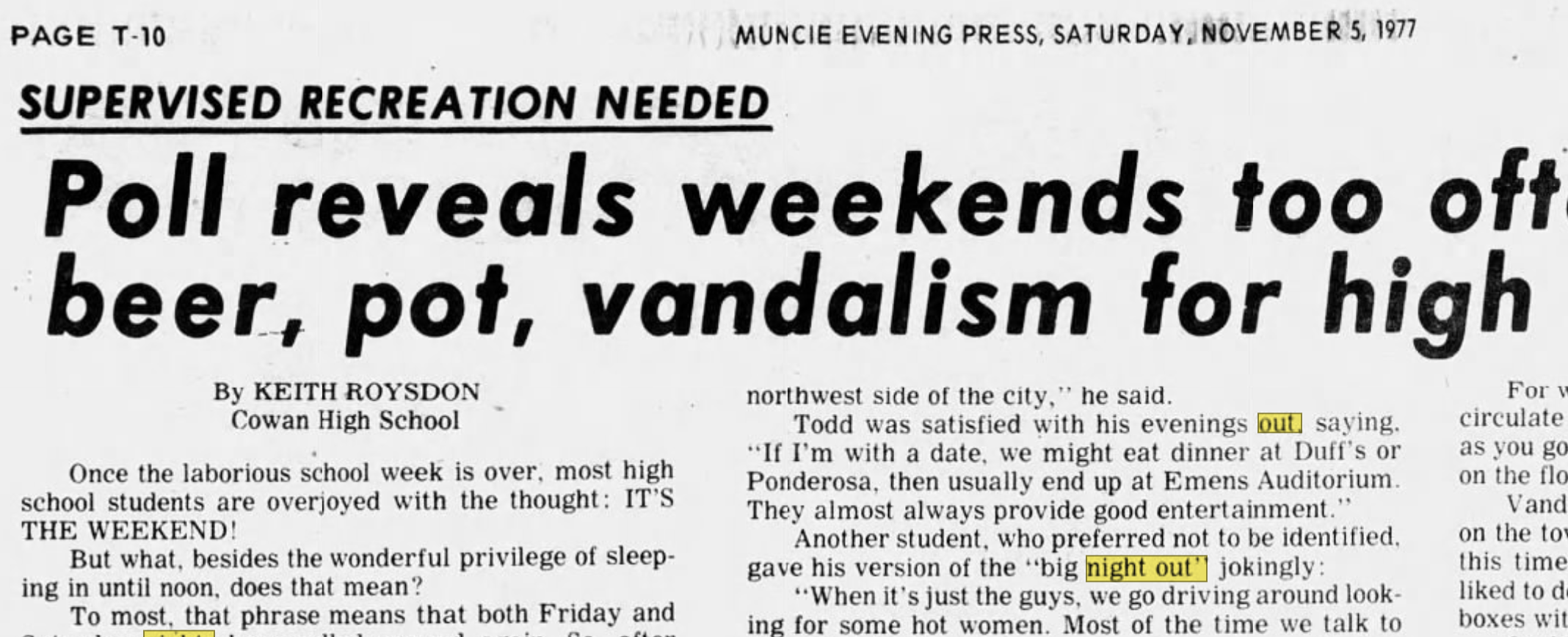
November 5, 1977, a date that will live in infamy, also known as my first published article, 49 years ago today

I could lie and say that this date 49 years ago seems like only yesterday, but truthfully it seems like eons ago.

After I woke up this morning, I opened Instagram to see video footage of author Stephen King leaving some book promotion event somewhere and I thought that King, one of my favorite authors of all time and a master of the written word, looked every day of his 79 years. He seemed a little unsteady and walked with a cane.

Funny coincidence, so do I. And King is more than a decade older than me.

If that wasn’t humbling enough, I opened Facebook memories and saw posts from 2017 and 2007, I believe, in which I noted the anniversary of my first published newspaper article from 1977.

Despite the inclination to turn over and go back to sleep at all those reminders of the passage of time, I decided to get up and, among other things, write about the 49th anniversary of my first published article.

That’s a screenshot from newspapers dot com above, and you can tell the gist of the article: friends and fellow students from Cowan High School in Delaware County, Indiana, let me interview them about what they did on a “big night out.” The gist of it was go see a movie, go see a concert, have dinner as well as a few more nefarious activities, like illegally obtaining beer – all of us were three or four years too young to buy carry-out liquor – and drinking and sometimes riding around in the rural countryside, throwing beer bottles at signs.

(I can write about this now that my son is years past the age to be encouraged to do this by my example.)

The article was hugely controversial, and a good indicator of why the less-legal activities were not attributed to anyone on the record: My school system apologized in the school newsletter to the poor students scandalized by the implication that they would do this. Somewhere, in a box somewhere, I not only have a clipping of the article but also a snippet of the apology (not from me, but from school administrators) in the newsletter.

The article came about because I had volunteered to fill in for a friend also on the school newspaper and yearbook staff. She had a ton of studying to do and wouldn’t have time to write the article for the Muncie Evening Press newspaper. (The newspaper regularly published articles written by local high school students, although most were of the “Big school fundraiser next week” variety.) I said I would and that kicked off a newspaper career that didn’t end until I took a buyout in January 2019. It didn’t completely end even then: I wrote freelance for the newspaper for a year or two even after the buyout, covering stories like Covid.

After a newspaper editor called the school guidance office (heh heh) and offered me a regular gig as the paper’s “teen columnist,” I wrote for the Evening Press all through college and for a couple of years after before they offered me a full-time reporting job in 1984. I started on my dad’s birthday, which was appropriate because my parents had never been anything but supportive of me going into writing rather than my original plan, which was to become a lawyer. My tenure at the newspaper continued even after my beloved evening paper merged with the hated morning paper in 1996.

The moral of this is: Kids, stay in school.

No, the moral is that you should take a chance every once in a while, trying something new and daring that might have an unexpected outcome.

You, too, could become a lifelong writer and pass up your chance to practice law and make far, far, far, far, far more than you ever would as a newspaper reporter.

Yeah, that’s the moral of the story.

You’ve somehow stumbled upon the latest of more than 1,100 posts on keithroysdon dot com, stretching back to the early 2010s. Books, writing, movies, TV, obscure pop culture, Halloween, snark and more snark. I’m the author of crime novels THAT OCTOBER and SEVEN ANGELS, co-author of four true crime books including the award-winning THE WESTSIDE PARK MURDERS and hundreds of short stories, news articles and pop culture pieces in spots like CrimeReads, Daily Yonder and elsewhere. You can contact me by leaving a message anywhere on this site or by hollering at me on one of my too many social media outposts.

Vincent Price documentary on TCM captures the day he came to my hometown, Muncie

Yesterday, I was watching the new documentary “Vincent Price: What Keeps Us Alive,” which I had DVRd from TCM’s premiere of the program Friday evening, and found it quite good. I’ve always liked Price and if you search for his name here on this site you’ll find posts about when I met him at an airport in the early 1980s and when I met his kind and generous daughter, Victoria Price, this summer here in Knoxville.

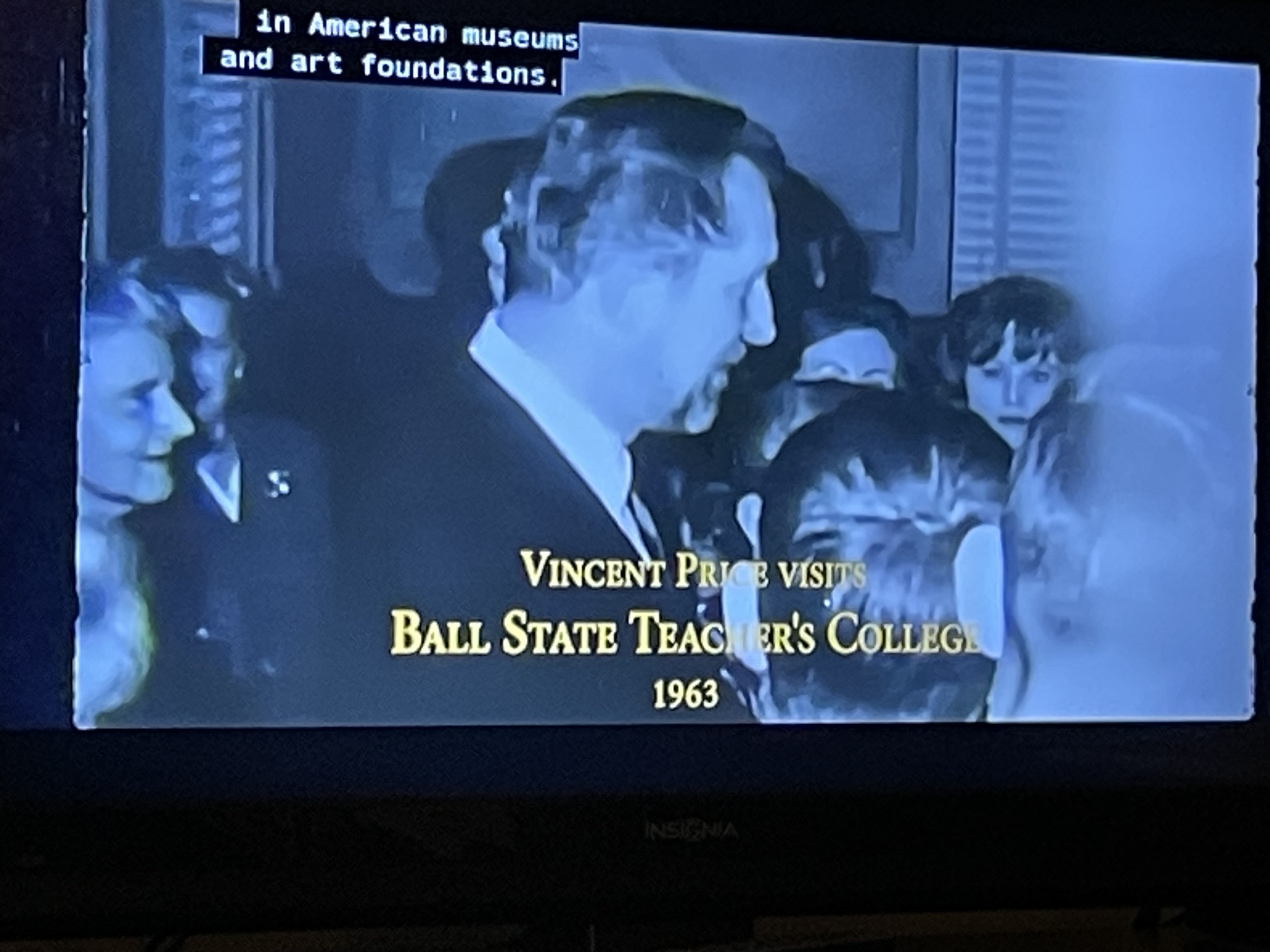
But as I was watching the documentary, I was startled to see some B-roll footage of Price talking to a large group of people and the caption read, “Vincent Price visits Ball State Teachers College 1963.”

If I’d ever known Price had visited my hometown of Muncie, Indiana, I’d forgotten that fact.

I was a pre-schooler at the time of his visit and was a few years away from becoming the huge fan of horror movies that I would become.

For his part, Price was in another of his career high points. He’d been acting on stage and screen since the 1930s and co-starred in “Laura” in 1944. He’d become, along with Boris Karloff, the king of American horror films in the mid-century, starring in a string of classic films like “The Tingler” and “House on Haunted Hill” in 1959.

His film roles in the 1960s brought him another kind of fame as he played the lead in a string of Edgar Allan Poe adaptations for director/producer Roger Corman and American International Pictures. Right before his Muncie visit the latest of those films, “The Raven” had been released and more films now regarded as classics were to come.

Price was in the midst of something else in 1963. He was promoting the democratization of art as part of a promotion by huge retailer Sears to encourage people to buy prints of works of art by great artists. As part of that promotion, Price appeared in hundreds of cities and towns, showcasing the art prints available at Sears and giving talks at local colleges and universities.

Among those was Ball State Teachers College in Muncie, where the footage used in the documentary was captured. The school was renamed Ball State University in 1965.

I was curious how the local newspapers covered Price’s appearance. It wasn’t that long before the aging newspaper editors, out of touch with popular culture, would question the need to put the 1980 assassination of John Lennon, for example, on page one.

But Price had the right mixture of old Hollywood and art appreciation to convince the editors to cover his March 6, 1963 appearance.

Both the Muncie Star and the Muncie Evening Press ran announcements of his appearance in advance and covered him at receptions with the city’s leading industrialists and philanthropists like various Ball and Kitselman family members.

I’m most proud of coverage by Roy Bigger of the Muncie Evening Press, who wrote a page one story for March 7 about Price’s talk to an “overflow audience” at a Ball State convocation in which he talked about art and the public’s right to know, understand, appreciate and own art. That’s where Sears’ art collection offerings came in, of course. He talked about writers like Tennessee Williams and artists like James Whistler.

About 500 people had to be turned away from the convocation in Ball State’s Assembly Hall, Bigger reported.

So cool to discover, even 60 years after the fact, the meeting of my hometown and one of my favorite film actors.

You’ve somehow stumbled upon the latest of more than 1,100 posts on keithroysdon dot com, stretching back to the early 2010s. Books, writing, movies, TV, obscure pop culture, Halloween, snark and more snark. I’m the author of crime novels THAT OCTOBER and SEVEN ANGELS, co-author of four true crime books including the award-winning THE WESTSIDE PARK MURDERS and hundreds of short stories, news articles and pop culture pieces in spots like CrimeReads, Daily Yonder and elsewhere. You can contact me by leaving a message anywhere on this site or by hollering at me on one of my too many social media outposts.